• TalkBass has been independent since 1998. Add your voice.
    Create a free account to reply to discussions, view embedded media, and browse with fewer display ads.
    Join freeLog in
    Want zero display ads or expanded classifieds tools? Compare plans.

Why Do Fender P Basses Come with the Pickup Staggered?

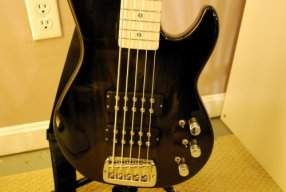
upload_2017-9-12_0-47-17.png
 
A serious answer:

It's geometry.

Leo decided to make the P-bass pickup humbucking design, to reduce humming noise from nearby electrics. Humbucking design means there are two coils, which are wired in opposite rotation, and with the magnets in opposite polarity. So, there needed to be two pickup coils, each one covering two strings.

For various reasons, Leo also decided to make the coils relatively short and wide. Because the coils are so wide, they won't fit end to end across the bass. If you put the two P-bass coils end-to-end inline with each other, the poles for the A and D will be too far apart for the string spacing. It's because the end of the coil, the bobbin flanges and wire turning around the pole, stick out too far.

So, the two coils can't be mounted in line with each other. They have to be offset to get the poles lined up with the string spacing. Leo chose to offset the treble side coil towards the bridge for various reasons.

The Jazz bass pickups are single coils, one long coil wrapping around all of the pole pieces. Only in recent years have some pickup makers started making two-coil pickups, where the coils can be mounted in line with each other. But it's tricky; the coils have to be very tall and narrow to fit the two ends of the coils into the width of one string space.
 
The ability to stagger the pole pieces on a P-Bass pickup is, IMHO, just part of the genious of the Fender design. My understanding of the original design is that the pickup was done as a split coil in order to get "the best of both worlds". Each half of the split coil is single coil, but when wired together in parallel, they are humbucking as a pair. This gives you the clarity of sound of a single coil pickup, but with the hum cancelling feature of a humbucker. As an added bonus, the split configuration enables you to adjust the pickup height to have the string to string balance that you desire. I am an avid "FrankenFenderer" and have done a fair amount of neck swapping in my day. The neck radius differences between my 10" Warmoth necks, 9.5" Fender American Standard necks and vintage spec 7.25" USACG necks require making adjustments to the relative pickup heights on a string to string basis. In addition, different brand/model/type/gauge set strings have different relative output from string to string and a pickup height tweak or two is often warranted after a string change.
 
Last edited:
What are those reasons?

I don't know. You'll have to ask Leo. He had two choices: treble coil back or treble coil forward. I assume that he chose treble side back, because it "widened" the sound range. It made the treble strings a little brighter and the bass strings a little deeper. Doing the reverse would have made the treble strings deeper and the bass strings brighter.
 
Those two pickups were actually NOT intended to be staggered.

But story has it that a factory worker at the original 1950's Fender, Ensenada plant
named "El Borracho" was so cockeyed-drunk when he installed the first such humbuckers
that the tradition stuck. El Borracho's drunken gait also explains the colloquial, "staggered pole pieces."

Oh, El Borracho was Polish? Therefore the staggered Pole pieces?
 
Why do Fender P Basses come with the pup staggered (slightly lower by the E string and the G string) I've looked at other companies, where the Pup is installed completely level. Is the pup supposed to be staggered like that for optimal sound?
Because that's the way it sounded best to Leo.

Here's essentially how he chose the designs.