• TalkBass has been independent since 1998. Add your voice.
    Create a free account to reply to discussions, view embedded media, and browse with fewer display ads.
    Join freeLog in
    Want zero display ads or expanded classifieds tools? Compare plans.

Why do you play fours?

The idea for this thread was spurred by curiosity. There are so many options to choose from these days. There is a thread posing the question of why you play more than four - this is not that thread.

I want to know why you play a standard four-string bass. That's it!

My reasons:
*It's comfortable.
*I enjoy the "classic" aesthetic of a four-string, Leo Fender-designed electric bass.
*Less is more (subjective!!)

Let's hear it.

99%?of All the great songs from the 50's thru 80's were written for and played on a four.
 
walking bass lines seems to be easier with 4s. Less finger option.

You are forced to just go up and down the neck instead of trying to figure out possible reasons to extend one or two extra frets and ruin conventional finger pattern.
 
Tradition
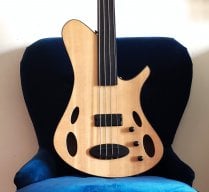
7E22B69B-3406-41B9-94A7-9CFDD7F36FEA.jpeg
 
I love the 6ers. They're fun at home and on that jazz fusion gig or gospel gig where it ventures high and does high chords and fills and all that. I fantasize about that at home but when playing MY gigs, it feels silly having a 6 string.

I use a 6 or 5 when the gig has specific tunes that call for those lower notes and there s no other way around it.

But if it was up to me, I like the slim feel and limitation of having it all compact and right there. It's more organic. Uprights have had 4 strings for centuries, and Leo did it right with the P-bass, which is 4 strings. If I don't NEED the extra low range (below D; I have a Hipshot on my go-to axe), I prefer the 4.

Plus, in my case, my 4 string bass has the tone and feel I like... AND.... all my favorite players do just fine with a 4 string.

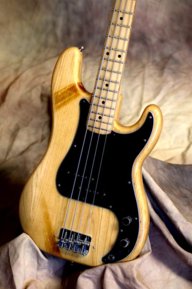
Here is my baby:
20180109_194609.jpg
 
I had a six string i liked for the extra voicing options. But I dont play function gigs currently so I dont need it.

I always play 4 - low end, for me is not about pitch, it is about tone and timbre. Some low Bs sound tinnier than the low E on a good Precision, for example. I do miss a high C string sometimes (it often sings better in the higher registers than a g string played up high) but with a very good bass with 2 octave neck it still can work well enough. And I like the sleekness of the 4 string neck.
 
  • Like
Reactions: twinjet
The idea for this thread was spurred by curiosity. There are so many options to choose from these days. There is a thread posing the question of why you play more than four - this is not that thread.

I want to know why you play a standard four-string bass. That's it!

My reasons:
*It's comfortable.
*I enjoy the "classic" aesthetic of a four-string, Leo Fender-designed electric bass.
*Less is more (subjective!!)

Let's hear it.
For me most home systems can't play notes lower than open E but I do like the 5 and 6 string for being able to play a lot of songs in one position.
 
I could never work with an odd number of strings. The mental construct that comes up in my head is for two strings and two strings. I couldn't explain it any better if it wasn't 5AM. I kinda get a blue print in my head when I'm playing of where the strings are. It's gotta be two strings and two strings. Having one in the middle confuses me. I've never tried but I think I'd have an easier time with a six string.

I’ve been playing bass since before there was any wide spread usages of a 5 or more stringed basses, even if they existed back then. I finally broke down last year and bought a 5 banger after 7 years of playing with the E string tuned to a D, which took a lot of mental adjusting. I’m at a point right now where I can switch back in forth in conventional tuning, although I may get another 4 string tuned to bead, just for giggles. For most music today, there is not much call for the upper register of a standard tuned 4 string.
 
For the record, I don't exclusively play 4-string basses.

But when I do play 4-string bass it's for one of the following reasons:
- the music requires the sound of one of my 4-string basses
- the music doesn't require the sound or extended range of one of my >4-string basses

I will say, when I do a gig on 4-string it always feels like home. Even though I've been playing 6-string bass since 1989 (and 5-string since 1996) I'm still intuitively more comfortable on a 4-string.
 
Like many, I learned on fours, lot of the music I like was done on fours, etc.

But there’s also the comfort and necessity. Fives are funny in that there are so many string spacing options. Fours are a little more consistent. I’ve had three fives and a six, all in the 16.5-18mm spacing range. I can get around fine, but I feel like I have to play more reserved to be accurate, and concentrate on the right hand more. And I only play my five when I need it, which is rare. Even when I do “need” it, the songs are Eb or D, which could be done pretty easily on a four. I don’t like going much lower than that.

Plus, there just seem to be more old cool fours than fives out in the world...
 
I want to know why you play a standard four-string bass. That's it!

Hi twinjet :)

because I have one! :D ('73 Fender Jazz bought in 1985)

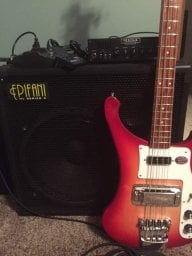
05042017113.jpg


why should I ever stop playing that bass? :bassist:


There is a thread posing the question of why you play more than four - this is not that thread.

okay! :D this is not that thread but...

03042017106.jpg


:p ;) :laugh::laugh::laugh: (can' t stop playing this one either :bassist:) both are different beasts for different stuff.

greetings

Wise(b)ass
 
  • Like
Reactions: BBQisgood
I've had 5 and 6 string basses and just couldn't gel with them. Could be that starting out on a 4 string learning modes I found the transition difficult on the 6, and I just found the B string useless for my style and type of music I like to play on the 5. About a month ago I tuned my Jazz bass DGCF and that worked for about a month now it's back to standard tuning. I just prefer a standard tuned 4 string bass.