

Enjoy the benefits of a premium membership!
Upgrade Account
-
TalkBass has been independent since 1998. Add your voice.
Create a free account to reply to discussions, view embedded media, and browse with fewer display ads.
Join free Log in
Want zero display ads or expanded classifieds tools? Compare plans.
You are using an out of date browser. It may not display this or other websites correctly.
You should upgrade or use an alternative browser.
You should upgrade or use an alternative browser.
Why don't more basses have set necks?
- Thread starter Alan i guess
- Start date
More options
Who Replied?
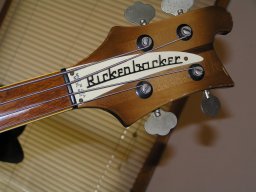
Some of the compression may also come from the stiffness of the construction. If you have loose neck bolts the sound suffers. This is one problem that almost always goes unchecked. An odd opinion about stiffness/tone wood/grain consistency/etc. is that plywood is inferior to solid hardwood, regardless of wood species. Most of the inconsistencies of grain or the organic properties of wood in general are mitigated by the glue used to connect the wood plies. Glue is much more uniform in consistency than wood, yet that feature is ignored as a positive due to the economics. Plywood bodies are resonant, lightweight and easy to machine. A "Hippie Samwich" booteek bass is sort of a glorified plywood. The deciding factor in tone tends to be a compromise of the sum total of all features combined. My suit of armor is on, feel free to respond. 
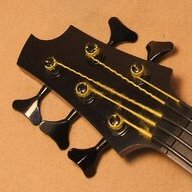
I've used others woods such as teak, ebony, ipe and laminates as well as solid maple. I have a preference for one piece blanks for neck through as opposed to laminates even though I have built the latter.I think most neck-through designs are Maple all the way through, but the wings will be a different wood.
So what is it about a neck-through and/or a set-neck that would cause a non-linear stiffness?
I think you were the one who mentioned dead-spots are the result of a resonant frequency in the neck.
So couldn't there be a subdued sound if the whole neck resonates differently from a screw-on neck?
I suppose "compressed" was the wrong word choice, but it seemed a good explanation someone else used to describe the subdued sound that happens with a neck-through vs. a screw-on.
Wow thank you everyone for all the insight! So many perspectives, I love it.
The resonant frequency of any material depends on density and stiffness. Frequencies at or near the resonant frequency would be enhanced and not suppressed. So pretty much like a parametric eq the center peak of the assembly can be shifted up or down depending on density and stiffness of material. How much of the effect can be heard or quantified is up to experiment or trial and error. The value of this is also debatable. Because science.I think you were the one who mentioned dead-spots are the result of a resonant frequency in the neck.
So couldn't there be a subdued sound if the whole neck resonates differently from a screw-on neck?
I suppose "compressed" was the wrong word choice, but it seemed a good explanation someone else used to describe the subdued sound that happens with a neck-through vs. a screw-on.

Acoustic string instruments have been built with set necks for centuries (there are exceptions, of course). When Gibson started building solid body guitars, they built them the way they built their acoustics. Fender's first guitars were solid body electrics so they didn't have traditional shop practices driving their construction methods. The Precision Bass was the first electric bass guitar to gain widespread popularity so its design and construction was what influenced other companies.Considering a set neck on an original bass build with a thin body. Wanted to switch it up from my other neck thru builds, but couldn't find neck bolts short enough for my needs. My question is why are set necks so uncommon in basses compared to guitars, whereas bolt-on basses are all over the place?
Frequencies at or near the resonant frequency would be enhanced and not suppressed.
That's exactly what I thought, but over in the Graphite vs. Ti thread it was suggested it's the opposite.
So now I'm confused as to which is true.
Apparently the idea is that if the neck is resonating (vibrating) at the same frequency as the note being played, then there's a dead-spot.
Yes the resonant frequency is the frequency that an object resonates with an applied frequency (the reason why some buildings collapse during an earthquake and others do not). So the resonant frequency of a complete bass assembly dictates where the assembly would resonate sympathetically and dictate what range of frequencies would be enhanced. Not a point to be argued as this is basic physics and proven again and again with science. Now to throw another wrench into the mix is the refraction of sound waves when passing from one media to another (assuming different densities). Here is where you would expect a dampening of select frequencies as there would be losses at the point of refraction (where one material meets another). Everything has an effect just some minute and some infinitesimal. Whether the human ear can discern such effects can be debated but not with subjective listening surveys. That makes one ponder the effect of laminating materials and the choice when laminating. In conclusion I therefore try to minimize the different woods used (see picture for an example). But I am not opposed to laminations or different construction methods and have assembled bolt-on set neck and neck through instruments with great results. Blindly slapping material together because you think a sound will result is at best a crap shoot.That's exactly what I thought, but over in the Graphite vs. Ti thread it was suggested it's the opposite.
So now I'm confused as to which is true.
Apparently the idea is that if the neck is resonating (vibrating) at the same frequency as the note being played, then there's a dead-spot.
As I understand it, if the whole instrument has a resonance at a given frequency, two things happen: It damps the string vibration because it's vibrating at the same frequency as the string, and the pickup's output is muted because the body is also making that vibrate at the same frequency.That's exactly what I thought, but over in the Graphite vs. Ti thread it was suggested it's the opposite.
So now I'm confused as to which is true.
Apparently the idea is that if the neck is resonating (vibrating) at the same frequency as the note being played, then there's a dead-spot.
IIRC this was the motivation for the trend of building extra-heavy basses starting in the late 70s: The idea that added mass would lower the resonant frequency. Turns out that, all things being equal besides mass, the resonant frequency drops, but the same result can also be had by building lighter instruments with different construction techniques, like using carbon fiber for added rigidity.
The pickup would not be affected so. It does not convert the mechanical vibration of the body. It converts the vibration of the steel string through its magnetic field. The resonant frequency of the body/neck/hardware assembly affects the vibration of the string hence the effect being then transferred to the actual electrical output of the instrument. Fade to black.

fwiw, gibson acoustics use a tapered dovetail joint and their electrics use a stub mortise and tenon joint -they aren't the same. keep in mind that when gisbon was growing, they started in the hub of american furniture manufacturing (kalamazoo) and thusly were heavily influenced by what the furniture makers were doing in their area, finishing techniques being one of the carry overs. done right, the stub tenon requires literally no hand fitting and assembly requires only glue and a clamp.
i tend to favor neck through designs for electric instruments, ime they seem to be the most stable in terms of sustaining a specific set-up for longer periods. but, when things go wrong you have less options for a fix.
i tend to favor neck through designs for electric instruments, ime they seem to be the most stable in terms of sustaining a specific set-up for longer periods. but, when things go wrong you have less options for a fix.
Last edited:

- Apr 18, 2008
- 16,007
- 1
- 31,705
- Disclosures
- I'm highly opinionated and extremely self-assured
i tend to favor neck through designs for electric instruments, ime they seem to be the most stable in terms of sustaining a specific set-up for longer periods. but, when things go wrong you have less options for a fix.
I suspect that it has less to do with neck-thru versus the others, and more to do with the fact that most neck-thrus are multi-lam instead of one piece.
I know set neck is pretty common on hollow bodies, but are there any current production solid body set neck basses OTHER than Gibson? I can’t think of any, but they must be out there. I wouldn’t call Gibson bass construction the gold standard for longevity in instrument design, particularly the whole “quick release headstock” feature.
This neck through built in 1987 has one piece maple neck and has remained absolutely stable. Laminations are not necessarily required for that, just careful selection of wood and proper curing and prep. By the way the neck is very thin on this one.I suspect that it has less to do with neck-thru versus the others, and more to do with the fact that most neck-thrus are multi-lam instead of one piece.
- Apr 18, 2008
- 16,007
- 1
- 31,705
- Disclosures
- I'm highly opinionated and extremely self-assured
This neck through built in 1987 has one piece maple neck and has remained absolutely stable. Laminations are not necessarily required for that, just careful selection of wood and proper curing and prep. By the way the neck is very thin on this one.
View attachment 3737791
Such a nice looking bass! And an exception to the general rule, I submit.
It does not convert the mechanical vibration of the body. It converts the vibration of the steel string through its magnetic field.
Exactly. If the string were stationary and body vibrating, the string would, in fact, be moving relative to the pickup. And, thus, the pickup will produce a signal.Right, but if the pickup is static relative to the body, it affected by the body's resonance.
- John
Further exceptions. There are more.Such a nice looking bass! And an exception to the general rule, I submit.

I would say that in the case of set neck vs bolt on--guitars & bases are different animals.
I have bolt on & set neck guitars, and both my basses are bolt ons.
The size, string gauge & scale-as well as the frequencies seem to affect it for me.
but ultimately it does come down to preference.
I've talked with bass players who will only play/buy bolt on necks
And price isn't the reason.
I have bolt on & set neck guitars, and both my basses are bolt ons.
The size, string gauge & scale-as well as the frequencies seem to affect it for me.
but ultimately it does come down to preference.
I've talked with bass players who will only play/buy bolt on necks
And price isn't the reason.


