• TalkBass has been independent since 1998. Add your voice.
    Create a free account to reply to discussions, view embedded media, and browse with fewer display ads.
    Join freeLog in
    Want zero display ads or expanded classifieds tools? Compare plans.

Why don't more basses have set necks?

Considering a set neck on an original bass build with a thin body. Wanted to switch it up from my other neck thru builds, but couldn't find neck bolts short enough for my needs. My question is why are set necks so uncommon in basses compared to guitars, whereas bolt-on basses are all over the place? I can't imagine sturdiness really being an issue as long as the pocket offers plenty of adhesion... Any insight here?
Also if anyone knows where I can get short neck bolts (like 1.25" or even 1"), still curious about that.

Thanks!!
 
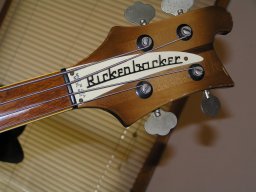
I don’t see much advantage to set necks. Full neck through allows you to carve the heel, and bolt on allows you to easily swap necks, shim a different neck angle, etc. Set neck does... what exactly? Other than being a giant PITA to remove if something goes wrong, I can’t see the point. It’s particularly bad on basses with 2 pups if the neck one is up near the fingerboard, which limits the length of the neck tenon into the body. Even if it’s long, passing under the neck pup, you end up hogging a lot of it out for the pup route. Ric basses are 1-1/4” thick body with through-neck, but so much wood was hogged out at the neck pup route (on the old ones) that it was essentially a glorified set neck. They relied entirely on the glue joint to the body wings, and if that failed (it occasionally did), the neck would start folding towards the body under string tension. If you use hex-head bolts into threaded inserts in the neck, you should be able to find a short length bolt at any hardware store. Do a bolt on with hex heads and inserts, that’s strong as hell.
 
Last edited:
I think instead you have to ask, why do so many guitars bother with set necks? And I think that has an easy answer, tradition. Gibson and others that used traditional methods like set necks ended up controlling enough of the guitar market that set necks are still popular today. But since most of today's electric basses essentially descended from Fenders with their bolt ons and not brands that preferred set necks, basses less frequently have set necks.
 
Gee I don't know? I've found everything works with correct design work.
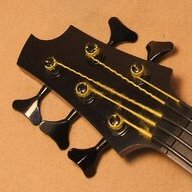
IMG_6159.JPG
 
:)Guitar and Bass Neck Threaded Inserts

But again, what advantage does set neck as a structural approach to guitar building have over bolt on or neck through? I can see an aesthetic argument, although in most cases you still have an offset between the body and back of neck, and you can’t afford to carve away the heel because you need the strength of the wood under the neck tenon. In the case of a 1-1/4” thick body, that usually means only 1/4” under the tenon. An intermediate approach might be a single (bridge or center only) pup with a tenon that extends halfway into the body, sort of a half-neck through. I haven’t seen any convincing evidence of tonal advantages to one system or another. Clearly bolt on is more practical, so far I’ve only built neck through, but that’s mainly an aesthetic decision, I do love that laminated through neck look. :)
 
Last edited:
I don’t have a ton of experience with set necks, but I thought they were supposed to offer better upper fret access, thinner body, and neck angles. Plus the aesthetics and other more subjective perceptions (like sound differences).

I think they’re a legit solution, perhaps with a combination of pros and cons of bolt-on and neck-thru construction... but as always it depends on the user whether it’s “worth it.”
 
Two considerations. Set neck historically allowed better higher fret access then bolt on. Newer bolt on options have narrowed that advantage. Set neck and bolt on allow the use of smaller pieces (less cost and easier to get) then neck through but again the popularity of laminations has narrowed that gap. I've built all three and all work well and I use them depending on the final ergonomics and aesthetics required or on the demand of the end user. As far a tonal differences they can be engineered into any configuration if wanted. So choose what works for you ergonomically and aesthetically and build away.
 
Last edited:
I've built a few of each kind. They all have their pros and cons.

Neck-thru provides the most consistent stiffness for the entire length of the string. But it's a pain to do the woodworking on the wings separate from the beam. At least it was the first time I did it. I've done a few since then, and I'm finishing one up now, and I'm sorta getting used to it.

Set-neck lets you work on the neck and the body separately, and then join them at the last minute. More manageable on the workbench.

Bolt-on has the advantages already mentioned - you can build the neck separately from the body, then assemble them at the end of the build. You can replace a neck that gets damaged, or a body that gets damaged.

People say things like "neck-thru allows better upper fret access", but that's not true. I've built bolt-ons with excellent upper fret access. They're just not built to Fender spec, that's all.

People say things like "neck-thru has such and such a tone", or "bolt-ons are punchier". I never know what they mean. All I know is that the stiffness of the structure plays a key role in the response of the string. I can build a plenty-stiff neck, and I can build a plenty-stiff body, and I can glue them together with Titebond, or bolt them together using 10/32 inserts and stainless machine screws, and both methods provide plenty strength and stiffness.

When you design from a blank slate, all things are possible.
 
Gibson uses set-necks, because Mahogany doesn't have the sheer-strength of Maple, meaning it would not do well being screwed on.

I suspect they use set-necks because their original designs were steeped in tradition.

Basses with set-necks & neck-through design have a natural compression that I'm not fond of, but somehow Rickenbacker gets around that!

Trying to wrap my mind around that one....
 
I agree with all said above. If you compare bolt-on vs neck-thru, there are pros and cons. Smooth shape vs simpler construction, etc. Set neck construction is part way in between. The big advantage is that you can make the body and neck from different woods. For example, if you want a softer lighter body, with a stiffer neck, but the smooth neck joint of a neck-thru. The penalty is tougher construction and repair. Design choices.
 
I'm not alone on this one, I did a poll & less than 50% think there's no difference at all between screw-on vs. neck-through:

https://www.talkbass.com/threads/screw-on-bolt-on-neck-vs-neck-through-can-you-hear-the-difference.1425534

A poll is not science.

When we talk about "compression" in a musical context, we generally mean "making the loudest sounds softer and making the softest sounds louder." I'm almost certain that wood - any wood - isn't capable of making soft sounds louder. So let's assume for the moment that what you really meant was "limiting", which is only making louder sounds softer.

We know that, since wood is an imperfect and imperfectly rigid material, a stringed instrument made from wood will flex a bit when the string that it's supporting is plucked. This flexion will actually absorb a bit of the energy of the vibrating string. The less stiff the structure, the more string energy gets absorbed, which explains why a Hofner doesn't sound like an Alembic.

Now, for a wooden stringed instrument to "make louder sounds softer" would mean absorbing only the energy of the loudest notes plucked; anything that is less loud than that threshold should be unaffected. In other words, the stiffness would have to be non-linear with respect to the amplitude of the string. I don't know of any wood with that property. There might be some; I just don't know about them. And anyway, your assertion isn't that a particular type of wood displays this property; you said that the particular construction methods are capable of this.

So what is it about a neck-through and/or a set-neck that would cause a non-linear stiffness?
 
I'm all for science explaining things, but personal experience tells me there is a difference. It's not the first time science has taken a back-seat to reality in my world.
It could be that Rics use maple. The old tone wood conversation once again rears its hideous head! :roflmao:

As for science, it is simply the art of proving a theory through trial. The problem often encountered is that the theory is held to be true before the homework is done. That renders conclusions that may or may not be true. For instance, colors aren't as distinguishable in darkness as they are in bright light. If you saw three red hens at night and they looked grey, then saw them as red in the daylight, you could conclude scientifically: "It is daytime, therefore all hens are red." That doesn't mean hens turn grey at night, that there are no such things as hens of other colors, or that red hens only exist during daytime. Beware of "scientists", not science itself.:)
 
Last edited: