Thank you for that MPM link Thomas. I've been thinking about something like that.
As the main advantage of such a construction I would see: a more even spread of the load, giving optimised contact between the bridge feet and the table; hence a more consistent distribution of the load on the table (over time), and (again, over time) less wear of the table, and also lower susceptibility to shaping errors. And it possibly improves acoustic transfer, but more importantly, because the load distribution on the table is more consistent over time (with the bridge tip moving up & down due to tuning & temperature variations [different expansion coefficients wood & steel]), the centre-point of the load will have a more constant distance from the soundpost.
What I mean by that is the following. Think of a stiff bridge (a bridge with adjusters has very limited free play, hence also stiff), with feet about the same thickness as the soundpost diameter, and the soundpost, say, 1.2 diameter below the bridge. If the bridge leans towards the tailpiece, the centre of the load will be on the bottom edge of the foot, so 1.2 SD above the soundpost. But if the bridge leans towards the fb, that load will be on the top edge of the feet, so typically 2.2 SD above the soundpost. Of course it depends on the instrument, but this may well have an effect on tone & playability. It may well contribute to variations people perceive in the behaviour of their instrument.
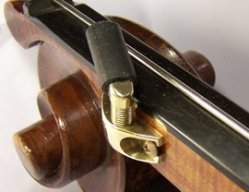
In my opinion, the main downside of such a gizmo is risk. I feel that you have to very carefully watch the inclination of the bridge, and make sure the centre line of the bridge (or the line between the contact point of the strings and the mid-point of the gizmo) always bisects the string breakover angle. If the tip moves too far away from that position, I think there is a real risk of the entire bridge tipping over (with a rather loud bang, and probably some ?minor? damage). This risk is increased if you lube the string notches w/ graphite. Whether or not something like that could happen, depends on the degree of freedom in the joint (not specified) & the thickness of the feet, but the animation certainly indicates that the tip can move beyond the edges of the feet. For a careful player, this risk is however perfectly manageable - but you should be aware of it. Minor downsides are extra mass & reduced structural strength.
My 2 cents on the main question of this tread (no adjusters in Europe): I don't use them because I hardly have any need for them, and I can only see downsides. They reduce structural strength of the bridge (am I the only one having seen the maple cracked round the pins?), stylistically they are quite an outstep from the conventional appearance of a bridge, and they add mass. The added mass, however, is not necessarily a bad thing, some instruments benefit from that, while others suffer from it. But if an instrument benefits from it, I feel there are more elegant ways of adding mass. And then there is this: why would you fuss about the micro-tuning of the bridge & ornaments, and then slap a few chunks of ugly metal on that same bridge?
The up side is of course easy adjustment of string height. I rarely need this, but if I want to go higher I just slide 1mm or 1.5mm shims of birch (aircraft) plywood below the feet. That conforms perfectly to the shape of table & feet, and is just about as easy to do.
Anyway, it all remains a subjective choice - as everything in music.
Edit: Thomas, thanks for the Forschung link too. Interesting reading, but while the author appears to suggest scientific authority, I still have quite a few question marks on method & consequently conclusions. Nevertheless, a valuable contribution. Particularly the sound samples are an ear-opener.



 .
.