
Enjoy the benefits of a premium membership!
Upgrade Account
-
TalkBass has been independent since 1998. Add your voice.
Create a free account to reply to discussions, view embedded media, and browse with fewer display ads.
Join free Log in
Want zero display ads or expanded classifieds tools? Compare plans.
You are using an out of date browser. It may not display this or other websites correctly.
You should upgrade or use an alternative browser.
You should upgrade or use an alternative browser.
Double Bass Why no bridge adjusters in Europe?
- Thread starter chris1125
- Start date
More options
Who Replied?

I live in the UK and dont find this to be true at all. Of course some bassists still don't like them but the majority of bassists I meet do. It's really not a big deal here, I've never heard of anyone getting a hard time for having them in the orchestra or jazz worlds.
Perhaps this is different in mainland Europe but I haven't heard of that.
Perhaps this is different in mainland Europe but I haven't heard of that.
geoffbassist said:I live in the UK and dont find this to be true at all. Of course some bassists still don't like them but the majority of bassists I meet do. It's really not a big deal here, I've never heard of anyone getting a hard time for having them in the orchestra or jazz worlds.
Perhaps this is different in mainland Europe but I haven't heard of that.
I was in Austria and the Czech Republic and I didn't see a single Bass that had adjusters... Even on the Vienna philharmonic bassists were using non adjustable bridges. Maybe its just that part of europe?
chris1125 said:I was in Austria and the Czech Republic and I didn't see a single Bass that had adjusters... Even on the Vienna philharmonic bassists were using non adjustable bridges. Maybe its just that part of europe?
Perhaps. My old teacher was principal bassist with the Czech Phil and never mentioned it. Europe is so big I'm sure you could be right. I think in an ideal situation we all wouldn't have them, but for most of us they are worth it.
geoffbassist said:Perhaps. My old teacher was principal bassist with the Czech Phil and never mentioned it. Europe is so big I'm sure you could be right. I think in an ideal situation we all wouldn't have them, but for most of us they are worth it.
Just out of curiosity, why don't you like them? The study I read in ISB said that the difference tonally was pretty insignificant.
chris1125 said:Just out of curiosity, why don't you like them? The study I read in ISB said that the difference tonally was pretty insignificant.
I really do like them and most of my bass playing friends do. However if I could play without adjusters, bow quivers etc I would prefer that. But it really doesn't bother me at all and I couldn't live without mine.

They come in handy in locations that have variable climates and wood shrinks and swells (string heights raise and lower with the top). Also if you don't always use the same strings or like to change height for certain styles of playing.
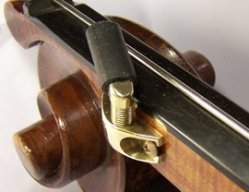
- Aug 1, 2005
- 3,546
- 1,421
- Disclosures
- Private Inventor - Bass Capos
You very rarely see them on orchestra basses in Germany. There is an overwhelming belief that they kill the sound. The thing is though that you just don't need them here the way you do in North America. The humidity is much more constant, and also there is no forced air heating, so indoor humidity stays pretty constant too.
in North America.... The humidity is much more constant, and also there is no forced air heating, so indoor humidity stays pretty constant too.
I think you'd better find another theory, too much of a generalization. The temps and humidity here in "North America" vary from cold artic to hot bone-dry desert and everything in between, many of them very constant.
I think you'd better find another theory, too much of a generalization. The temps and humidity here in "North America" vary from cold artic to hot bone-dry desert and everything in between, many of them very constant.
- Aug 1, 2005
- 3,546
- 1,421
- Disclosures
- Private Inventor - Bass Capos
in North America.... The humidity is much more constant, and also there is no forced air heating, so indoor humidity stays pretty constant too.
I think you'd better find another theory, too much of a generalization. The temps and humidity here in "North America" vary from cold artic to hot bone-dry desert and everything in between, many of them very constant.
Ouch! I must crawl into a deep cave and lick my wounds.
Ha, ha. . .but you got us all with the string winder. A great reason to finish that bottle of vino 
I'm located in Germany and I do have string height adjusters and never ever have used them. The luthiers I have talked to they all do not like adjustable bridges.
In my next setup the adjustable bridge will have to make place for a Windelband bridge.
I do know bass players that have several bridges - they change the whole bridge e.g. for summer and winter or changes in playing styles.
In my next setup the adjustable bridge will have to make place for a Windelband bridge.
I do know bass players that have several bridges - they change the whole bridge e.g. for summer and winter or changes in playing styles.

More than a decade ago, when i started my double bass venture, i asked many European players about adjustable bridges. The overwhelming majority of orchestra players were negative to the idea. Most of them used a "summer bridge" and a "winter bridge, in order to compensate for the slight adjustments needed. Only some jazz players in the European South (in particular Spain and Italy) used them.
Now i find more and more players with adjustable bridges, albeit less of them in the orchestra world. Most of them know that the tonal differences are minimal. In my country an adjustable bridge is more than useful for the varying humidity levels. Three days ago i played in a studio recording, in a sterilized environment with a 45% humidity and 25 Celcius and after it i played unamplified in the ancient theater of my city, in 78% humidity and 35 Celcius. I simply adjusted the wheels and i participated in the European Music Day in the best possible way.
Mike
Now i find more and more players with adjustable bridges, albeit less of them in the orchestra world. Most of them know that the tonal differences are minimal. In my country an adjustable bridge is more than useful for the varying humidity levels. Three days ago i played in a studio recording, in a sterilized environment with a 45% humidity and 25 Celcius and after it i played unamplified in the ancient theater of my city, in 78% humidity and 35 Celcius. I simply adjusted the wheels and i participated in the European Music Day in the best possible way.
Mike

The UK is an exception.
I've seen alot of orchestras throughout Europe and rarely seen adjusters. I always discussed it with the bassists, and their belief in non-use of adjusters was usually adamant. Instead, they have a "winter" bridge and a "summer" bridge to accommodate seasonal swelling of the top.
Edit: I skipped down to post without seeing MIKMAN's post.
I've seen alot of orchestras throughout Europe and rarely seen adjusters. I always discussed it with the bassists, and their belief in non-use of adjusters was usually adamant. Instead, they have a "winter" bridge and a "summer" bridge to accommodate seasonal swelling of the top.
Edit: I skipped down to post without seeing MIKMAN's post.
...I never thought they were useful, once I find the right spot I don't ever touch them anymore, so my basses don't have them.
...I do have string height adjusters and never ever have used them. ole bridge e.g. for summer and winter or changes in playing styles.
In addition to using adjusters to compensate for changes in temperature, humidity, different strings, etc., I find them useful even if they are never moved. That's because they allow one to adjust the string height to where one likes it much more precisely than can be done by cutting a fixed bridge.
I've been amazed more than once by how a small (e.g., 1/4) turn of the adjusters can seem to make a substantial difference in the feel and response of the instrument. Of course, what's changing is more than the height of the strings. There's the slight change in break-angle over the bridge, tension on the top, etc. There seems to be a "sweet spot," at least on the carved basses I've owned. Considering that there there really is no substantial degradation in sound as a result of using adjusters, the advantage, IMO, is well worth it. Even if a small degradation could be demonstrated, it is, IMO, more than balanced by the advantages.
Now, consider that the "sweet spot" seems to vary across seasons (so that I really do move them a bit) and, for me, adjusters are quite desirable.
I wonder if sensitivity to small changes in bridge height are greater for pizz. than for arco. That might explain some of the differences in preferences mentioned here.
In addition to using adjusters to compensate for changes in temperature, humidity, different strings, etc.,
I agree that bridge adjusters are the best option. I'll never again be without them. In my experience, the feet of the summer or winter bridge, when the bridge is changed over or switched , never seem to fit the belly without adjusting-- sanding the feet or filing the string slots.
One or two further questions:
Is there a marked difference in the usage of bridge adjusters between gut and steel string players? Don't most, if not all, classical players use steel strings which are not as susceptible to environmental changes? I would think that gut players would need more frequent string height adjustments.
- Aug 1, 2005
- 3,546
- 1,421
- Disclosures
- Private Inventor - Bass Capos
In addition to using adjusters to compensate for changes in temperature, humidity, different strings, etc.,
Is there a marked difference in the usage of bridge adjusters between gut and steel string players? Don't most, if not all, classical players use steel strings which are not as susceptible to environmental changes? I would think that gut players would need more frequent string height adjustments.
Well, you're probably right that wheels would be especially advantageous for gut players. Speaking from over here, though, I've certainly never seen adjusters in a baroque orchestra, and imagine that - fairly or not - anyone who showed up for a rehearsal with them would be laughed out of town. Even the winter/summer bridge thing is rare IME. I know no one who does it, and I also only turn my adjusters when I change string type.
If I may defend my arrogant, generalizing, probably racist, insensitive comments about North America having humidity swings, Well I 'pologize to all who were offended, especially Mr. Grable. I've only lived in the northeastern and midwestern parts of USA. There at least, weather was quite an issue. It seems to me though that there is quite a concentration of orchestra playing in this part of your continent though. Were my comments really that off base?


