
I'd say I have medium hands but strong because of my work. Fender J 5s neck too way chunky for me. Ibby neck was nice but too small, not enough 'pushback' I guess you'd call it, a little too easy to play...Wick LX5 now. Liked my old Ken Smith Burner custom neck too.

Enjoy the benefits of a premium membership!
Upgrade Account
-
TalkBass has been independent since 1998. Add your voice.
Create a free account to reply to discussions, view embedded media, and browse with fewer display ads.
Join free Log in
Want zero display ads or expanded classifieds tools? Compare plans.
You are using an out of date browser. It may not display this or other websites correctly.
You should upgrade or use an alternative browser.
You should upgrade or use an alternative browser.
Width - Ibanez vs Fender. Is it really such a big difference?
- Thread starter Hurdea Darius
- Start date
More options
Who Replied?
A P-bass typically has a nut width of 1.75" and a J-bass has a nut width of 1.5". That's a difference of only 1/4" spread across 4 strings, and it's easily noticeable. So yes, even very small differences in spacing can be felt.
I don't think of it as 1/4 inch difference, I think of it as a 14 percent difference. Quite noticeable.


Don’t most Ibanez models also have a flatter fingerboard radius? I think that’s a big factor in the feel difference.

JeezyMcNuggles
Inactive
- Feb 23, 2018
- 14,723
- 20,970
- Disclosures
- I suck, but nobody really notices
The bigger the board, the easier it is to hit the notes. The better the bass, the less you have to rely on cheap electronics that short out in a year or two, and leave you constantly fiddeling with your sound never being happy with your settings.Call it as you like - neck width, fretboard width, bridge string spacing, nut width etc. The thing is that I have big hands. I like metal so Ibanez is always recommended to me by the people I talk with. But the same people, when I tell them I have big hands, say that it'd be better for me to buy something with a wider neck. As I see on producer's sites, almost any Ibanez is 45mm on the nut and Fenders are like 47.6mm. I see that Fenders are 69mm on the last fret while the Ibanez is like 68.8-68.9 or something. Accurate or inaccurate, these differences of a few millimeters I wrote above, at least in my mind, do not seem to make such a difference as folks say. I mean, how could 1 mm more or less affect your playing? Please tell me if I'm wrong, if I would really need a wider neck for my long hands and if my info written above is accurate. Thanks in advance!
Metal, pop, country, hip-hop, and everything in between can be played on anything. But, there's a reason one is half the price of the other.

The BTB basses sure do. I could not bond with that no matter how much I liked the tone. Having just moved back to a 4-string, I don't think I'll be keeping the SR505 around. The Music Man-like spacing of my Carvin Icon 5 will be the one for going B-strung. Neck geometry in all of its facets matter, especially when I'm switching around.Don’t most Ibanez models also have a flatter fingerboard radius? I think that’s a big factor in the feel difference.

That's actually a very nice thing about them. I've had two Fender MIA passive Jazz Basses. First one was a 1965 Jazz that I bought in 1966. Among other things I used it touring with a nightclub group for three years playing 5-nights a week, 50-weeks a year. I got to know that neck really well, right up until it was stolen in 1976. I didn't find my current bass until 1985. It has the same neck profile that my '65 had. It is what is known as a "60's slim C-shape neck with a 7.25" radius". In the mid/late 70's every Fender Jazz I picked up had this thick P-bass type of neck. Some of them felt like the fat part of a baseball bat to me.I suppose as a proportion of your fingertip width, a couple of mm difference can be pretty significant. I can certainly feel it.
Ibanez necks tend to have shallower profiles (back-to-front) as well, which has as big an effect on feel as fingerboard width to me.
When I pulled that white Jazz with the maple neck off the wall of the music store I was working at, I was shocked. It felt exactly the same. And I love it. So "slim" necks are a really good thing in my opinion!
In my opinion, the narrower and slimmer neck like what was on my '65 Jazz and is on my '82 Jazz is easier to play - by far. Everytime I pick up a P-bass, I like the sound but hate the neck. It makes me work too hard to do runs and moves I can easily do on my "60's slim C-shape neck with 7.25" radius". Got spoiled using it for 10-years and touring with it for three of them. After it was stolen, it took my another 10-years to find my current bass that I bought in 1985.The bigger the board, the easier it is to hit the notes. The better the bass, the less you have to rely on cheap electronics that short out in a year or two, and leave you constantly fiddeling with your sound never being happy with your settings.
Metal, pop, country, hip-hop, and everything in between can be played on anything. But, there's a reason one is half the price of the other.
I did play my grandson's Squier P-bass with PJ pickups in Australia when he got it two Christmas' ago. And I was surprised. It still had the width of what I expect from a P-bass, but not the depth. It was actually a slim neck and I was pretty comfortable playing it. So yeah, pay attention to how thick or slim those necks are too. If you don't have an opinion yet on what you like, I'd suggest trying the same runs on a few different types of necks to see what feels good to you.
@JeezyMcNuggles likes a wider neck and a thicker one. I like a narrow and slim one. Up to you to figure out what you prefer...

I don’t really care about neck profiles. I can adapt to any neck, from a Hofner pencil neck to a 6 string neck.
JeezyMcNuggles
Inactive
- Feb 23, 2018
- 14,723
- 20,970
- Disclosures
- I suck, but nobody really notices
Haha, I do prefer thicker necks. Thin ones hurt my hands the way I have to curl. But, the statement was just more kind of jokingly saying that there's more room for your fingers.In my opinion, the narrower and slimmer neck like what was on my '65 Jazz and is on my '82 Jazz is easier to play - by far. Everytime I pick up a P-bass, I like the sound but hate the neck. It makes me work too hard to do runs and moves I can easily do on my "60's slim C-shape neck with 7.25" radius". Got spoiled using it for 10-years and touring with it for three of them. After it was stolen, it took my another 10-years to find my current bass that I bought in 1985.
I did play my grandson's Squier P-bass with PJ pickups in Australia when he got it two Christmas' ago. And I was surprised. It still had the width of what I expect from a P-bass, but not the depth. It was actually a slim neck and I was pretty comfortable playing it. So yeah, pay attention to how thick or slim those necks are too. If you don't have an opinion yet on what you like, I'd suggest trying the same runs on a few different types of necks to see what feels good to you.
@JeezyMcNuggles likes a wider neck and a thicker one. I like a narrow and slim one. Up to you to figure out what you prefer...

Play the one that feels most comfortable to you.
A large part of comfort on a bass is actually familiarity. You can always buy the bass that you feel is a better value for you - perhaps it sounds better, or is more versatile in terms of pickup and EQ configuration, etc. (If one of the basses has bridge saddles that allow for variable string spacing and the other does not, get the one with the adjustable bridges.)
The longer you play an instrument, the more you get used to it. A couple of millimeters can make a difference, but in my opinion it's not likely that a couple of millimeters will render an instrument unplayable for you.
Good luck.
A large part of comfort on a bass is actually familiarity. You can always buy the bass that you feel is a better value for you - perhaps it sounds better, or is more versatile in terms of pickup and EQ configuration, etc. (If one of the basses has bridge saddles that allow for variable string spacing and the other does not, get the one with the adjustable bridges.)
The longer you play an instrument, the more you get used to it. A couple of millimeters can make a difference, but in my opinion it's not likely that a couple of millimeters will render an instrument unplayable for you.
Good luck.
Based on an unscientific survey with an inadequate sample size, my hands are a little smaller than most guys around my height. And personally, I find Ibanez SR necks feel too small for me. Maybe a little narrow (side to side), but not too bad. Mostly they feel too thin (back to front). So Ibanezes are not necessarily suited for peoplr with small hands. I think the best thing is to try playing as many different basses as possible and just take note of what feels good for you.
If asked, I say I prefer Fender Jazz necks, but what does "Fender Jazz neck" even mean? According to Fender's website:
If asked, I say I prefer Fender Jazz necks, but what does "Fender Jazz neck" even mean? According to Fender's website:
- C profile neck: Aerodyne Jazz Bass, 60s Jazz Bass, Flea Jazz Bass, Standard Jazz Bass, Classic Series '60s Jazz Bass, Standard Jazz Bass, Road Worn '60 Jazz Bass, Jaco Pastorius Jazz Bass
- Mid '60s C-shaped neck - Vintera '60s Jazz Bass
- Slim '60s C-shaped neck - American Original '60s Jazz Bass
- Slim '64 C-shaped neck - Rarities Flame Ash Top Jazz Bass
- '70s C-shaped neck - '70s Jazz Bass
- Mid '70s C-shaped neck - Vintera '70s Jazz Bass
- Slim modern C-shaped neck - American Professional Jazz Bass
- Slimmer C-shaped profile - American Vintage '64 Jazz Bass
- Thinner C profile - Geddy Lee Jazz Bass
- Thicker C profile - USA Geddy Lee Jazz Bass
- Custom C-shaped neck - Adam Clayton Jazz Bass, Limited Edition Adam Clayton Jazz Bass
- Modern C-shaped neck - Deluxe Active Jazz Bass, Player Jazz Bass, American Performer Jazz Bass, Limited Edition Lightweight Ash American Professional Jazz Bass
- Compound modern C to D - American Elite Jazz Bass
- Modern D-shaped neck - American Ultra Jazz Bass
- Thick '70s U-shaped neck - American Original '70s Jazz Bass, American Vintage '74 Jazz Bass

I have 2 ibby bases, and a schecter. The ibby SR neck is very fast and slim, but gave me sore finger joints by the end of the night. The ibby G104 is slightly thicker, and perhaps more of a C profile - it fits like a glove, very comfortable all night. The schecter has a baseball bat neck, which is also surprisingly comfortable, but not quite as quick as the ibbys. I have stumpy little fingers, btw.
After reading here I’d say it’s an individual thing, which gives you no help whatsoever in choosing without playing. I’d say buy a reputable brand bass and see what happens. Sell it if it does not fit.
Cheers, A.
After reading here I’d say it’s an individual thing, which gives you no help whatsoever in choosing without playing. I’d say buy a reputable brand bass and see what happens. Sell it if it does not fit.
Cheers, A.

I am a trombone player and this reminds me of the mouthpiece size debates they have all the time. We all have to find what is comfortable to us and not try to use what Player X uses. Find the nut width, neck profile, fretboard radius, string spacing, etc that works for us and go with it.
Kind of like shoes...we find what fits and that’s what we wear.
Kind of like shoes...we find what fits and that’s what we wear.
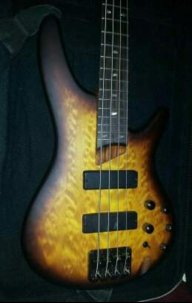
Man know what he wantsI have big monster paws and I like thin necks

asked whats the best bass for metal...and noone batted an eye....this ones clever! hehe
What? You can see my threads just by clicking on my profile info? Lol. Well, I was a beginner and I still am


What? You can see my threads just by clicking on my profile info? Lol. Well, I was a beginner and I still am
Hurdea Darius
click on postings.

Call it as you like - neck width, fretboard width, bridge string spacing, nut width etc.
I spent 25 years with a Fender Precision so I thought most of my preferences would be based around that, but the more basses I play, string spacing at the bridge is the only one that matters to me.
When I pickup a bass it's got to be 18/19mm, less than 9.5lbs and great tone. The rest of these parameters don't figure.
Latest posts
-

-
-
 TC Electronic Spark Booster. Underrated champion of low-gain overdrives
- Latest: John D Harris
-

-
