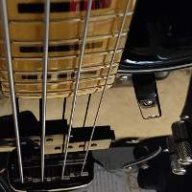
my husband is 6' 7" and he prefers narrow bass necks, and he plays 'em with no problem at all. i'm 5' 3", and i prefer wide neck guitars (with nut width of 1.8" or a little more), but i found that i prefer narrow neck basses.

TalkBass has been independent since 1998. Add your voice.
Create a free account to reply to discussions, view embedded media, and browse with fewer display ads.
Join free Log in
Want zero display ads or expanded classifieds tools? Compare plans.
Yes, I would go to the music store to try some basses. The thing is that the closest music store where I can try out some basses is 850km away... And now, more precisely - I don't really wanna buy an Ibanez, I don't wanna buy a Fender neither. My eyes are on the Cort C5 Plus and Marcus Miller V3 - the budget Ibanez and the budget Fender for a guy like me, who wants to buy a MXR M81 and a looper too. I asked about Ibanez and Fender because if it would have been to ask about Cort and Marcus Miller nobody would've responded
).



Call it as you like - neck width, fretboard width, bridge string spacing, nut width etc. The thing is that I have big hands. I like metal so Ibanez is always recommended to me by the people I talk with. But the same people, when I tell them I have big hands, say that it'd be better for me to buy something with a wider neck. As I see on producer's sites, almost any Ibanez is 45mm on the nut and Fenders are like 47.6mm. I see that Fenders are 69mm on the last fret while the Ibanez is like 68.8-68.9 or something. Accurate or inaccurate, these differences of a few millimeters I wrote above, at least in my mind, do not seem to make such a difference as folks say. I mean, how could 1 mm more or less affect your playing? Please tell me if I'm wrong, if I would really need a wider neck for my long hands and if my info written above is accurate. Thanks in advance!

In 2003 I bought a mahogany Cort lefty from MF. It was a dream bass. I loved everything about it. But it didn't have the Ibanez name on it. I sold it and have regretted it since. BTW both Cort, Ibanez, and Schecter basses come in identical shipping boxes. Same factory.Re: Cort.
What many people don't realize is that the the Cort/Core-Tek factories not only make Cort instruments, but also make instruments for several other manufacturers. They're the largest guitar manufacturer in the world. Ibanez, Schecter, and a whole bunch of other brands have a lot of their instrument lines manufactured by Cort. So people arguing over Ibanez Standards vs. Schecter Diamonds are all technically playing Corts.
Moral of the story is that Cort's house brand stuff is good solid stuff that definitely punch above their weight class in terms of features and specs for the price, because you're not paying extra for the Ibanez or Schecter or whatever name.

Call it as you like - neck width, fretboard width, bridge string spacing, nut width etc. The thing is that I have big hands. I like metal so Ibanez is always recommended to me by the people I talk with. But the same people, when I tell them I have big hands, say that it'd be better for me to buy something with a wider neck. As I see on producer's sites, almost any Ibanez is 45mm on the nut and Fenders are like 47.6mm. I see that Fenders are 69mm on the last fret while the Ibanez is like 68.8-68.9 or something. Accurate or inaccurate, these differences of a few millimeters I wrote above, at least in my mind, do not seem to make such a difference as folks say. I mean, how could 1 mm more or less affect your playing? Please tell me if I'm wrong, if I would really need a wider neck for my long hands and if my info written above is accurate. Thanks in advance!
Ibanez looks metal but sounds vanilla. You want Darkglass + any bass for metal.
A P-bass typically has a nut width of 1.75" and a J-bass has a nut width of 1.5". That's a difference of only 1/4" spread across 4 strings, and it's easily noticeable. So yes, even very small differences in spacing can be felt.

So the old bait and switch. Asks about a Fender and wants a Sire.
It's all about comfort. Strangely a few mm less and I'm hating a bass, especially at the bridge end of things.
So the old bait and switch. Asks about a Fender and wants a Sire.
It's all about comfort. Strangely a few mm less and I'm hating a bass, especially at the bridge end of things.
 ( I didn't know this bait is frequently made here. Id din't even want to make it a bait, I just named a Squire a Fender because the neck width is practically the same so I am talking about the dimensions, not the bass' electronics or anything like this and I bet this isn't clasified really as a bait like others.
You are doing the same error I see done over and over by lots of people. The difference is NOT split across four strings, it is spread across THREE gaps between the strings...