• TalkBass has been independent since 1998. Add your voice.
    Create a free account to reply to discussions, view embedded media, and browse with fewer display ads.
    Join freeLog in
    Want zero display ads or expanded classifieds tools? Compare plans.

Will this wiring work? (Diagram)

Ok, so I have this old tube combo that is made to run at 4 ohms at 100 watts, it doesn't have a switch so I assume its supposed to always run at 4 ohms (and I've read that if you set a tube amp to the wrong ohm load then you can damage the power transformer).. so the amp has two 8 ohm speakers in it, usually wired to run at 4 ohms total.. but I'd like to use it with another 8 ohm cab. So I was wondering if I could wire it this way, so that the two 8 ohm speakers create an 8 ohm load, matched with the 8 ohm cab, creating a 4 ohm load. Will this work?
Will the wire attached to nothing hurt anything?
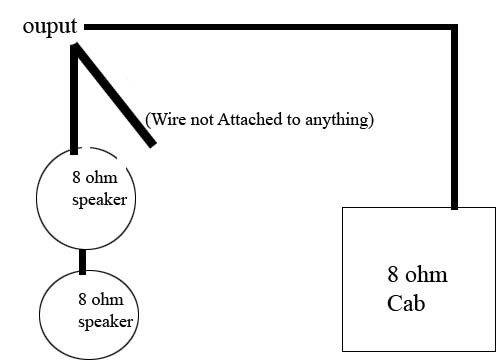
twinwiringcopy.jpg

(The thicker lines represent the wires)
 
Short answer: No

Long Answer: I'm not sure what you're trying to convey in that diagram, but I'll wager a guess.

The 2 speakers are wired in parallel, creating a 4 ohm load, because each is 8 ohms. So you disconnect one side of that. That doesn't create an 8 ohm load. There is no way to connect two 8 ohm speakers to create an 8 ohm load. If they're in parallel, it's 4 ohms, if they're in series, 16 ohms.

What is the wire that's not connected to anything. Where is that? Why is it there? Help us understand.
 
damn.. i thought that by connecting the 8 ohm speakers like that, that it makes it an 8 ohm load? Apprantly not.. so would that make the internal speakers make a 4 ohm load? Good thing I checked first.
Now I don't know what to do.. cause I want to use another cab, but I don't see how I could make it work if I can't make the internal speakers an 8 ohm load without replacing them.

Just to make sure, since this was designed to run at 4 ohms.. anything else might damage the power transformer?
 
originally, the amp had two pairs of wires going straight to each speaker, creating a 4 ohm load. I thought by taking off the wire of one speaker, and then wiring the other from speaker to speaker, it would create a 8 ohm load, apparantly I was misinformed.
Any suggestions of what to do?
 
Ok, that's what I'll do. But it will be ok to leave the disconnected wire disconnected? I'll probably just take the speaker out as it's pretty heavy and if I'm not using it then might as well take it out. That would be ok, right?

Also, if I wanted to, how would I go about wiring it in series to create a 16 ohm load?

Thank you a lot for the help, its greatly appreciated.
 
"For a tube amp set for a 4 ohm load that would mean that you could run it into anywhere from an 8 ohm load to a 2 ohm load and still be reasonably safe."

I took this from the ohms FAQ page.. is this true? I always thought it had to be exact? What about running a 4 ohm load when its set to 8? I did this earlier today, because I was misinformed about the wiring, hope I didn't mess anything up.
 
"For a tube amp set for a 4 ohm load that would mean that you could run it into anywhere from an 8 ohm load to a 2 ohm load and still be reasonably safe."

I took this from the ohms FAQ page.. is this true?
In most cases, yes. No speaker has a constant impedance anyway. Impedance varies with frequency; the average 8 ohm speaker's impedance ranges from about 5 ohms to 50 ohms across its bandwidth.
 
Ok, that's what I'll do. But it will be ok to leave the disconnected wire disconnected? I'll probably just take the speaker out as it's pretty heavy and if I'm not using it then might as well take it out. That would be ok, right?

Also, if I wanted to, how would I go about wiring it in series to create a 16 ohm load?

Thank you a lot for the help, its greatly appreciated.

If you remove the speaker your going to leave a big hole in the cab screwing up the tuning frequency and thusly the sound if not damaging your remaining speaker. If you leave it in there it will still flop around even though it's disconnected acting as a passive radiator. Learn more about your amp and what it's really ok to run at ohms wise. If you decide to remove it from the cab, take a piece of wood and plug the empty speaker hole.
 
"For a tube amp set for a 4 ohm load that would mean that you could run it into anywhere from an 8 ohm load to a 2 ohm load and still be reasonably safe."

I took this from the ohms FAQ page.. is this true? I always thought it had to be exact? What about running a 4 ohm load when its set to 8? I did this earlier today, because I was misinformed about the wiring, hope I didn't mess anything up.

I disagree with that.

If it was ok to run a 2ohm load or a 8ohm load with an amp set at 4 ohms, then what would the point in having switches be? I agree with BFM in that the impedence of the speaker varies, but the speakers are rated nominally.

Your amp might work fine, it might not, someone on here took that chance, thier SVT worked fine on an 8 ohm load for about 6-9 months (SVTs can only do 2 or 4 ohm loads) and then bye-bye mr power transformer.

Its up to you if you want to risk it or not.
 
If it was ok to run a 2ohm load or a 8ohm load with an amp set at 4 ohms, then what would the point in having switches be? .

To better match the source and load, which will prolong tube life. But, unlike SS amps, tubes aren't very fussy about low impedance loads, it's high impedance loads that they don't handle as well. Where multiple taps are used it's usually to allow the amp to function better with a high impedance cab.
Read over this entire page..... It may help you understand the different wonderful ways to get wired .. :hyper:
Ignore the fact that it's about car audio electronics. Speakers are speakers.. The section is more about impedance.
Hope that helps you some. :cool:
http://www.bcae1.com/spkrmlti.htm

Useful information, but mostly where SS amps are concerned. It's not the total reverse with tubes, but almost.
 
thanks a lot for the info.. its defenitely been useful and interesting..

and now I have an idea.. the internal cabinet has 2 speakers.. both at 8 ohms.. so can I wire them like this to get it to be a 16 ohm load..
4sp_ster_ser.gif

(only pay attention to one side)

Then.. the 8 ohm cab that it goes with has 4 speakers.. so if I combine the 8 ohm cabinet with the 16 ohm internal speaker load, then I would get a total load of about 5.33 ohms, which wouldn't be bad for the amp, correct? (also assuming that all the speakers are the exact correct ohms, which I know they aren't.)
This way.. since the 8 ohm cab is getting twice as much power, but has twice as many speakers as the internal load, then all the speakers will be receiving the same amount of power.. am I correct? (also assuming the ohms to speakers are correct.)

If this will work it's probably what I'll go for.
 
I'd try it both ways, and go with whatever sounds best. I wouldn't lose a lot of sleep over getting a perfect impedance match. This is an impedance chart of a typical vented cab. Care to venture what it's rated impedance is?

Impedance.jpg


It's 8 ohms, and if you look closely you'll see that it only actually measures 8 ohms at four frequencies.
 
So from what I can tell, the chances of an 8 ohm cab measuring 8 ohms is actually really slim?

So basically I can wire it either way and it won't do any harm to my amp as long as I try to keep the total ohm load in the general vacinity?
I just want to make sure before I do anything and mess up my amp, you know?