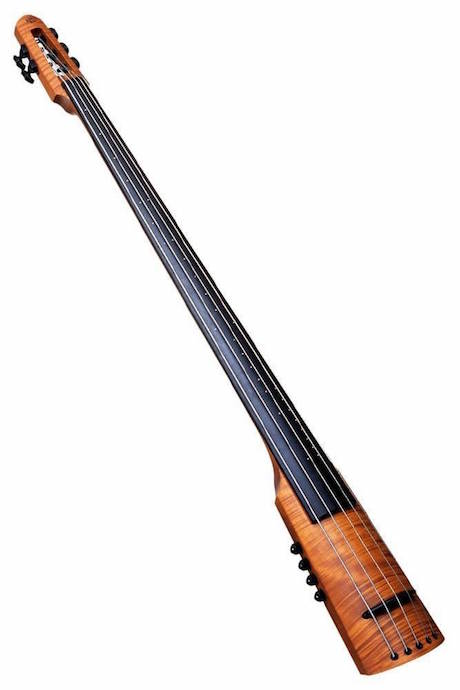
I’ve always wanted to add an upright to my stable, and an electric upright makes sense to me because building a “real” acoustic upright is a whole lot of fussy construction that will, for my purposes, still need to be amplified.
But I have almost zero experience with upright. I’ve never even touched one, with the sole exception of an old plywood Kay that my aunt brought to a family reunion eight years ago. This is both an advantage and a disadvantage. The drawback is the relative unfamiliarity - so many of the dimensions I’m dealing with on this build are quite different from my usual guitar design parameters. Fingerboard radius, scale length, neck thickness and profile, neck-to-body angle, body thickness and construction, it’s all new here. Even the way(s) of fastening the neck to the body, and the way the pegbox is arranged, need to have a re-think.
But the advantage I have is a clean slate - no pre-conceptions, no need to be constrained by traditional aspects of the upright. For instance, most EUBs have a shoulder that mimics the spot where the neck would join the body on an acoustic; this is (from what I’ve read) used as a tactile reference for going into what’s called “thumb position”. But because I’ve never learned to rely on that, I’m free to shape the entire length of my neck however I see fit.
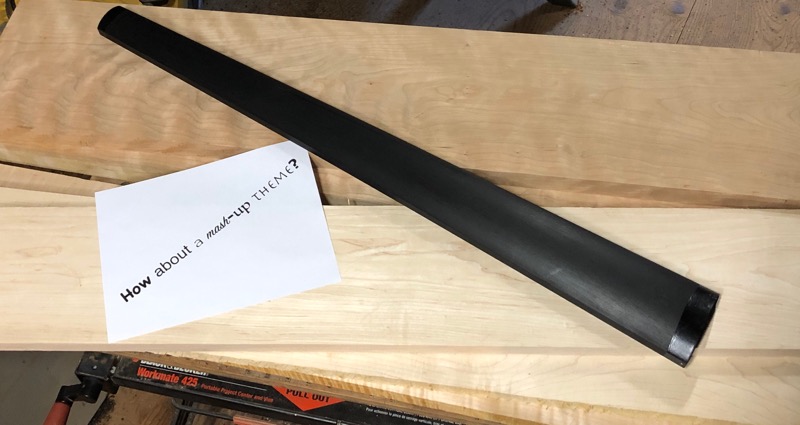
Still, I’m having to work through dimensions that I would otherwise take for granted. For instance, usually I shoot for a neck thickness that results in just under an inch for a bass guitar. That apparently doesn’t work for upright, partly because of the extremely small radius for the fingerboard, and partly because of the radically different playing technique. Near as I can tell, I need to aim for about 45mm total, and since my fingerboard is 24mm thick at the nut, that only leaves 21mm for the neck itself, which means I could build a single-piece neck from my 7/8” blank.
Do I want a truss rod? Tradition says no, as the relief is typically carved directly into the fingerboard itself. But I, being completely out of my depth, am taking a lot of my design cues from Ned Steinberger’s current line of EUBs, and he uses a truss rod, so.... Honestly I can’t decide. My neck joins the body 30” from the nut, so I would have to order a custom 29” rod from LMII, which isn’t expensive, but then I think that with that huge slab of ebony glued to a nice slab of rock maple, things aren’t going to move much at all.
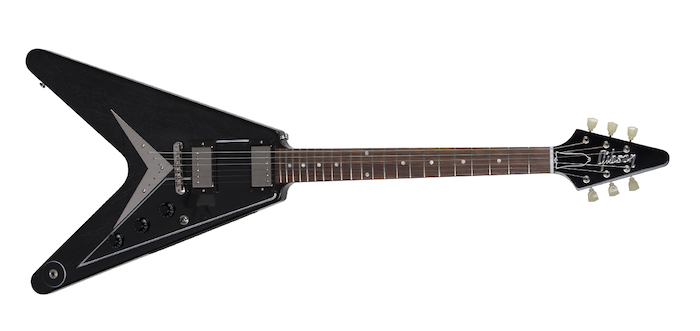
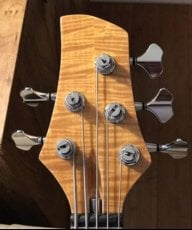
Bass guitar headstocks are easy - scarf joint, thickness, and shape it, and you’re done. Not here. I could go with a bass guitar style headstock, but I really want something that resembles an upright’s pegbox, only in the shape of a Flying V headstock. How best to construct it? The traditional way is to build the pegbox separately, then glue it on to the neck. I think I would rather create an “open” headstock from the neck wood, and build depth onto the back of it by gluing on another layer.
So, not much progress to show here, other than laying out the pegbox on the neck blank.