• TalkBass has been independent since 1998. Add your voice.
    Create a free account to reply to discussions, view embedded media, and browse with fewer display ads.
    Join freeLog in
    Want zero display ads or expanded classifieds tools? Compare plans.

Winter Build Off 2026 - Yewkulele!

Dec 11, 2019
893
3,208
UK
A few years ago, I built a bass stick dulcimer as a bit of fun. It’s quite nice to have a small acoustic instrument to hand just to pick up and play, without having to plug in or anything. The dulcimer only had 3 strings and the string spacing was a bit narrow, which is kind of limiting. So I’m going to build something to replace it – a bass ukulele.

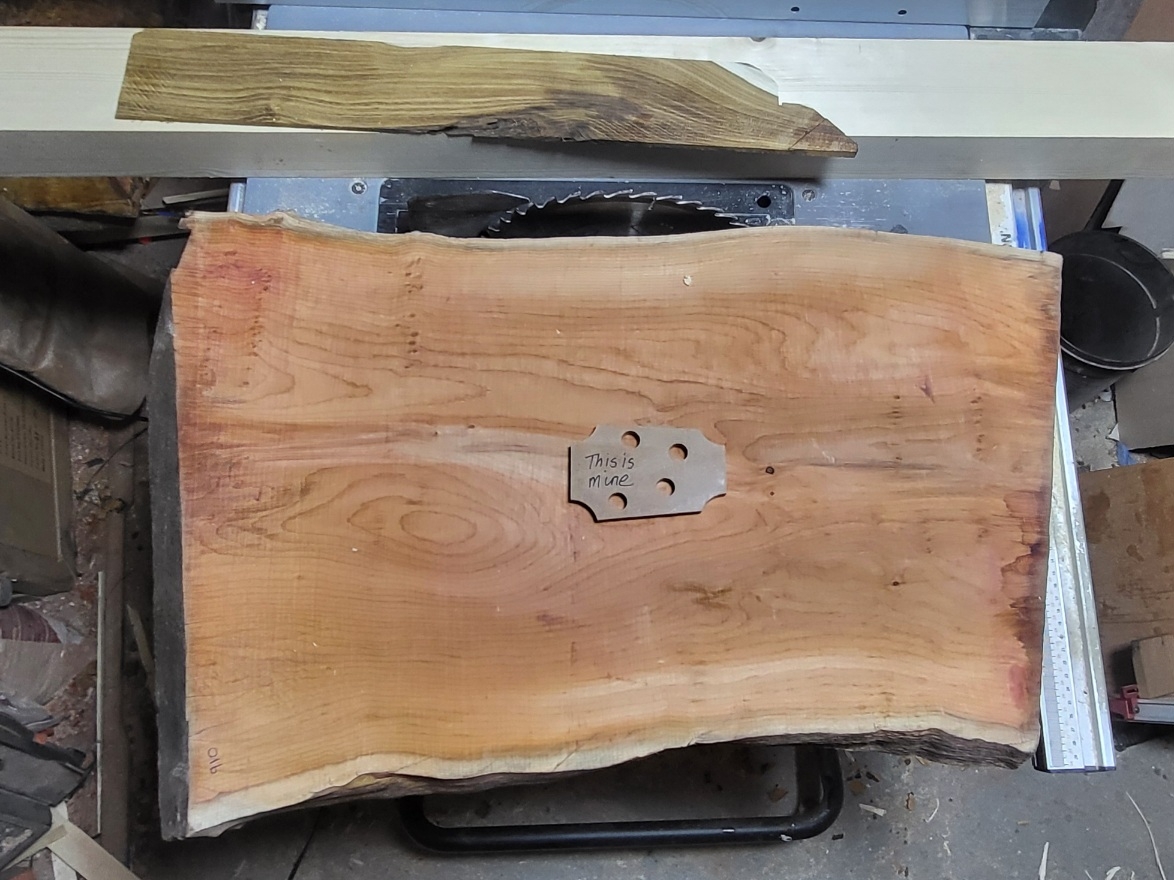
I’m trying to use native timber where I can, and eBay recently threw up a huge, thick slab of Yew. It’s big enough for both the body and the neck and I couldn’t resist. As luck would have it, it’s nicely quarter sawn too. The fingerboard is Laburnum, which is as close to Rosewood as British timbers get, and the top is spruce.
20260101_171044.jpg
 
A little bit more about the build. It will be an archtop with the strings anchored on a fixed tailpiece. I've sized it to use standard short scale bass strings, and putting the bridge in a sensible position gives a 635mm (25") scale length. I've gone for a 44mm nut with fairly wide 11mm string spacing, and a fairly narrow 14mm spacing at the bridge. It makes the neck seem almost parallel. In keeping with Ukuleles, it will have a flat fretboard.

The back will be a single piece "nut bowl" carved out of a solid block. I like a big round over on the back that a conventional acoustic body can't readily give. The yew slab that I have is 60mm thick, which is just about doable by that method.

1767307782544.png
 
A few years ago, I built a bass stick dulcimer as a bit of fun. It’s quite nice to have a small acoustic instrument to hand just to pick up and play, without having to plug in or anything. The dulcimer only had 3 strings and the string spacing was a bit narrow, which is kind of limiting. So I’m going to build something to replace it – a bass ukulele.

I’m trying to use native timber where I can, and eBay recently threw up a huge, thick slab of Yew. It’s big enough for both the body and the neck and I couldn’t resist. As luck would have it, it’s nicely quarter sawn too. The fingerboard is Laburnum, which is as close to Rosewood as British timbers get, and the top is spruce.

View attachment 7400316
Such a perfect wood for the pun. Awesome.
 
  • Like
Reactions: smart51
Wow that fingerboard is hawt stuff :drool:

I love laburnum; they are planted on city property all over here in Victoria and I've gotten a few small pieces here and there from the local wood-scavenger group, but nothing big enough to use in a build. I'd love to source some for a few fingerboards.
 
How's your day going? Mine's been up and down. I finished carving the body earlier and put a nice 5/8" round over on the bottom. The plan was to do that first, see how it looked, then go up to 3/4" and possibly 7/8". The 3/4" bit took a bite out of my work piece.

20260104_151718.jpg


Luckily I had just the piece to cut a repair patch from. Matching grain, colour and everything.

20260104_151910.jpg


So I marked up the cut and stuck down some guides for a palm router to cut out the damaged section. It turns out that one side of my palm router base is slightly smaller than the others, so I cut the hole just a little larger than the patch. There's only 1 other offcut big enough and the grain direction is all wrong. It will have to do.

20260104_160739.jpg
 
Did you document how you hollowed out that body at all?
I didn't take photos. I milled out the basic shape with a hobby CNC then routed out the rest will a bowl bit - a pattern follower with rounded shoulders. The outside was flushed with a trim router and rounded over with a round over bit.

I milled it out to the max depth of my end mill on the CNC and did the last bit with the router. With hindsight, I should have just CNCed it to about 6mm and routed out the rest. It would have been a lot quicker. CNC to get the accuracy. Router for speed.
 
Nice, can I ask which CNC machine you have?
Genmitsu 4040 Reno.

I did the fretboard on it, but not the usual way. Doing 9 passes per fret slot at 20mm / minute doesn't seem like a good use of time. I used a V score bit to mark each fret slot to just over the 0.5mm width of a fret slot, then used that to guide a fret slot saw cut by hand. By making the V slot 0.6mm wide, you're left with a nicely chamfered slot that doesn't need attention from a triangular file.