• TalkBass has been independent since 1998. Add your voice.
    Create a free account to reply to discussions, view embedded media, and browse with fewer display ads.
    Join freeLog in
    Want zero display ads or expanded classifieds tools? Compare plans.

Wireless IEM for pedalboard

Nothing from the pedalboard but here’s my take and suggestion.

I have been using the Carvin EM901 system for about 12 years but decided I wanted to go to a high-end system so I spent nearly $1300 on the Sennheiser G4. It is phenomenal.

HOWEVER please read on. You can probably relate to this but I hate lugging a rack case around to use it.

I decided to try the Xvive U45 and I have zero complaints. The sound is very good and I simply attach the receiver to my guitar strap and plug the receiver module into the main mixer.
It’s easy, convenient, extremely portable and very affordable at $269.

PS: The Sennheiser system is gathering dust. 🙂

Here’s a link:
Xvive U45 Wireless In-ear Monitoring System - 5.8GHz, Silver | Sweetwater

View attachment 7563642
Nice. This is the upgraded and improved version of my U4. Inexpensive and reliable.
 
You want one of these, paired with a set of these...

Input 1 is from your pedalboard
Input 2 is a full band mix from FOH
Thru is a 1/4" to a stage monitor
DI is a XLR to FOH

You can send only 1 or both 1 & 2 inputs to the 1/4" & XLR outputs, but I would just send the pedalboard output (1) to the outputs
You can set the levels for 1 & 2 that come thru to the IEMs, so you get as much bass as you want with the full band mix
The belt pack receiver has a 1/8" input so you can practice with backing tracks
 
Last edited:
Okay, I’ve used my Shure PSM300 IEM system for many years. Rock solid and no drop-outs or interference. Operating on the UHF frequencies around the 566-580 mhz range. It’s always rack mounted and easy to set up and use. However…..
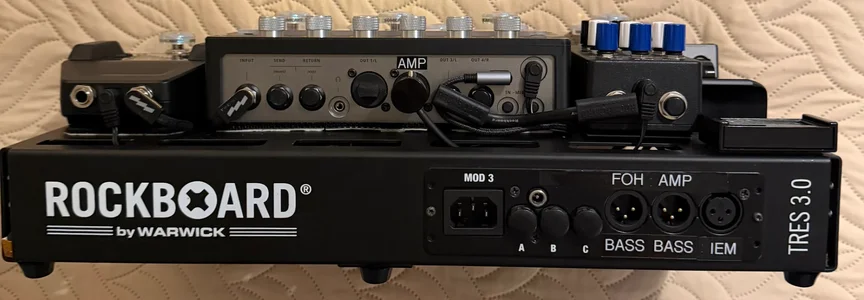
My goal was similar to yours for occasions where I wanted a bit more streamlined rig, I wanted a system I could incorporate into my pedalboard (Rockboard Tres 3.0) and have one less item to bring to the stage. As you can see in my pics, I too have the Shure GLXD16+ for my bass wireless and operates perfectly with its dual band ability in either the 2.4 GHz or 5.8 GHz bands. The majority of times when I scan before a gig it locks onto a 5.8 frequency. So my concern was getting an IEM system installed in close proximity to that wireless that wouldn’t interfere. I ended up getting the Galaxy Audio ASD-700 system which also operates on the UHF frequencies in the 571 MHz-585 MHz range, similar to my Shure PSM300 system. I attached the transmitter under the board as you can see in the pic and routed the XLR out to the patchbay module on the rear of the Rockboard but even without a patchbay could be easily connected to an XLR cord underneath. I run a 40’ 3 wire snake then between the soundboard or stage snake and pedalboard for my needs which are vocal channel, bass channel and aux out channel for my monitor. Then it’s a simple thing to use whatever mixer app on my iPad or iPhone to adjust my in-ears to my liking. Also on the pic of top of pedalboard you’ll see the receiver belt pack (lower left) for the IEM. I ended up using one of those magnet mounts that are used for a phone in a car and attached it to the pedalboard where the receiver attaches securely so now when I’m setting up for a gig I plug in the snake and pull the receiver off the pedalboard and attach my iem’s which are custom molded Ultimate Ears Pro 11’s. While not as crystal clear and perfect sounding as my PSM300 system the Galaxy Audio has surprised me over the most recent shows I’ve played with no drop-outs or interference. I’ve used a few Galaxy Audio pieces of gear in the past and have been disappointed but expected due to its low-end reputation and performance but this system has been exactly what I was hoping for. As with all things, everyone’s expectations and experiences are often vastly different but just sharing what has worked out well for me.
 

Attachments

  • IMG_0535.webp
    IMG_0535.webp
    155.6 KB · Views: 3
  • IMG_0538.webp
    IMG_0538.webp
    104.7 KB · Views: 3
  • IMG_0534.webp
    IMG_0534.webp
    172.1 KB · Views: 3
Last edited:
  • Like
Reactions: Motown971
Yeah, definitely need something to pull in a monitor mix. I'm using a Rolls PM351 that takes a monitor feed, plus bass, and my vocal.

From that, I'm using an XVive wireless, and while I had no issues with it, it's kinda bargain basement as far as wireless solutions go IMO. But everything fits on my board

Just a question did you connect your Xvive through headphones out?
Thanks
 
Just curious- Are you all using wireless in-ears for a monitor system? With bluetooth? I REALLY want to be able to do that, but I'm told by almost everyone that you cannot pair wireless IEM's with a bluetooth mixer, and not experience unacceptable latency. Am I missing something here? I tried to pair my mixer with an adapter, and it doesn't work. If this can be done, with a level of near zero latency, I sure would like to use my wireless in-ears.
I opted for the Sennheiser G4 IEM system... which has 0 latency since it's analog. I prefer 0 latency in my IEM's even if it doesn't sound as good as a digital system. However, I do use a Sennheiser EW-D for my bass... which is digital wireless system. It has 1.9ms latency... which is pretty good for digital... but worth it for the cleaner wireless bass signal.
 
Not just bass, the full band mix.
So you want to put the IEM Transmitter on your pedalboard? Then you're going to run an XLR to your IEM mixer from your board?

I guess I am not following what advantage any of this would be. Our band has been on IEM's for a decade. We utilize a large transit case which has a Power Stabilizer/Conditioner, Soundcraft 16 channel interface, Router and all IEM and wireless mic units. Everything is self contained. The only thing not in that rack are the IEM Receivers (Obviously) which we wear. Never a problem with interference or otherwise.
 
I guess I am not following what advantage any of this would be.
I don't believe the op said what he's trying to accomplish, but it could be a convenience if you play in more than one band and/or regularly sub/freelance or for some other reason would prefer to carry a full setup...an alternative to a personal rack case/bag separate from the pedalboard.

I considered it momentarily but technical reasons that it's supposedly not a good idea for some systems (technical/recommendation-wise, not necessarily as a practical matter...it might never be a problem) led me to pass on the idea.
 
Last edited:
So you want to put the IEM Transmitter on your pedalboard? Then you're going to run an XLR to your IEM mixer from your board?

I guess I am not following what advantage any of this would be. Our band has been on IEM's for a decade. We utilize a large transit case which has a Power Stabilizer/Conditioner, Soundcraft 16 channel interface, Router and all IEM and wireless mic units. Everything is self contained. The only thing not in that rack are the IEM Receivers (Obviously) which we wear. Never a problem with interference or otherwise.
I have a mini snake with 3 XLRs that I run from my board to FOH for whatever system we’re using, whether that’s our own X32 or into our snake when running into another system.

When playing with other bands or filling in, I don’t have to remove my transmitter from a rack, it’s already on my board with me.

Self-contained single board/bag/carry to play anywhere I need to. But that’s what I need for my gear, it’s okay if you don’t agree.
 
Last edited:
I have a mini snake with 3 XLRs that I run from my board to FOH for whatever system we’re using, whether that’s our own X32 or into our snake when running into another system.

When playing with other bands or filling in, I don’t have to remove my transmitter from a rack, it’s already on my board with me.

Self-contained single board/bag/carry to play anywhere I need to. But that’s what I need for my gear, it’s okay if you don’t agree.
Makes sense. I guess I wasn't thinking of the use case where folks are playing in multiple bands. Anytime I've done fill in work I've just been handed the receiver from the band for their system, and plugged in my own buds.

It wasn't even on my radar that some folks out there are in multiple gigs! (Mainly because my primary band plays 100+ per year so I rarely have time for anything else!) but now it makes TOTAL sense to me. :thumbsup:
 
  • Like
Reactions: Barticus
Just curious- Are you all using wireless in-ears for a monitor system? With bluetooth? I REALLY want to be able to do that, but I'm told by almost everyone that you cannot pair wireless IEM's with a bluetooth mixer, and not experience unacceptable latency. Am I missing something here? I tried to pair my mixer with an adapter, and it doesn't work. If this can be done, with a level of near zero latency, I sure would like to use my wireless in-ears.
Not sure what you mean by s "Bluetooth mixer", but bluetooth latency doesn't work for live bands.
As long as your mixer has an XLR out then you can use wireless.
 
  • Like
Reactions: Barticus
Not sure what you mean by s "Bluetooth mixer", but bluetooth latency doesn't work for live bands.
As long as your mixer has an XLR out then you can use wireless.
Bluetooth mixers are readily available. I'm really not very Audio/ interface savvy- could you please explain how the XLR would allow me to do so? Do you mean XLR out to a wireless transmitter?
 
Bluetooth mixers are readily available. I'm really not very Audio/ interface savvy- could you please explain how the XLR would allow me to do so? Do you mean XLR out to a wireless transmitter?
Again, not sure what you mean by Bluetooth mixer. Wireless in ear monitoring systems use typically 5GHz NOT Bluetooth, because Bluetooth has too much latency for real-time audio, such as a mix coming from a digital board.

If you look at any of the wireless IEM gear that’s talked about above, you can see that there is an XLR that plugs into the mixer, which is the transmitter end of it, and then you have a body pack which goes on the person (that is the receiver) that you plug your earbud/headphones into.

Do a quick search on YouTube for IEM systems and you’ll get the gist of what I’m talking about.
 
Again, not sure what you mean by Bluetooth mixer. Wireless in ear monitoring systems use typically 5GHz NOT Bluetooth, because Bluetooth has too much latency for real-time audio, such as a mix coming from a digital board.

If you look at any of the wireless IEM gear that’s talked about above, you can see that there is an XLR that plugs into the mixer, which is the transmitter end of it, and then you have a body pack which goes on the person (that is the receiver) that you plug your earbud/headphones into.

Do a quick search on YouTube for IEM systems and you’ll get the gist of what I’m talking about.
I have done a lot of gigs in bands using Avioms, (see my avatar) and the Behringer version. Those have a lot of outboard rack gear to make them work. And I still use wired in-ears. I'm primarily interested in home practice. I will, indeed continue to do more research.
 
  • Like
Reactions: s0c9 and Barticus
Bluetooth mixers are readily available. I'm really not very Audio/ interface savvy- could you please explain how the XLR would allow me to do so? Do you mean XLR out to a wireless transmitter?
There’s not really any such animal as a “Bluetooth” (BT) mixer per se. There ARE digital mixers that have BT capabilities, but that is usually used for audio playback. It’s NOT used for live audio due to its inherent latency. Meaning: it’s too slow to get a signal from the mixer into your ear buds to match what you play. When you play a note you get a delayed response (due to the latency). Impossible to play that way.
BT works great for one-way audio, such as playing music off your phone into BT-enable buds, or from your phone into a BT capable mixer.

Yes, as @Barticus explained above.. you take a mic (XLR) cable from the back of the mixer (or stage box) into the wireless transmitter. You then have the receiver on your person with the buds connected to it.
Think of your Aviom/Behringer unit not having a network (CAT5) cable attached but on your belt, but much smaller.
There are other aspects to consider when moving to wireless IEM’s.
I discuss that in the google doc in my sig - band wireless for beginners.
Feel free to ask questions as I’ve been doing this stuff professionally for many years!
 
Last edited:
I recently have been "trying out" IEM. I went real cheap to start, just to see if I like the experience. Donner EM1 on the board gets my Aux feed, then connected to Lekato MS-20, and I'm using the KZ ZS12 buds. All in for about $150. It's a usable system with decent quality and I'm enjoying the experience. I really miss the feel of my rig and band but my ears are certainly happier.
 
As an Amazon Associate, TalkBass may receive commissions from qualifying purchases made via links on this site.
  • Like
Reactions: s0c9
I recently have been "trying out" IEM. I went real cheap to start, just to see if I like the experience. Donner EM1 on the board gets my Aux feed, then connected to Lekato MS-20, and I'm using the KZ ZS12 buds. All in for about $150. It's a usable system with decent quality and I'm enjoying the experience. I really miss the feel of my rig and band but my ears are certainly happier.
I've been 99.99% exclusively IEM for ~13 yrs now. I refuse to do gigs with only wedges.
It takes getting used to IEM's and having control over your own mix makes a HUGE difference vs wild hand gestures to the monitor eng (if you have one) or the FOH person requesting more x and less y. That's almost impossible in any band with more than 4 or 5 folks!
That's why most of the bands in my area (at least my genre) have onstage IEM mixers with splits going to FOH.
 
Last edited:
As an Amazon Associate, TalkBass may receive commissions from qualifying purchases made via links on this site.
I've been 99.99% exclusively IEM for ~13 yrs now. I refuse to do gigs with only wedges.
It takes getting used to IEM's and having control over your own mix makes a HUGE difference vs wild hand gestures to the monitor eng (if you have one) or the FOH person requesting more x and less y. That's almost impossible in any band with more than 4 or 5 folks!
That's why most of the bands in my area (at least my genre) have onstage IEM mixers with splits going to FOH.
Some great points. In your experience, how have in-house sound guys provided you access to your monitor mix (generally speaking). I haven't had that experience yet. I'm in 2 bands, the most active we have and run our own PA.. so easy. But the other band will be playing some bigger auditoriums with in-house systems, and I was curious how that is typically handled (each member using and controlling their own IEM).

Edit: so re-reading, you use a splitter. We don't have that, I'm assuming it's something we should look at.
 
I've been 99.99% exclusively IEM for ~13 yrs now. I refuse to do gigs with only wedges.
It takes getting used to IEM's and having control over your own mix makes a HUGE difference vs wild hand gestures to the monitor eng (if you have one) or the FOH person requesting more x and less y. That's almost impossible in any band with more than 4 or 5 folks!
That's why most of the bands in my area (at least my genre) have onstage IEM mixers with splits going to FOH.
Completely agree with you, I had a large event stage with a quick turn where we were only allowed to use wedges on stage… and after using IEMs with my own control for so long, I absolutely hated the open wedge. I couldn’t hear a thing with that thing blasting at me.
 
  • Like
Reactions: Laklandfan
Some great points. In your experience, how have in-house sound guys provided you access to your monitor mix (generally speaking). I haven't had that experience yet. I'm in 2 bands, the most active we have and run our own PA.. so easy. But the other band will be playing some bigger auditoriums with in-house systems, and I was curious how that is typically handled (each member using and controlling their own IEM).

Edit: so re-reading, you use a splitter. We don't have that, I'm assuming it's something we should look at.
As for access to an IEM from my mixer, if they want they could download the monitor mix app for my system, "QU You" in my case, they then connect to my mixer WIFI, I'll help them set up the app to control their mix and that mix is under their control. If not I'll set up the mix as they want.
Best case is the band has it's own mixer rack and a split, had a band just last weekend with a self contained IEM mix system.
 
  • Like
Reactions: Barticus