Great job!The OP has a fantastic starting point to learn on!!
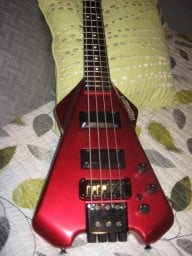
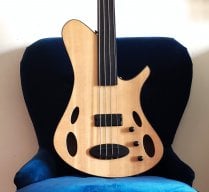
I wanted to try my hand at refinishing, defretting and changing electronics, so for $60 I picked up a crappy-looking bass in a local hock shop. It was covered with black runny spray paint, and was missing one string. It looked pretty hard used.
Now it looks like this:
View attachment 3352355 View attachment 3352356 View attachment 3352357 View attachment 3352358

Enjoy the benefits of a premium membership!
Upgrade Account
-
TalkBass has been independent since 1998. Add your voice.
Create a free account to reply to discussions, view embedded media, and browse with fewer display ads.
Join free Log in
Want zero display ads or expanded classifieds tools? Compare plans.
You are using an out of date browser. It may not display this or other websites correctly.
You should upgrade or use an alternative browser.
You should upgrade or use an alternative browser.
Worth fixing up this thrift store pile of...?
- Thread starter BadSanta1281
- Start date
More options
Who Replied?

I'm guessing at the factory when they cut the slots on the fingerboard where the frets go, their measurement was slightly off. That's the only explanation I can think of.
Got it now. Thanks.
At my current skill level it might not be much of an issue anyway. Spending most of my practice time closer to the head stock than above the 12th fret. I will investigate, though.

I say: Good score! 
Sounds like an extremely low risk learning opportunity. Having a cheap no name instrument to learn repairs and play with mods on is worth the time and small coin needed. Hands on is everything. Watch some videos, or get a book or two, and have at it. Odds are very good you'll end up with a unique funky bass that (at the very least) will sound good and play acceptably when you're finished.
Luck!
Sounds like an extremely low risk learning opportunity. Having a cheap no name instrument to learn repairs and play with mods on is worth the time and small coin needed. Hands on is everything. Watch some videos, or get a book or two, and have at it. Odds are very good you'll end up with a unique funky bass that (at the very least) will sound good and play acceptably when you're finished.
Luck!
Last edited:

If I got that thing, I'd sand the pickguard enough to get good pain adhesion, and respray it with a better color. I've done that before, with good results.
- Sep 4, 2010
- 3,304
- 2,730
- Disclosures
- Endorsing: Martin Keith Guitars
Awesome.
+1 to fix setup, string and cleaning fretboard first, and then shim existing nut if necessary (I use thin maple veneer). Making a good nut is not that easy actually, while I do my own parts swaps, setups and occasional finishes, a new nut is is one of those things I leave to a proper luthier.
Also love that you want to go wild with the finish. Maybe a see through pickguard is the ticket here (ready-made pickguards probably don't have the proper screwhole posoitions for your off-brand bass to begin with. More fun to make your own with either some perspex from local Home Depot or look into cheap pickguard sheets at guitarfetish. Their own pickups are decent too fro not much money.)
+1 to fix setup, string and cleaning fretboard first, and then shim existing nut if necessary (I use thin maple veneer). Making a good nut is not that easy actually, while I do my own parts swaps, setups and occasional finishes, a new nut is is one of those things I leave to a proper luthier.
Also love that you want to go wild with the finish. Maybe a see through pickguard is the ticket here (ready-made pickguards probably don't have the proper screwhole posoitions for your off-brand bass to begin with. More fun to make your own with either some perspex from local Home Depot or look into cheap pickguard sheets at guitarfetish. Their own pickups are decent too fro not much money.)


There's nothing wrong with having a cheap bass to monkey wrench on. I've owned both a $100 P-bass and built one of those $100 J-bass kits. I've learned a lot about doing my own setups. I got the P setup and playing great before passing it on to somebody who would enjoy it more. The J underwent a late night (somewhat drunken) defret job and then a much more sober slot filling, and now I have a lined fretless.
The knowledge gained helped me build a bass from warmoth parts, and I'll be building a body from scratch for my next build. I never would have been willing to spend the money on those warmoth parts without having fiddled with those cheap basses.
The knowledge gained helped me build a bass from warmoth parts, and I'll be building a body from scratch for my next build. I never would have been willing to spend the money on those warmoth parts without having fiddled with those cheap basses.
That looks like a fun project. I find that as long as the neck is not warped in some weird way, the frets aren't completely warn out or the instrument is just not constructed correctly from the get-go, these budget thrift store finds can often be made to play excellent. Over the past several years I've learned to do my own set-ups, repairs and modifications. It has been a lot of fun and a great learning experience. It's a great feeling to take something that others rate as 'garbage' or 'guitar-shaped object' or 'firewood' and turn it into a player. When you get in deep and get your hands dirty, it also de-mystifies electric instruments to their wood, steel, wire and magnet components. It's got to the point with me that rather than go to a music store and check out new guitars, I prefer to go to thrift stores or buy and sell stores to see what sub $100 cheapies would make a cool project. I like to stay in the $40 to $60 zone if possible.
It's interesting that the nut slots on your bass seem to be cut too deeply. I find that most often budget guitars and basses have nuts that are not cut deep enough, and need to be filed down. Although there are exceptions. I recently bought an entry level Yamaha, EG 112 (HSS Strat style). The nut was cut perfectly, and I could see no sign that the previous owner had filed it down. Sometimes the quality of budget guitars blows me away on those rare occasions where I just have to clean it up, change strings and do a set-up.
What's also great is that you can do a lot without having to spend a fortune on specialty tools. I think the only specialty tool that I own is a re-crowning file.
For filing nut slots, I use spiral welding tip cleaners which are usually between $2 and $5. To level frets, I use a cheap knife sharpening stone from a dollar/discount store. Even my soldering iron is a generic $8 one from a discount store.
And if you are cool with buying direct from China through Aliexpress or Amazon or others, the price and availability of parts is unbeatable. Most metal parts, pots, switches plastic parts and pickups I've bought have been fine. I find that guitar tuning pegs have been a real gamble though. I've bought some really good cheap bass tuning pegs, but haven't had very good luck with generic guitar tuners. It's hit and miss.
I'm so excited that you've got this project to work on. I hope that it goes well, and you have a good time fixing up that fixer-upper.
It's interesting that the nut slots on your bass seem to be cut too deeply. I find that most often budget guitars and basses have nuts that are not cut deep enough, and need to be filed down. Although there are exceptions. I recently bought an entry level Yamaha, EG 112 (HSS Strat style). The nut was cut perfectly, and I could see no sign that the previous owner had filed it down. Sometimes the quality of budget guitars blows me away on those rare occasions where I just have to clean it up, change strings and do a set-up.
What's also great is that you can do a lot without having to spend a fortune on specialty tools. I think the only specialty tool that I own is a re-crowning file.
For filing nut slots, I use spiral welding tip cleaners which are usually between $2 and $5. To level frets, I use a cheap knife sharpening stone from a dollar/discount store. Even my soldering iron is a generic $8 one from a discount store.
And if you are cool with buying direct from China through Aliexpress or Amazon or others, the price and availability of parts is unbeatable. Most metal parts, pots, switches plastic parts and pickups I've bought have been fine. I find that guitar tuning pegs have been a real gamble though. I've bought some really good cheap bass tuning pegs, but haven't had very good luck with generic guitar tuners. It's hit and miss.
I'm so excited that you've got this project to work on. I hope that it goes well, and you have a good time fixing up that fixer-upper.

As long as the truss rod works and you have the desire to do it, do it. I seen some stuff about Davidson bassesI'm pretty much brand new to all this and haven't done any work on my basses myself yet so bear with me. You won't be impressed. I promise.
Found this sad looking Davison P-style at a local thrift store yesterday. I would have walked away but this particular thrift store employs developmentally challenged adults and we try to support them whenever possible. Plus I don't have a P-style bass and it seems all the cool kids have one or two (or ten).
I jokingly asked for a 25% discount since it only had 75% of the strings but they just laughed at me and said no. My wife didn't bat an eye when I took it to the register and even whipped out her credit card. Love that woman.
There was duct tape on the nut under the D and G strings trying to keep them from touching the first fret. For sure it needs a new nut installed. The old one popped right out so no worries about removal. The output jack doesn't have that "spring lock" feeling when you plug in the cable. Feels like the cable will fall right out. It's making a connection, though. The volume and tone controls seem to be working. I gave the truss rod 1/8 of a turn just to make sure it was operational.
I'm thinking that with about fifty dollars (or less) in parts and strings maybe I can make it playable and educate myself a little bit at the same time. Then I won't be too intimidated to wrench on my other two "better" basses. I know there's lots of good set-up info on YouTube and such.
Haven't found too much info on these, not even here. I'm assuming quality is about on par with all the cheap eBay basses. Anyone else had any experience with one of these? Is it so bad that I should just tear it apart and save the body?
There seems to be a myriad of choices on replacement nuts. I realize the need to measure the old one before I order and the need to sand down a replacement to fit but curious about what material or brand name is preferable.
Thanks in advance for any and all opinions or advice. Even if you tell me to burn it.
View attachment 3351939
here you go
Link Removed
Making a good nut is not that easy actually, while I do my own parts swaps, setups and occasional finishes, a new nut is is one of those things I leave to a proper luthier.
It's interesting that the nut slots on your bass seem to be cut too deeply. I find that most often budget guitars and basses have nuts that are not cut deep enough, and need to be filed down.
I'll try the shim trick first and maybe the crazy glue and baking soda if the shim isn't sufficient.
I had to do the crazy glue repair once on a bass when I filed too much material out of one of the slots. It worked perfectly and is still holding up a few years later.I'll try the shim trick first and maybe the crazy glue and baking soda if the shim isn't sufficient.
I recently bought an entry level Yamaha, EG 112 (HSS Strat style). The nut was cut perfectly, and I could see no sign that the previous owner had filed it down. Sometimes the quality of budget guitars blows me away on those rare occasions where I just have to clean it up, change strings and do a set-up.
My crazy painted guitar I posted earlier in this thread is a Yamaha eg112 that I got at a thrift store for $30. I also have a TRBX174 that I like a lot. Yamaha stuff seems pretty solid and also bargain priced compared to some other brands. I have GAS for a budget acoustic guitar and a Yamaha is on top of my list unless I find a Craigslist or thrift store gem.

How does this work? I've never heard of it.After a cleaning and setup, if only a couple of the nut slots are too low- don't dismiss the CA and baking soda trick.
I love turning a $40 craigslist find into a playable instrument. I've thrown $200 worth of lace pickups into a $40 strat copy and used it for gigs (I even kept the girly sticker on the body and used the pink and black striped strap that came with it)

How does this work? I've never heard of it.
Sometimes it's a handy thing to know!
I've never totally filled a slot. But it's great if you just need a tad more height in the slot.

If I needed a project, that's a great fixer upper modding platform.
If I needed a backup bass and not a project, and the total cost for this bass + repairs exceeded $100, I'd take a pass and easily find its equal ready to play.
If I needed a backup bass and not a project, and the total cost for this bass + repairs exceeded $100, I'd take a pass and easily find its equal ready to play.
Last edited:
Got it now. Thanks.
At my current skill level it might not be much of an issue anyway. Spending most of my practice time closer to the head stock than above the 12th fret. I will investigate, though.
There is also a chance that when you put the proper relief in the neck the nut slots will be at a more appropriate depth.

A quick note about the pick guard, for something fun, scuff it up with very fine steel wool and spray paint it a new color. I used "Hammered" finish spray paint. It comes out looking like hammered metal and if it scratches it can be touched up with a silver sharpie. It's a $5 can upgrade that will add something nice.
Others have made good points about the repairs.
-Don't swap the nut unless you have too.
-Used parts from a reliable cheapie (squire VM or CV) are your first bet, then take a look on Ali express or Ebay for truly cheap new parts that will take longer to arrive, but not push the budget into the realm of a new SX.
Good luck and have fun!
Others have made good points about the repairs.
-Don't swap the nut unless you have too.
-Used parts from a reliable cheapie (squire VM or CV) are your first bet, then take a look on Ali express or Ebay for truly cheap new parts that will take longer to arrive, but not push the budget into the realm of a new SX.
Good luck and have fun!

Pretty sure this one was white before it got spray painted.
I thought tort pick guards made the tone better. I read it on TalkBass so it must be true.
That's a myth. 3-ply B/W/B actually sounds better
.