• TalkBass has been independent since 1998. Add your voice.
    Create a free account to reply to discussions, view embedded media, and browse with fewer display ads.
    Join freeLog in
    Want zero display ads or expanded classifieds tools? Compare plans.

Xsonics Club

Just to make things clear, compound = isobaric

What the design does here is none of the above.
Both drivers work on the same volume, right? (or are there more drivers inside?, correct me if I'm wrong)
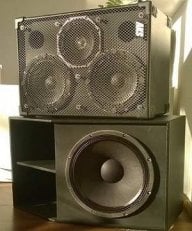
The driver in the open sidechamber may have a slightly altered mid response, in the bassdepartment though there will not be any difference (the cone will not "see" any resistance, the hole is to big for that to happen)
If there are no other drivers inside this type of setup is called push-pull, one cone moves forward and one cone moves backward(in relation to it's magnet). This reduces harmonic distortion.
 
Note to cab builders...........please stop putting straps on top of the cab unless it's recessed..........thank you!!


Nice cabs! Outta my price range.

Thanks funkfather. I am moving the strap handle to the side of the cabinet. Recessed is available on the Options page.

Cheers!
 
  • Like
Reactions: Count Bassie
Just to make things clear, compound = isobaric

What the design does here is none of the above.
Both drivers work on the same volume, right? (or are there more drivers inside?, correct me if I'm wrong)
The driver in the open sidechamber may have a slightly altered mid response, in the bassdepartment though there will not be any difference (the cone will not "see" any resistance, the hole is to big for that to happen)
If there are no other drivers inside this type of setup is called push-pull, one cone moves forward and one cone moves backward(in relation to it's magnet). This reduces harmonic distortion.

Hello Arjank, my fellow dutchman!

My understanding is that Isobar is a greek word and means "equal pressure" and really is limited to sealed enclosures hence the "pressure" part. I was informed my design was compound non-isobaric (because it's ported) push-pull. I certainly want it classified the right way, and I think I did so but I'm no expert here.

Tot ziens
 
Hello Arjank, my fellow dutchman!

My understanding is that Isobar is a greek work and means "equal pressure" and really is limited to sealed enclosures hence the "pressure" part. I was informed my design was compound non-isobaric (because it's ported) push-pull. I certainly want it classified the right way, and I think I did so but I'm no expert here.

Tot ziens

Goeiedag Ncognito!

As far as I can see we have two woofers, both share the same volume(ported). The only difference between this design and other 2-woofer designs is that we have one driver mounted with the magnet to the front(this driver will have it's polarity reversed). So, my conclusion is that this is a ported push-pull cab. (push-pull though makes the most sense with open-baffle subs when it comes to lowering distortion, check e.g. the Orion from Mr Linkwitz)

Fijne avond!
 
The side chamber would filter some topend off the side facing driver, yes?. Not a lot, or enough to make the whole of the sound "dark" or anything, just voiced with low mids. Depending on how the tweeter integrates, maybe not all that noticable.

Neat....should sound pretty fat.

Hey will33

I have my cabinet front shelf ported and side shelf ported into the right chamber. I don't believe there is really any high end loss. The porting does give it a bit of growl and minor mid bump as Eden's do. The cabinet does not have that middy boxyness you get when having a speaker firing into a surface directly in front of it.

Cheers!
xsonics212cfi_zpsde34c979.jpg
 
A question---
What is the advantage of this configuration as opposed to a standard 2x cab with the same internal volume? Since the tucked-away woofer is mounted back-out I would expect midrange and low-highs loss? I would think the dynamic range would be no different than a conventional cab with the same drivers and internal volume, but with some frequency anomalies due to the 2cnd driver firing into the cab side.

Not trying to be a crank, just trying to expand my knowledge base.
 
I too wonder about the push-pull versus two front firing drivers. My guess is that a front fire design would be stronger in the mids and highs. This x-fire design may have less highs and mids overall but, the off-axis response would have to be superior since the highs and mids would basically be produced by one driver. I really have no idea how porting effects the growl and mids of a cab. Im very interested in this cab, I just dont' know anything about the physics of it. Then again, if it works well, I wouldn't care about the physics.
 
I too wonder about the push-pull versus two front firing drivers.

Like I said, it reduces distortion.
So simplify the matter, the movement of the cone/suspension should be the same when the cone travels to the front or to the back(magnet). In the real world this is not the case, the suspension and magnetic field cause most of the problems.
The idea with push-pull is to eliminate this, it reduces non-lineair (2nd harmonic) distortion.
 
So, this design should give a cleaner low end than a front load? Hmm. It was my understanding that the 2nd order distortion is part of what gives eden xlt cabs their full low mid sound and growl. This cab is supposed to do exactly that. Im sure that it does since, this is the cabs goal. The science of porting to achieve that result is beyond me.
 
A question---
What is the advantage of this configuration as opposed to a standard 2x cab with the same internal volume? Since the tucked-away woofer is mounted back-out I would expect midrange and low-highs loss? I would think the dynamic range would be no different than a conventional cab with the same drivers and internal volume, but with some frequency anomalies due to the 2cnd driver firing into the cab side.

Hi Mike, my fellow Chicagoan!

My design allows for conventional loading if one wishes. I like the push-pull as it helps limit excursion and allows my cabinet to get louder with the two drivers working together with their own kind of "governor" if you will. I've had a few years experience with the Tech SoundSystems/Schroeder's knock-off which is somewhat similar to the Glasstone Lil G I believe. My ears tell me along with years of playing that design that those cabinets having a woofer firing directly into a surface in very close proximity is what causes midrange and high anomalies. The Xsonics doesn't fire directly into a close sidewall, and I believe there is little or no high end loss or sonic anomalies happening here. Charts and graphs are great but aren't the ears what we hear with or is it our eyes?

I think the advantage of the Xsonics is that it's the smallest and lighest possible cabinet that doesn't sacrifice tone. The cabinet roars.
 
Hey Nick. I think what folks are trying to figure out is, how the design of your cab is going to sound next to a dual driver, front firing cab like the Barefaced Super Twelve. I myself can't figure out why the schroeder design that fires a driver into a side wall does anything helpful so, given the choice, I think that most would go the way you did, if using that design. If your cab was sitting right next to a Super Twelve, Im willing to bet that the Bareced may be stronger in the upper mids due to having the full output of both drivers where, your cabs tone profile would "sound" like it is alittle fatter in the low-mids and alittle less bright in the upper range. Maybe alittle smoother than the barefaced. Just a guess because I haven't used either of them. Yet.
 
It seems to me firing the driver into the side chamber would cancel/reduce a bit of treble from that driver though some frequencies may still be reflected out.. The design of the chamber and how high that woofer can play would dictate how noticable it is. Similair to playing a conventional cab facing into a wall or down at the floor.

Having the magnet structure there with the reverse mount would also change things.

On the right track here?
 
Hey Nick. I think what folks are trying to figure out is, how the design of your cab is going to sound next to a dual driver, front firing cab like the Barefaced Super Twelve. I myself can't figure out why the schroeder design that fires a driver into a side wall does anything helpful so, given the choice, I think that most would go the way you did, if using that design. If your cab was sitting right next to a Super Twelve, Im willing to bet that the Bareced may be stronger in the upper mids due to having the full output of both drivers where, your cabs tone profile would "sound" like it is alittle fatter in the low-mids and alittle less bright in the upper range. Maybe alittle smoother than the barefaced. Just a guess because I haven't used either of them. Yet.

I had a Big Twin from Alex at Barefaced and I have a Genz Benz 212T Neo Nx2 right now sitting next to my Xsonics 212CF. The high, lows, and overall output between the GB and Xsonics are strikingly similar. Strikingly. Absolutely NO audible loss in highs or sonic anomalies detectible by my human ears with either cabinet. The Xsonics does a great job in keeping up with the GB212T although the Xsonics is a bit tighter and agressive with some growl and a little bit less high-fi.
 
Hi Mike, my fellow Chicagoan!

My design allows for conventional loading if one wishes. I like the push-pull as it helps limit excursion and allows my cabinet to get louder with the two drivers working together with their own kind of "governor" if you will. I've had a few years experience with the Tech SoundSystems/Schroeder's knock-off which is somewhat similar to the Glasstone Lil G I believe. My ears tell me along with years of playing that design that those cabinets having a woofer firing directly into a surface in very close proximity is what causes midrange and high anomalies. The Xsonics doesn't fire directly into a close sidewall, and I believe there is little or no high end loss or sonic anomalies happening here. Charts and graphs are great but aren't the ears what we hear with or is it our eyes?

I think the advantage of the Xsonics is that it's the smallest and lighest possible cabinet that doesn't sacrifice tone. The cabinet roars.

As someone who currently owns a Tech 212, Schroeder 1210L and Glasstone Lil G I think the comparison and conclusions drawn are off. Way off. I look forward to checking one of your cabs out... assuming the Lil G sounds like the others or sacrifices tone is a mistake.
:cool: