• TalkBass has been independent since 1998. Add your voice.
    Create a free account to reply to discussions, view embedded media, and browse with fewer display ads.
    Join freeLog in
    Want zero display ads or expanded classifieds tools? Compare plans.

Yamaha Motion B Bass Guitar

I have owned a MB-II since approx. 1990 that was made circa 1985-86. I fell in love with these basses the second they hit the market. They are mid-scale but have 24 frets as well as fine tuner bridge, which I personally love. They came in black, wine red, purple, and white. They came stock with a split stacked tone control that allowed control of both pickups individually in addition to each volume control representing its corresponding pickup.

Surprising how rare they are!!! Back in the mid to late 80's, they originally sold for about $1000. Not MSRP. Mine is wine red and a bit modded in that I added an EMG BTC on-board active EQ (still use the original passive pickups, though). I also sanded the back of the neck decades ago which I think makes it even easier to play than its original design (and makes it distinctly mine). I absolutely LOVE my bass and wouldn't trade it/sell it for anything in the world. I tried to once but it somehow made its way back to me - the rest is history. I could die a happy man if I could obtain the other 3 colors. Then I'd mod the crap out of them. One would be fretless; one setup for drop D tuning; another for baritone.
 
So, having acquired a couple of the later 1990s versions of these, here's what I've been able to learn about them:

They first appeared in Yamaha catalogues in late 1985, in the original "small headstock" variant.

[Invalid or Expired Link Removed] - if anyone reads Japanese and can translate the specs that would help.

The MB-II had the fine tuner bridge, 24-fret fingerboard, gold hardware, the two large pickups, and truss rod adjustment at the body end. Available in Pearl White, Candy Apple Red, or Black. Original price 80,000 yen, or roughly $400 in 1985 USD, or roughly $900 in today's money.

The MB-III was similar, but had a plain bridge, chrome hardware, and only came in plain white or black. 55,000 yen list price, about $200 USD in late 1985, $400+ in today's money.

The MB-I was the top-of-the-line model with an (I believe) ebony fingerboard with oval mother-of-pearl markers, gold hardware, and available in semi-transparent red and blue finishes in addition to black and white. 120,000 yen in 1987, $600 USD at the time, roughly $1.300 today.

[Invalid or Expired Link Removed]

1987 also saw the addition of the MBIII-PJ model, which swapped out the large humbuckers for a slanted P and straight J pickup, with gold hardware. There was also the MBIII 'G' series which I believe had different body woods (again, if someone can translate, that would be awesome) and translucent finishes which showed the woodgrain.

[Invalid or Expired Link Removed]

1990 saw an additional "R" series added to the MB line, with a radical change in design, with a completely different body design with a carved top and the 4-in-line hockey stick headstock and PJ pickups. Sold as the MB-IIR and MB-IIIR.

[Invalid or Expired Link Removed]

However, the traditional MB design was still in the lineup. Now differentiated as Special, Deluxe, and Custom versions, with dual-humbucker and PJ variants. Also notable, Yamaha had a medium-scale RBX bass at this time (RBX-MS)

[Invalid or Expired Link Removed]

By 1992, they had created two new variations on the line, all with PJ standard pickups and TRB-style headstocks with a tiltback scarf joint, 22-fret fingerboard and truss rod adjustment at the nut. The first two models were the top-of-the-line MB-75 and the MB-55. The 75 had an alder body, arched top and tummy cut for the first time, a contoured neck heel and two 'mini plate' neck plates, and transparent finishes. The 55 had a basswood body, flat top, Fender-style forearm contour and tummy cut and solid finishes. Fingerboards switched to 22 frets, with truss rod adjustment at the headstock. The headstock switched to a tiltback design similar to the TRB line, with a scarf joint.

[Invalid or Expired Link Removed]

In 1993, they added the MB-65, a unique model with a contoured body like the 55, made of mahogany with a maple front. It was apparently only in the lineup for this year.

[Invalid or Expired Link Removed]

By 1994, the line was back to just the 75 and 55 but with more color options.

[Invalid or Expired Link Removed]

In 1995, the MB-65 returned as the "MB Special", and a new lower-cost version, the MB-40, was added to the lineup. The 40 was more barebones, with a more downsized body, and while it had the same TRB-like headstock design, returned to a 24-fret fingerboard, flat body front and back, and truss rod adjustment at the body end.

[Invalid or Expired Link Removed]

By 1996, the MB Special / MB-65 was gone from the lineup again, but otherwise the same as last year.

[Invalid or Expired Link Removed]

In late 1996, the lineup changed to the lower cost MB-50, MB40-H, and MB-40.

These were basically all MB-40 style instruments. The 50 had gold hardware and an alder body, the 40H had a 'high definition' photo-flame-maple top and chrome hardware, and the 40 was plain Alder and/or Basswood with chrome hardware.

[Invalid or Expired Link Removed]

This lineup stayed the same till 2000, when the MB-45HB model was added, essentially an MB40 but with dual humbuckers with large, visible, 'music man' style polepieces.

[Invalid or Expired Link Removed]

This lineup stayed unchanged until 2005, when the MB series finally disappeared from Yamaha's catalogues.
 
Last edited:
Great information. Are all of them light in weight, like 6-7 pounds?

It will depend on the wood and hardware. I've seen examples of the MB-I and MB-II that come in a hair under 8lbs, and examples of the later MB40 that come in under 7lbs, all of them being alder body instruments. Big difference is the bridge on the original MBs being a heavy Badass-type, or the later version with the fine tuners which was even bigger.

Roughly I'd say the original MBs are probably the heaviest (MB-I, II, III + variants) due to the body size. Depending on the models, they were either alder or basswood, or ash if they had a transparent finish, but this is hard ash, not swamp ash. The 90s style MBs (MB-75, 65 / Special, 55) are a bit lighter, and the late 90s / early 2000s ones would be lightest (MB-50, 40 / 40H, 45HB), all with alder bodies that were even smaller. The 40 has the lightest bridge, being simple bent steel. (The MB Special of 1995 has the same maple/mahogany body as the MB-65, but with the heavier OGEB-205 bridge also used on the RBX-850R, so I wonder if that was an attempt to use up spare parts.)

On my MB55, which is basswood, replacing the tuners with Hipshot Ultralites and the bridge with an aluminum Hipshot Style A bridge made it much lighter - I'll have to dig out a scale and check but it feels ridiculously light to me, and still sounds great.
 
It will depend on the wood and hardware. I've seen examples of the MB-I and MB-II that come in a hair under 8lbs, and examples of the later MB40 that come in under 7lbs, all of them being alder body instruments. Big difference is the bridge on the original MBs being a heavy Badass-type, or the later version with the fine tuners which was even bigger.

Roughly I'd say the original MBs are probably the heaviest (MB-I, II, III + variants) due to the body size. Depending on the models, they were either alder or basswood, or ash if they had a transparent finish, but this is hard ash, not swamp ash. The 90s style MBs (MB-75, 65 / Special, 55) are a bit lighter, and the late 90s / early 2000s ones would be lightest (MB-50, 40 / 40H, 45HB), all with alder bodies that were even smaller. The 40 has the lightest bridge, being simple bent steel. (The MB Special of 1995 has the same maple/mahogany body as the MB-65, but with the heavier OGEB-205 bridge also used on the RBX-850R, so I wonder if that was an attempt to use up spare parts.)

On my MB55, which is basswood, replacing the tuners with Hipshot Ultralites and the bridge with an aluminum Hipshot Style A bridge made it much lighter - I'll have to dig out a scale and check but it feels ridiculously light to me, and still sounds great.
Thanks!
 
Just got this MB-40 and I'm loving it. Very light, 32" scale, and surprisingly beefy tone.
.
Yamaha Motion MB-40.jpg
 
  • Like
Reactions: Skillet and HughC
Anyone ever change the original pickups in an MB III? If so, could you please tell me what you used / what would fit?
I am also curious about his. I have an ‘86? I bought used in 1992 as a beginner for $230 and it’s the only bass that I could afford I’ve ever owned. I love the tone and the short neck. Nothing else I’ve ever tried that I could afford was worth switching to. I haven’t played since 2000 and just started again. Probly time for new pickups.
 
Last edited:
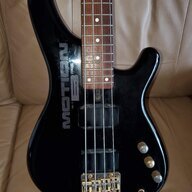
The originals did indeed have the Motion Logo printed on the body.

IIRC, only the Motion MB2 had the fine tuner bridge, which the 1 and 3 didnt have.

My MB 2 had a fantastic sound, easy to play, a tiny headstock, they weigh nothing, and were 32" scale, if memory serves

View attachment 1290943

No - I've got an MB-1 that I purchased in Osaka c. 1988 and it has the fine tuner bridge. No mods.

It's indeed a great instrument. I wouldn't part with it.
 
Not to revive a dead thread but indeed the first generation MB-1 and MB-2 had the fine tuning bridge while the MB-3 had a sort of Fender/Badass hybrid thick plate bridge.

I recently acquired an MB-1 that needs some fixing up - notably the fine tuning thumbscrews are missing (original Yamaha part number EX800680). The folks at Yamaha were kind enough to send me a PDF of the original service manual but there are no specs listed, and all the original parts are long out of stock.

Anyone out there know what the proper thumbscrew is? Presuming it’s metric it would be an M-type similar to the ones used in computer cases, which I could easily order online, but not sure of the diameter and length... prefer not to have to order a huge assortment to try them all :)
 
  • Like
Reactions: LABassJames and eee
Embarassing question. Recently started playing my '86 Yamaha Motion B after 20 years and after sitting in the garage for 20 years it need some work. New strings- its been so long im basically a noob again- I dont remember the specifics of what I used to get. There are so many different ones now. I know i used roundwounds, Blue Steel and Ernie Ball, dont remember what guage, any recommendations for alll-around strings for rock?
Also, i think its time for truss rod adjustment, as well as bridge height. Neck seems flat or even convex. Is a specific truss tool necessary and available anywhere? any advice?
 
Embarassing question. Recently started playing my '86 Yamaha Motion B after 20 years and after sitting in the garage for 20 years it need some work. New strings- its been so long im basically a noob again- I dont remember the specifics of what I used to get. There are so many different ones now. I know i used roundwounds, Blue Steel and Ernie Ball, dont remember what guage, any recommendations for alll-around strings for rock?
Also, i think its time for truss rod adjustment, as well as bridge height. Neck seems flat or even convex. Is a specific truss tool necessary and available anywhere? any advice?


If it's a 1986 Motion B, the truss rod adjustment is at the body end. I think it should take a standard Allen key but as it's Japanese you may need a metric set. Not sure which but on the basic keyring of keys I got from Canadian Tire there's usually one that fits.

Strings are really personal. If the current set on the bass are what you used to use, take it to a luthier and they can measure the size with calipers or specialized string gauge tools and recommend something. Most basses come from the factory with 45-100s or 45-105s.

Generally speaking: Roundwound will sound brighter, flats will sound smoother, and there are types called half-rounds or ground-rounds that are basically flattened roundwounds so they still retain more ping and brightness, but with a smoother feel.

Flatwounds will feel a lot stiffer. If you prefer to dig in or do string bends, you may prefer roundwounds.

For a prog rock (Yes?) or grindy modern rock (think Seattle sound) sound, roundwounds would be the pick. For old-school British blues / beat pop, flatwounds.

Remember of course that the MB series are medium scale. Don't put long scale strings on them, you'll be putting the speaking length of the string well past the nut.

Of the brands that are easiest to find in stores, D'Addario have the widest range of medium scale string types and gauges, but you can find a wider selection online. I have found Strings & Beyond carry a pretty massive selection. You can use the filters to search by gauge, string material, and string construction type: Search Results
 
If it's a 1986 Motion B, the truss rod adjustment is at the body end. I think it should take a standard Allen key but as it's Japanese you may need a metric set. Not sure which but on the basic keyring of keys I got from Canadian Tire there's usually one that fits.

Strings are really personal. If the current set on the bass are what you used to use, take it to a luthier and they can measure the size with calipers or specialized string gauge tools and recommend something. Most basses come from the factory with 45-100s or 45-105s.

Generally speaking: Roundwound will sound brighter, flats will sound smoother, and there are types called half-rounds or ground-rounds that are basically flattened roundwounds so they still retain more ping and brightness, but with a smoother feel.

Flatwounds will feel a lot stiffer. If you prefer to dig in or do string bends, you may prefer roundwounds.

For a prog rock (Yes?) or grindy modern rock (think Seattle sound) sound, roundwounds would be the pick. For old-school British blues / beat pop, flatwounds.

Remember of course that the MB series are medium scale. Don't put long scale strings on them, you'll be putting the speaking length of the string well past the nut.

Of the brands that are easiest to find in stores, D'Addario have the widest range of medium scale string types and gauges, but you can find a wider selection online. I have found Strings & Beyond carry a pretty massive selection. You can use the filters to search by gauge, string material, and string construction type: Search Results

Thanks, I figured out the truss, its 8 mm bolt, i fit a socket in there and was able to turn it with a screwdriver stuck at an angle in the ratchet side of the socket. Loosened it a half turn and got perfect neck relief, and adjusted bridge. fret buzz completely gone. Ordering a set of DR Sunbeams I think.
 
If it's a 1986 Motion B, the truss rod adjustment is at the body end. I think it should take a standard Allen key but as it's Japanese you may need a metric set. Not sure which but on the basic keyring of keys I got from Canadian Tire there's usually one that fits.

Strings are really personal. If the current set on the bass are what you used to use, take it to a luthier and they can measure the size with calipers or specialized string gauge tools and recommend something. Most basses come from the factory with 45-100s or 45-105s.

Generally speaking: Roundwound will sound brighter, flats will sound smoother, and there are types called half-rounds or ground-rounds that are basically flattened roundwounds so they still retain more ping and brightness, but with a smoother feel.

Flatwounds will feel a lot stiffer. If you prefer to dig in or do string bends, you may prefer roundwounds.

For a prog rock (Yes?) or grindy modern rock (think Seattle sound) sound, roundwounds would be the pick. For old-school British blues / beat pop, flatwounds.

Remember of course that the MB series are medium scale. Don't put long scale strings on them, you'll be putting the speaking length of the string well past the nut.

Of the brands that are easiest to find in stores, D'Addario have the widest range of medium scale string types and gauges, but you can find a wider selection online. I have found Strings & Beyond carry a pretty massive selection. You can use the filters to search by gauge, string material, and string construction type: Search Results
Hey Hooky,

I am looking at buying a Yamaha Motion on line right now. The guy selling it says the pots need to be cleaned. He is asking $400 Canadian, would you say that is a fair price?

Their isn't much info this bass online other than this thread!

Thanks for your time
J
 
Hey Hooky,

I am looking at buying a Yamaha Motion on line right now. The guy selling it says the pots need to be cleaned. He is asking $400 Canadian, would you say that is a fair price?

Their isn't much info this bass online other than this thread!

Thanks for your time
J

No worries. Depends on the model and condition. If you want to post or PM me some more info and pics I can help more.
 
Embarassing question. Recently started playing my '86 Yamaha Motion B after 20 years and after sitting in the garage for 20 years it need some work. New strings- its been so long im basically a noob again- I dont remember the specifics of what I used to get. There are so many different ones now. I know i used roundwounds, Blue Steel and Ernie Ball, dont remember what guage, any recommendations for alll-around strings for rock?

Just wanted to add: I'm using D'Addario Chrome flats 45-100 on my MB2. I love this bass. Besides the ease of playing it sounds huge and fat, plenty of mids and clarity in the mix. Great basses.
 
Any chance anyone has found a drop in pickup replacement? I was struggling to find the right ones to fit in :(

Thanks in advance!

Alas, they are a unique shape. There are some Bartolini soapbars that should fit in the cavity but none that are an exact match.

If you really want an exact match, maybe find a local fab workshop that can measure your existing ones and 3D print new shells, and then you can find a pickup maker to install new coils. Or make new shells from wood via CNC or hand carving etc.

I found some files to print new shells for my Ibanez Roadstar’s dead Super J6/J5, which I had done at Shapeways, then the team at Nordstrand installed NJ4 coils inside.
 
  • Like
Reactions: kraken_kr