FWIW:
for starters I'm no guru with this stuff. David, Dharmabass (engineer) and others have a lot more grip on component function, how and the whys, etc. I'm just an isolate the component, common sense, trial and error guy.
The first thing to do is isolate the problem to the bass for a fact - which sounds like it's been done, but that's paramount. You need to know your trying to fix somethng that's broke and not breaking something that's fixed. That includes location. Does the bass make the racket no matter where or what it's played through or is it just in that room? Electronics do very wierd things. Are you using the same cord all the time or one for the 6 and another for the 5? Cords are a problem more often than a bass. Definetly make sure the cord's not a source.
In the bass itself moving components are by far the most common problem areas - the jack in particular but also the battery clip, switches, and pots on occassion. I would definetly wiggle each terminal on the jack and see if there's any slop there. Also, that's one funky looking battery. Do you know for a fact the battery is up to snuff? Most passive by-passes only cut the hot leg to the preamp so you're still connected to the electronics/battery through grounding which means the passive mode could still be affected.
The bass of that bay is shielded so anything metal is automatically grounded (including hot leads) and any grounds between the pots are redundant and unnecessary. Probably the reason they didn't shield the sides is they feared the pot lugs close to the wall would short out. I always throw a strip of electrical tape beneath the lugs of each pot and on the wall anywhere near a hot lug. Which brings to mind that some switches aren't to be grounded for whatever reason but that switch is probably grounded by the shielding. Make sure none of the leads going to the switch are hitting the metal casing.
When I check for continuity I just set the meter on 1k ohms, cross the leads to check for the reading to make sure it's working and to know what the most I can expect is. I guess ideally the reading should be 0 (no resistance) but I ususually have some for whatever reason.
If you get zip between the bridge and jack, then the bridge wire should be fine. A properly grounded bass should result in touching the strings decreasing the hum to the point of killing it altogether. If hum increases when the strings are touched that's a red flag of improper grounding somewhere. Some active electronics (primarily EMG) don't connect a bridge wire cause it's unnecessary for quiet operation and it's a shock hazard.
I touch the meter pot to pot and pot to shield, jack to bridge, switch to shield and switch to pot. They should all give me the same reading I got crossing the meter leads (if the switch is grounded). To check bare pots out of the bass or to determine how a switch works, I use the same setting and connect the leads to each possible combination of terminal connections with the switch in each position. For pots, I connect the postive lead to the center lug via alligator clips leads and the negative to the outside lugs one at a time. Each time rotating the pot from off to max and observing the meter arm for travel. There should be a smooth, responsive, and appropriate transition as the pot stem is turned back and forth. I prefer the cheap meters with arms that I can see move to the more expensive digital meters that just give you a number.
Does a 0 reading mean all grounds are fine? In my experience to date - yes, if the meters fine and checks were done properly. But it's very easy to think you're touching one place with the meter probes when you may not or you may be touching that AND something adjacent to it (which is properly grounded).
I doubt the blend is the problem. Usually their wired similarly but not always. Typically the 4 perimeter lugs have tiny wires attached in an X patter but I've seen them wrapped around the pot cause it's easier to do. Blend backs are typically open in the center unless they're ganged pots and from what I can tell from your pic the second pot from the left is the blend.
Looking at that control bay is one reason I've gone straight to jacks with no onboard controls but that is a very well done wiring job for all the junk it contains.
My approach for onboard electronic trouble shooting is to first run the pups straight to the jack. If the problem is present then it's in the pups or jack (or battery/clip if active pups). If the problem is not present then you know it's somewhere in the harness or something in the way the harness interacts with the pickups. Next I remove the active components from the harness and run the pups through the passive harness. If the problem is present it's in the pots/switch/connections. If not, the pups and harness are fine - that leaves the active components. The only way I know to check active modules is to remove them or replace one with a known working unit or equivalent.
I had a Tobias harness with buffer, pre, and mid that was distorting and when I removed the buffer, it was fine. It seems like a hassle to gut and start from scratch but it's a lot faster, easier, and more effective in the long run than a hit or miss approach with the components in the bass.
Does decreasing the gain to 0 with the problem still present indicate the pre is fine. I wouldn't rule out the pre till it's in the circuit and there's no problem. A better indication to me the pre is ok is you get the same problem in passive mode which it implies it's something common to both circuits. Short of abuse and design error, pre's a pretty fault free till they get about 10 years old it seems.
I always remove the entire harness from the bass and mount it to a piece of cardboard to do any trouble shooting. Trying to work in the bass is asking for grief, poor connections, and inadvertantly melting wires with the iron. Even so, if the bass uses a flush mount jack (like yours), you still have to wire the jack connections in the bass (which I will usually do first while laying the harness on the back of the bass then drop the harness in after the jack is complete). Wire lengths should be no longer than necessary but I leave slop for flush mount jacks so the harness is completely out of the way so I have an unobstructed approach to soldering the jack.


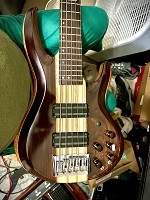

 lurknfur???


