

Incorrect. Fender has protected the trademarks associated with its headstock and logos over the years, and still maintains the trademarks. It failed to protect certain of its body shapes, and those have become generic, which is why you see plenty of Fender knock-offs with Fender-style bodies but different headstock designs.
Here is one example of a recent successful lawsuit by Fender enforcing the trademark on its headstock design: https://www.govinfo.gov/content/pkg...v-01075/pdf/USCOURTS-tnmd-3_13-cv-01075-2.pdf
They successfully sued and won because the defendant violated a consent order they previously signed with Fender
The parties came to an agreement and entered into a Confidential Settlement Agreement ("Agreement"). In the Agreement, Swade agreed to "completely cease using . . . any trademark, service mark, name, logo, design, source designation, or identifying characteristic of any kind that is a copy, reproduction, colorable imitation, or simulation of or confusingly similar to, or in any way similar to" Fender's Telecaster and Stratocaster headstock designs. (Docket No. 120 at 6) (emphasis added). This Agreement was incorporated into a Final Judgment and Permanent Injunction on Consent Order entered by this Court. (Docket No. 94). In the Permanent Injunction, the Court also expressly retained jurisdiction over the matter in order to enforce any violations of the Agreement.
Fender argues that the designs on the bottom—Swade's new, redesigned headstocks— violate section 2C of the Agreement: that Swade will not use characteristics "in any way similar to" Fender's Telecaster and Stratocaster headstocks.
Which doesn't sound like they actually proved their trademark violation complaint in court. More like they got the defendant to cave and had the court bless off on the agreement, which they also took the precaution of making confidential.
Which raises the interesting question as to why they'd want the agreement to remain confidential. Wouldn't it make far more sense to publicize it widely as a warning to discourage anyone else from thinking about doing (or continuing to do) the same? ( I can think of two reasons they'd want it kept quiet. Smarter people than me can probably think of several more.)
But this was also pretty clear case of the plaintiff agreeing to not do something which they later did. So I can't sympathize at all with them getting bit. Regardless of what you may think about an agreement, you made, you'd better stand by it or expect to face the consequences. Especially of a court gets involved.




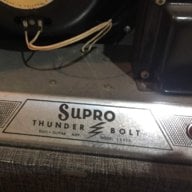
 Yup, a close friend of mine is national procurement manager for a large American corporation. At last count he had six very nice guitars and three very nice amps sitting in his office, totaling around 50K retail. This is a guy who can just barely manage a barre chord, but he enjoys his gear!
 But after brushing shoulders with a few hundred of my comrades, I understand the colloquial lament.


