
Enjoy the benefits of a premium membership!
Upgrade Account
-
TalkBass has been independent since 1998. Add your voice.
Create a free account to reply to discussions, view embedded media, and browse with fewer display ads.
Join free Log in
Want zero display ads or expanded classifieds tools? Compare plans.
You are using an out of date browser. It may not display this or other websites correctly.
You should upgrade or use an alternative browser.
You should upgrade or use an alternative browser.
Your thoughts on the G&L bridges?
- Thread starter RAZubieta
- Start date
More options
Who Replied?
Honestly, there isn't a whole lot of difference in 95% of the bridges out there. They do what they're designed to do which is hold the strings in place and allow for adjustment and intonation. The majority of designs aren't better or worse than any others, just different. Incorporating designs like quick release and string thru capability are just more options.
The G&L bridge is nice and solid and does the job. I honestly didn't see THAT much of a difference with the saddles locked vs. not. As far as vs. Musicman or Fender, it's more substantial than the Fender so some may feel it adds some sustain though I'm not 100% sure it's weighs enough to make a difference like a BadAss II, but vs. the Musiman, really it's just a matter of looks, not functionality or sound improvement.
The G&L bridge is nice and solid and does the job. I honestly didn't see THAT much of a difference with the saddles locked vs. not. As far as vs. Musicman or Fender, it's more substantial than the Fender so some may feel it adds some sustain though I'm not 100% sure it's weighs enough to make a difference like a BadAss II, but vs. the Musiman, really it's just a matter of looks, not functionality or sound improvement.
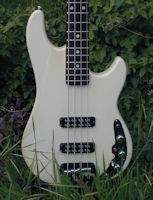
Difference #1:
The G&L bridge is more massive than either the Fender or the MusicMan items. Massive is good. It helps to provide a solid foundation upon which to mount one end of the string. The MusicMan bridge is also fairly massive, but not as massive as the G&L item. Fender's is a simple piece of bent steel.
Difference #2:
The Saddle lock screw physically squeezes the saddles together and further squeezes them as a unit into the bridge structure. This directly couples the strings' vibration to the bridge and allows the strings to sustain as long as most "string-thru-body" designs. MusicMan bridges have heavy posts on either side of the saddles, but they only locate the saddles and provide no real saddle-to-bridge coupling. The Fender bridge has nothing here.
Difference #3:
The G&L bridge has a cast-in extension that fits snugly into a body rout. This extension helps to transmit the vibration of the strings into the body. MusicMan bridges have heavy posts that use machine inserts on either side of the saddles to provide coupling, which is nearly as effective as G&L's extension and body rout. The Fender bridge has nothing here, as it's a flat piece of metal screwed down onto the body.
Summary
All three of these bridge types contribute to the sound of their respective instruments. They reflect what their manufacturers believe is best for the sound they are after. If you put a G&L bridge on a Fender, you'll lose the Fender sound and vice-versa.
Ken...
The G&L bridge is more massive than either the Fender or the MusicMan items. Massive is good. It helps to provide a solid foundation upon which to mount one end of the string. The MusicMan bridge is also fairly massive, but not as massive as the G&L item. Fender's is a simple piece of bent steel.
Difference #2:
The Saddle lock screw physically squeezes the saddles together and further squeezes them as a unit into the bridge structure. This directly couples the strings' vibration to the bridge and allows the strings to sustain as long as most "string-thru-body" designs. MusicMan bridges have heavy posts on either side of the saddles, but they only locate the saddles and provide no real saddle-to-bridge coupling. The Fender bridge has nothing here.
Difference #3:
The G&L bridge has a cast-in extension that fits snugly into a body rout. This extension helps to transmit the vibration of the strings into the body. MusicMan bridges have heavy posts that use machine inserts on either side of the saddles to provide coupling, which is nearly as effective as G&L's extension and body rout. The Fender bridge has nothing here, as it's a flat piece of metal screwed down onto the body.
Summary
All three of these bridge types contribute to the sound of their respective instruments. They reflect what their manufacturers believe is best for the sound they are after. If you put a G&L bridge on a Fender, you'll lose the Fender sound and vice-versa.
Ken...


Chef
In Memoriam
Ken did a nice job with the technical aspects. I just know when I see a G&L bass, one of the most distinctive characteristics is the bridge. Distinctive is good. And solid is good, too ! It's a good bridge in many respects.


The G&L bridge is definitely more massive than Fender bridges, but two points about the latter: (1) the U.S. Fenders usually have through-body stringing option, which in theory should provide greater bridge/body coupling; and (2) the new American Standards have a higher mass bridge that's more than just the old bent steel, and is similar to a Gotoh 201.
Chef
In Memoriam
Alright thanks guys I was just wondering if it might be something to replace in the future in case I wanted to upgrade the bass but it seems like its already a good bridge.
There's a great market for 3rd party stuff to upgrade Fender basses: pickups, bridges, electronics, and such. There's even a bit of a market for MusicMan replacement parts; notably pickups. But you just don't see that market for G&L basses. Granted, the target is smaller than Fender or EBMM, but the question usually ends up to be, "Why?" or, "To what?"
Yeah, they're that good. Leo, that great tinkerer, certainly got it right.
Ken...

Must the old adage really be repeated here? Yes, I think so. *ahem* mi-mi-mi-, la-la-la...*cough*...ahem...
"If you want a great Fender bass, get a G&L."
There, I said it.
"If you want a great Fender bass, get a G&L."
There, I said it.
The G&L bridge has a cast-in extension that fits snugly into a body rout. This extension helps to transmit the vibration of the strings into the body.
Isn't this more or less how an Alembic is built?
Isn't this more or less how an Alembic is built?
Dunno. And no Alembic owner in his right mind wouldn't let me near his bass for myevil experiments!
Ken...

One of the very best, IMO.
Even tho the fivers could use a few more anchor screws, eh?

Like Ken says, there really is no upgrade for a G&L bridge. Definitely one of the best looking bridges, to boot.
Chef
In Memoriam
Uh...yeah...there was that one thing...
Even tho the fivers could use a few more anchor screws, eh?
]

I have always wondered why (other than low production cost) traditional bridges, i.e. fender, were made so lightly. I wonder if the G&L bridge is significantly more stable than the older style fender bridges? Has anyone had a fender snap its bridge due to flexing and work hardening of the metal?


The Saddle lock screw physically squeezes the saddles together and further squeezes them as a unit into the bridge structure. This directly couples the strings' vibration to the bridge and allows the strings to sustain as long as most "string-thru-body" designs.
The G&L bridge has a cast-in extension that fits snugly into a body rout. This extension helps to transmit the vibration of the strings into the body.
I dont quite get this concept though I see it posted a lot. And truly I am not trying to be picky. From a physical perspective I think the less of the string energy that is transferred into the body of the instrument, the more sustain you have. Since the pickup will only create signal proportional to the metal string moving, if energy (or vibration) is transferred into the body, in theory sustain of the string in motion is lost.
I think the G&L bridge does help sustain but for a different reason. The screw squeezing the saddles together and against the bridge prevents loss of string energy due to the saddles moving. On a typical Fender the saddles essentially float and I they definitely move with the string to some degree. MM bridges are something in between Fender and G&L. On a side note I have always thought string through body was a wash or if anything a disadvantage.

When you are done setting the bridge, and you have tightened the locking screw, go back over the height adjusters and snug up any that might be slightly loose. The pieces may have shifted slightly as they are forced together by the locking screw.
A quick check for tightness when you are done will ensure that there is good coupling between the bridge pieces and the base plate.
A quick check for tightness when you are done will ensure that there is good coupling between the bridge pieces and the base plate.


