• TalkBass has been independent since 1998. Add your voice.
    Create a free account to reply to discussions, view embedded media, and browse with fewer display ads.
    Join freeLog in
    Want zero display ads or expanded classifieds tools? Compare plans.

Your thoughts on the G&L bridges?

I dont quite get this concept though I see it posted a lot. And truly I am not trying to be picky. From a physical perspective I think the less of the string energy that is transferred into the body of the instrument, the more sustain you have. Since the pickup will only create signal proportional to the metal string moving, if energy (or vibration) is transferred into the body, in theory sustain of the string in motion is lost.

This is true. If "heavier mass" = "good sustain," and "vibration transferring to the wood" = "good tone" then the two are mutually exclusive. Transferring vibration to the wood 100% absolutely does lower sustain. It's just simple science.

That said, how much sustain do you really need? I've never had to hold out a note nearly as long as my bass can sustain one. And how much does transferring vibration to the wood help tone? Entirely debatable.
 
That said, how much sustain do you really need? I've never had to hold out a note nearly as long as my bass can sustain one. And how much does transferring vibration to the wood help tone? Entirely debatable.

I agree. One way or the other I think the G&L bridge is an improvement over Fender and MM. And if aesthetics count I think they look pretty cool too.

 
I dont quite get this concept though I see it posted a lot. And truly I am not trying to be picky. From a physical perspective I think the less of the string energy that is transferred into the body of the instrument, the more sustain you have. Since the pickup will only create signal proportional to the metal string moving, if energy (or vibration) is transferred into the body, in theory sustain of the string in motion is lost.

I think the G&L bridge does help sustain but for a different reason. The screw squeezing the saddles together and against the bridge prevents loss of string energy due to the saddles moving. On a typical Fender the saddles essentially float and I they definitely move with the string to some degree. MM bridges are something in between Fender and G&L. On a side note I have always thought string through body was a wash or if anything a disadvantage.


I'm undecided on this one. I love the G&L bridge & see no need for improvement. I tend to think that the saddle-lock design allowed for more cross-string harmonics, especially at gigging volumes. On the other hand, I had the pleasure to play a Hamer 2Tek jazz-style back in the late '90s. That was one of the most harmonically-rich and easiest-playing basses I've ever strapped on. The harmonics on that bass seemed to be centered on the string that you were fingering. Very impressive bass.

 
I'm undecided on this one. I love the G&L bridge & see no need for improvement. I tend to think that the saddle-lock design allowed for more cross-string harmonics, especially at gigging volumes. On the other hand, I had the pleasure to play a Hamer 2Tek jazz-style back in the late '90s. That was one of the most harmonically-rich and easiest-playing basses I've ever strapped on. The harmonics on that bass seemed to be centered on the string that you were fingering. Very impressive bass.


you have a good point and the bridge is not the only way to get good sustain and harmonics on a bass, there are many other factors that go into it, its not just the bridge that helps with that, its just one of many things.
 
Great thread! I particularly liked the relatively quantitative comparison between G&L, MM, and Fender bridges.

I disabled my saddle lock by removing the small plastic piece that pushed the saddles together. On my bass (L2500), the B string lost a significant level of output & sounded pinched with the saddles locked. I string through the body & it sounds phenomenal.

In terms of a locking bridge, I know they are different beasts, but any thoughts on a comparison between the G&L locking bridge design and the SPECTOR locking bridge design? That is also a counter-sunk high mass bridge with a locking saddle design? I imagine that the SPECTOR design might actually be better w.r.t vibration transfer into the wood given the vibrational losses along the screw shaft for the G&L design compared with only the saddle on the Spector design. Of course, the neck and body / string length designs are also different, so a direct comparison may not be appropriate. Any thoughts are appreciated.

Best,

imp.
 
That said, how much sustain do you really need? I've never had to hold out a note nearly as long as my bass can sustain one.
Maybe it's for those people that like to play drone notes for several bars, though effects can help in that area.

The G&L bridge is one of the most solid and easiest to work with bridges I have ever used. Much easier to work with than my old Rickenbacker.
 
I dont quite get this concept though I see it posted a lot. And truly I am not trying to be picky. From a physical perspective I think the less of the string energy that is transferred into the body of the instrument, the more sustain you have. Since the pickup will only create signal proportional to the metal string moving, if energy (or vibration) is transferred into the body, in theory sustain of the string in motion is lost.

True, but look at it from the standpoint of the string having an exceptionally strong anchor. That strong anchor allows the string to ring and decay at its own pace, rather than its pace affected by damping from a relatively weak anchor.

I think the G&L bridge does help sustain but for a different reason. The screw squeezing the saddles together and against the bridge prevents loss of string energy due to the saddles moving.

And then carry that to a solid mount to the body.

.... On a side note I have always thought string through body was a wash or if anything a disadvantage.

Agreed, if the bridge is of good design and anchored well to the body. Sometimes string-thru is required, sometimes recommended (G&L 5'ers), and sometimes it makes a notable difference in the tone.

Of course, YMMV.

Ken...
 
I own a couple of L2500s, one USA and the other Tribute (Indo). The Trib is my #1 currently.

But I'm not sold on any particular bridge design. I hear and read claims about the advantages of having the saddles all up together and tight so it helps sustain, but what about those designs that tout the complete opposite, that is, individual separate bridges for each string, like on Ibanez BTBs (of which I own one), Yamahas, others? So that other strings don't "influence" each other? In some ways I have to just chalk it up to marketing efforts.

Bottom line really ends up being, each instrument line, and even each individual sample of an instrument, ends up having its strengths or weaknesses, based on the consistency of the total package.
 
True, but look at it from the standpoint of the string having an exceptionally strong anchor. That strong anchor allows the string to ring and decay at its own pace, rather than its pace affected by damping from a relatively weak anchor.

Ah yes I hear what you are saying. Good point!

So why is string-through recommended for 5ers? With the exception of string-through being the only option, when would it be required? I had some Labella flats once and the E broke instantly when I went through the body due to the break angle. It was on a Fender though.
 
So why is string-through recommended for 5ers? With the exception of string-through being the only option, when would it be required?

It's recommended on some 5 strings because it can help with sustain, or at least give that perception.

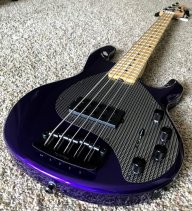
On G&Ls. The bridge is technically thru-bridge capable (the holes are there), but two #10 wood screws are NOT enough to hold the beast down for the long haul - especially if high tension strings are used.

I'd really like to see G&L adopt something similar to EBMM, where the outer screws are fine thread machine bolts going into inserts.

I had some Labella flats once and the E broke instantly when I went through the body due to the break angle. It was on a Fender though.

I've read where some folks have problems with certain flats for that very reason. Fender thru-bodies do seem to have a sharp break, but they can't be the only ones. The issue would go away if the manufacturers angled the holes such that the ferrules were closer to the butt of the instrument, but this would require 35" scale strings on 34" scale basses.

Ken...
 
You know I agree with that, said the guy who's bridge ripped off.
Yep, G&L fixed it; but it shoulda never happened.
One could also argue threaded inserts would sonically couple the bridge better as well as actually keeping it affixed to the instrument..
The bridge is technically thru-bridge capable (the holes are there), but two #10 wood screws are NOT enough to hold the beast down for the long haul - especially if high tension strings are used.

I'd really like to see G&L adopt something similar to EBMM, where the outer screws are fine thread machine bolts going into inserts.

Ken...
 
You know I agree with that, said the guy who's bridge ripped off.
Yep, G&L fixed it; but it shoulda never happened.
One could also argue threaded inserts would sonically couple the bridge better as well as actually keeping it affixed to the instrument..

I remember seeing a picture you posted of that. It made me shudder a bit...
 
Has anyone experimented with putting a tapered bolt thru the ferrules? They are tapered holes so it looks like it would work, if you could get a nut small enough to fit thru the ferrules.

Not a huge deal for me, as I have found strings that work fine thru the body, but it looks like it could work, although I 'aint no luthier.
 
I recently purchased an L2500, the problem was that when I lowered the action to how I liked it the screws were too short to get the intonation correct on some of the strings.
The threads were of a US type 32 per inch luckily a friend of mine had a die and was able to make me some replacement screws.
This is the first time I've ever encountered such a problem on any Bass I've owned over 46 years of playing.
 
But I'm not sold on any particular bridge design. I hear and read claims about the advantages of having the saddles all up together and tight so it helps sustain.

I was talking to my local Luthier about sustain on Bass; he asked me to play any of the basslines in my bands repertoir and then point out to him where sustain was needed.

He said it was a bit like the days of CB radio; if you'll pay another fiver they'll put on another switch.
 
  • Like
Reactions: Alex-Thompson