
Enjoy the benefits of a premium membership!
Upgrade Account
-
TalkBass has been independent since 1998. Add your voice.
Create a free account to reply to discussions, view embedded media, and browse with fewer display ads.
Join free Log in
Want zero display ads or expanded classifieds tools? Compare plans.
You are using an out of date browser. It may not display this or other websites correctly.
You should upgrade or use an alternative browser.
You should upgrade or use an alternative browser.
Zero fret question
- Thread starter Mahataru
- Start date
More options
Who Replied?

People have been known on occasion to use one size taller, but I never understood a justification for it. I think it is more common to use the same size. I did, and with 22 months of regular use, I have had no fret wear on the zero fret.

People have been known on occasion to use one size taller, but I never understood a justification for it. I think it is more common to use the same size. I did, and with 22 months of regular use, I have had no fret wear on the zero fret.
pilotjones,
Just curious, did you level your zero fret as well?
I can't justify it either, but I tried using one size taller for the zero fret, and the result was amazing. I could achieve a very low action (around 6/64th of an inch on the 17th fret) without buzz. Lower than I could get if I used the same size.
Do you have any ideas?

I didn't level any of the frets. The board had been very well leveled before fret insertion (very easy on a flat board!), and after fretting I got a very nice action, so it wasn't needed. But the intent was to go across all the frets for leveling.pilotjones,
Just curious, did you level your zero fret as well?
See, that's the thing that makes no sense to me. If you have either a high zero fret, or (in a non-zero-fret build) a nut that's cut higher than the fret heights, then if you have it set up to where it's nearly buzzing on the open strings, then it should BE buzzing as soon as you play on the frets.I can't justify it either, but I tried using one size taller for the zero fret, and the result was amazing. I could achieve a very low action (around 6/64th of an inch on the 17th fret) without buzz. Lower than I could get if I used the same size.
Do you have any ideas?
What does make sense to me is that all the frets be level while the board is level, and then when the relief forms under string tension, this is effectively adding a tiny amount of additional height to each fret, all the way down the board--not just in one place for one fret in particular.
- Jul 1, 2005
- 4,291
- 21,932
- 79
- Disclosures
- CataldoBasses: Designer/Builder ThunderBuckerPickups:Consultant
According to Dan Erlewine (and all the zero fret basses I've seen, including John Entwistle's Status Graphite Buzzard) the zero fret should be slightly taller than the others. It basically replaces the nut which becomes just a string guide. The Reason for a zero fret is so that open strings have the same sound as fretted ones since all notes are 'fretted'. Entwistles basses had a brass nut to boot.
With lots of relief and high action I guess you could get by with the zero fret the same height but for a dead flat zero relief neck (with a perfect fret job) the only way to get the action super low is with a taller zero fret. BTW, Entwistle's Statii had very large radius necks with no trussrod that were dead flat under tension. Unnecessary in a carbon fiber neck with phenolic board, on his basses anyway.
Google "zero fret Dan Erlewine" if you want more info from a highly respected source- which I ain't!
With lots of relief and high action I guess you could get by with the zero fret the same height but for a dead flat zero relief neck (with a perfect fret job) the only way to get the action super low is with a taller zero fret. BTW, Entwistle's Statii had very large radius necks with no trussrod that were dead flat under tension. Unnecessary in a carbon fiber neck with phenolic board, on his basses anyway.
Google "zero fret Dan Erlewine" if you want more info from a highly respected source- which I ain't!

- Jun 6, 2004
- 6,351
- 543
- 66
- Disclosures
- Owner and builder Clementbass
I use the same size but stainless wire and when I level the frets I don't level it. Just what I do......
What does make sense to me is that all the frets be level while the board is level, and then when the relief forms under string tension, this is effectively adding a tiny amount of additional height to each fret, all the way down the board--not just in one place for one fret in particular.
What you said was exactly my logic. However, that way, what i noticed was, the additional height gained (from the relief) gradually increased, the closer you move to the heel direction.
This is the point where I thought that extra height from a higher size zero fret would help (I slotted the nut lower than the zero fret).
What i found, I can set up my neck perfectly straight (tiny bit of relief), the gap between the strings and the frets are much more even across the fretboard.
I have been trying to find a justification whether this is the right thing to do, but so far, I haven't found any.
I might have to try it again and see whether I will get a consistent results.
- Jul 1, 2005
- 4,291
- 21,932
- 79
- Disclosures
- CataldoBasses: Designer/Builder ThunderBuckerPickups:Consultant
Honestly, I' don't accept that justification. If you were to accept that the zero or nut must be higher than the 1st, it follows that the 1st must be made higher than the 2nd, et cetera, on up the board. If not, the setup falls apart once you fret a note.
THE ZERO FRET IS NOTHING BUT A NUT WITHOUT SLOTS. It has exactly the same effect on a setup as a nut.
With properly leveled frets and correct relief:Too high and intonation will be sharp on the first few frets. Too low and the first fret will buzz. Once you understand that a zero fret is nothing more than a nut without slots it's easy to visualize how it works and why if it is higher than the first fret it doesn't effect any other frets.
I have been trying to find a justification whether this is the right thing to do, but so far, I haven't found any.
As I said Google 'zero fret Dan Erlewine'. You'll eventually find a better explanation than I can give. But IMO, you and Tom Clement are doing it correctly.
THE ZERO FRET IS NOTHING BUT A NUT WITHOUT SLOTS. It has exactly the same effect on a setup as a nut.
With properly leveled frets and correct relief:Too high and intonation will be sharp on the first few frets. Too low and the first fret will buzz. Once you understand that a zero fret is nothing more than a nut without slots it's easy to visualize how it works and why if it is higher than the first fret it doesn't effect any other frets.
This was the base thought of why I made the changes.
As I said Google 'zero fret Dan Erlewine'. You'll eventually find a better explanation than I can give. But IMO, you and Tom Clement are doing it correctly.
Sorry, I obviously didn't read your previous comment carefully

I will google it.
Thanks.
THE ZERO FRET IS NOTHING BUT A NUT WITHOUT SLOTS. It has exactly the same effect on a setup as a nut.
With properly leveled frets and correct relief:Too high and intonation will be sharp on the first few frets. Too low and the first fret will buzz. Once you understand that a zero fret is nothing more than a nut without slots it's easy to visualize how it works and why if it is higher than the first fret it doesn't effect any other frets.
This was the base thought of why I made the changes.
As I said Google 'zero fret Dan Erlewine'. You'll eventually find a better explanation than I can give. But IMO, you and Tom Clement are doing it correctly.
Sorry, I obviously didn't read your previous comment carefully
I will google it.
Thanks.
Last edited:
Except that I would cut the nut to the same height as the frets for that exact reason. Please don't yell.
Putting it higher is inviting the common problem of notes being sharp on the first few frets.
Putting it higher is inviting the common problem of notes being sharp on the first few frets.
- Jul 1, 2005
- 4,291
- 21,932
- 79
- Disclosures
- CataldoBasses: Designer/Builder ThunderBuckerPickups:Consultant
Except that I would cut the nut to the same height as the frets for that exact reason. Please don't yell.
Putting it higher is inviting the common problem of notes being sharp on the first few frets.
Not exactly sure how you do a proper setup without leveling frets. Also your theory of the necessity of "increasing fret heights" with a high zero fret is puzzling since a properly cut nut and a zero fret are the same height. Also how a slightly higher zero fret would cause buzzing. Once you fret a note the nut/zero fret have no effect on buzzing. Intonation, yes.
By 'slightly higher' I mean around .005 inch. That is not enough to cause intonation problems.
There is much information available relating to the proper height of a zero fret. All of it that I've seen says it should be higher than the other frets. Of course that is also the recommendation for nut slot heights.
I apologize for yelling.
If the board is in proper form, and the fretwire is consistent in height, and the fretwire is installed uniformly, then the proper surface of the board would telegraph out to become a proper surface at the tops of the fret wires. And would not require leveling, because it is already level.Not exactly sure how you do a proper setup without leveling frets.
which, to my mind, are both the the same height as the frets.Also your theory of the necessity of "increasing fret heights" with a high zero fret is puzzling since a properly cut nut and a zero fret are the same height.
The reason for producing buzzing would be because having an artificially high nut would allow you to set the bridge saddle too low for use with the "regular frets," and still not buzz on the open string.Also how a slightly higher zero fret would cause buzzing. Once you fret a note the nut/zero fret have no effect on buzzing. Intonation, yes.
Buzzing is caused by the vibrating portion of a string contacting intermediate frets when it shouldn't. This is governed by the distance from the string to any given fret, and of course the string displacement due to the vibration. This distance is a product of the accuracy of fret installation and/or leveling, the relief curvature of the neck, and the bridge saddle height. Plus, for open strings only, the added height of a high zero fret or nut slot, if this has been done.
Imagine a fretboard with level fret tops, and a well-functioning amount of both relief and bridge saddle height. Imagine fretting at the 3rd fret. The combination of relief, bridge saddle height, and the degree of sting vibration (forming an string arc of maximum displacement) is producing a good vibration, with no buzz. Let's say it is at a "best/lowest" setup--where lowering the saddle any more, or decreasing the relief would produce buzz, with the string most likely striking the fourth fret.
Now imagine moving the fretting back to the 2nd fret. Due to the good setup, we also have a nearly buzzing, but still good setup. This is with the 2nd fret being the same height as the 3rd fret.
Now imagine moving the fretting back to the 1st fret. Due to the good setup, we also have a nearly buzzing, but still good setup. This is with the 1st fret being the same height as the 2nd and 3rd frets.
Now imagine moving the fretting back to the 0 fret or nut. Due to the good setup, we also have a nearly buzzing, but still good setup. This is with the 0 fret or nut being the same height as the 1st, 2nd and 3rd frets.
It makes sense. And if this were a Kubicki Ex Factor, you can take that back to the -1 and -2 frets up on the headstock.
Likewise, we can follow failure of the opposite logic. If successfully stopping the string at the 0 or nut requires an extra .005 in order to to not buzz against the 1, 2, 3 etc., then it follows that if we fret at the 1, then the 1 is going to need an extra .005 or so above the 2, 3, 4 etc. in order to to buzz; the 2 requires an extra .005 or so above the 3, 4, 5 etc.--but this clearly is not the case. Another way to state this is to say that if a guitar requires the nut to be cut an extra .005 high, then using a capo requires the guitarist to install a .005 shim on the new "temporary end fret" every time he uses a capo. This is also clearly not true.
In short, there has to be a justification for extra height at the 0 or nut, due to some uniqueness in that area. I know of none. In fact, the function of a zero fret as opposed to a nut is to make just like the other frets. Therefor, it makes sense to make it just like the other frets.
Last edited:

A zero fret functions exactly like a nut. Yes. We understand that. What you're missing, dadogabai, is that a zero fret ALSO functions exactly like any other fret.
- Jul 1, 2005
- 4,291
- 21,932
- 79
- Disclosures
- CataldoBasses: Designer/Builder ThunderBuckerPickups:Consultant
A zero fret functions exactly like a nut. Yes. We understand that. What you're missing, dadogabai, is that a zero fret ALSO functions exactly like any other fret.
Nope, a zero fret has continuous contact with the string, none of the others do.
On a neck with no relief and super low action a higher zero fret or nut slot depth is required to eliminate buzzing. I set my personal action at 1mm (.04 inch, less than 1/16 ) at the 12th fret E string. Nut or zero fret at .005 above the others.
A nut or zero fret at the same height as the (other) frets requires what I consider excessive relief or an uneven action from top to bottom of the neck as shown in the bottom example.
Take a look at your do diagrams, and imagine the string redrawn to be as it would be when fretting at the first fret.Nope, a zero fret has continuous contact with the string, none of the others do.
On a neck with no relief and super low action a higher zero fret or nut slot depth is required to eliminate buzzing. I set my personal action at 1mm (.04 inch, less than 1/16 ) at the 12th fret E string. Nut or zero fret at .005 above the others.
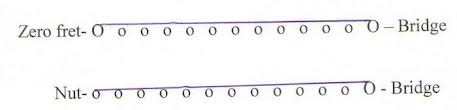
The two will be identical from that 1st fret on up. Same action, and same not buzzing. But, somehow the 1st fret does not require extra height above the 2nd, and it works.
Likewise, up the neck.
Therefor, there was no need to raise the 0 fret in the first place. It's just another fret.
Again, if 0 frets had to be raised, Kubickis would not be playable.
I and others will attest that this is not true. I've got a nice low action, with no buzzing, and my 0 fret is even with the others. I adjust my truss rod twice a year, and that's it -- and when the TR needs adjusting because the action has gone low, I get equal buzzing on all the frets until it is adjusted, not any extra buzz at the 0 fret.A nut or zero fret at the same height as the (other) frets requires what I consider excessive relief or an uneven action from top to bottom of the neck as shown in the bottom example.
Another way to look at it is this:
Imagine you have a 34" scale fretted bass. It plays well, is set up nicely. And for the sake of this example, let's assume it's a headless bass, with the tuners at the bridge and some sort of anchorage at the head end.
You put a capo at the 2nd fret, to try out what a short-scale would be like. It works nicely.
You decide you want to make it permanent, and you're tired of the capo. So you move the string anchors from behind the nut or 0 fret, to between the 1st and 2nd frets.
Do you suddenly have to add .005 height to the 2nd fret because it is now a 0 fret? No, you don't.

Geoff St. Germaine
Commercial User
- Aug 31, 2001
- 6,267
- 302
- Disclosures
- Owner - St. Germaine Guitars
The capo is the argument I'd use as to why the zero fret or nut do not need to be higher than the other frets, other than the simple logic that a zero fret functions identically to other frets as far as being a witness point for the string.

I built a zero fret into my last bass. I didn't level it down to the same level at the rest of the frets. That was the advice a few people gave me. It's worked well. The action is still super low.

Irrespective of whether using a zero fret or conventional nut, the rules of physics still apply. In the real world, we still have to deal with an optimal 1st fret clearance of .003-.005" (while fretting the 3rd). Sidenote: I just did the "ping" test on my zero fret-equipped Schack so it must be higher. If it were the same height as the balance of the frets, the back buzz would make the bass virtually unplayable. We see this all the time with conventional string nuts: when cut or worn too deeply, the string height frequently reaches "critical mass" where it is equal-to-or-less-than than the 1st fret. What's the diagnostic test of choice? That's right: stick a piece of aluminum foil in the nut slot to elevate it just beyond that of the 1st fret. Unfortunately, that's no an option with a too-low zero fret. FWIW, the Buzz Feiten tuning system is based on the concept that a properly installed nut or zero fret will draw a string sharp unless some degree of compensation is built-in.
My MTD Saratoga 5 incorporates all these elements: zero fret and Buzz Feiten.
Riis
My MTD Saratoga 5 incorporates all these elements: zero fret and Buzz Feiten.
Riis


