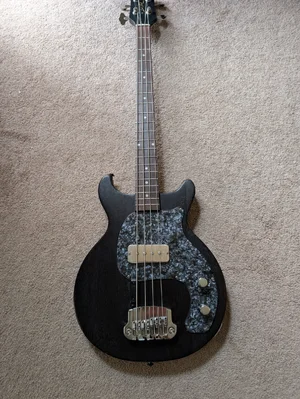
Clay Dots???
- By bassgirl57
- Basses [BG]
- 13 Replies
Emplyees have verified that "clay" dots were made from white fiberboard, not linoleum tiles.It's asbestos floor tile that Leo Fender recycled.
IIRC, the pearloid is just ABS plastic.
TalkBass has been independent since 1998. Add your voice.
Create a free account to reply to discussions, view embedded media, and browse with fewer display ads.
Join free Log in
Want zero display ads or expanded classifieds tools? Compare plans.
Emplyees have verified that "clay" dots were made from white fiberboard, not linoleum tiles.It's asbestos floor tile that Leo Fender recycled.
IIRC, the pearloid is just ABS plastic.
I played a beat up used attitude in a store about a month ago. The neck was indeed a baseball bat at the nut and the basic sound was fat and deep.I'm not a luthier, of course, but my take is that there are number variables here in addition to the neck profile. The Yamaha has a 6-bolt mount, including the two that are angled; the JB has a 4-bolt mount. The Yamaha body is a sandwich of alder/maple/alder, the JB is one wood (alder, ash, or empress, whichever yours is). The bridges are different, the Yamaha having it's cool 45-degree angle design and the G&L having it's massive Saddle-Lock bridge. I don't doubt for a second that you can hear a difference between the two basses, but I'd say it'd be hard to pin the tone difference solely on the neck profile.
OTOH, I've read/heard more than one interview with Billy Sheehan describing his Attitude basses, and he always points out that they have big, baseball necks in part because he feels a bigger neck gives you a bigger/fatter tone. And I'm not gonna argue with Billy. Paul Gilbert says the same thing when comparing the necks on his Fireman guitar to the typical thinner Wizard shredder necks of his prior Ibanez guitars.
My thumpi is also nursed by a cioks 9/12. Never experienced your issue. Faulty cable?I just switched to a 1 Spot, and the problem went away. Yay!
My CIOKS power supply has various voltage/current outputs. I had it on a 9/12V-300 mA outlet set to 9V. Maybe the variable voltage thing causes some shenanigans in the power-up waveform? Who knows? But at least I know it's not an issue with the mThump now.
Try Franklin Guitar Works.In my experience, the best place to buy parts is right here. Stratosphere is probably the most expensive place to buy parts.
SquarvelHey, that's my Squarvel! Just to add to this, I did also swap the neck and bridge on a Squier Affinity Jazz bass with the Charvel parts with no issues.
ThisI've been using SVT's for fifty years and they are among the most reliable amps out there. If it's been sitting in a closet for ten years the tubes are probably fine. check it out, if it sounds good and is loud as hell and all 6 power tubes are glowing similarly, play the hell out of it, you'll probably never turn back. I don't bring any of mine to a shop unless they obviously have a problem which is not very often. 6550's last for years.
It's Jazz-like, but definitely its own thing. Very warm and gooey in the mids. Maybe that's the Barts talking (this is my first bass with Bart pu's and pre).I’m glad you like it. It looks like a cool take on the Jazz Bass.
Let's face it, 34" scale was something Leo Fender thought would be ok. And it was, but other lengths could also have been ok. 33 is easier on shorter fingers though.If you look at scale lengths from a Fendercentric point of view, you have 30” on one end and 34” on the other.
30” are generally viewed as easier to play but don’t sound as defined.
34” are generally viewed as harder to play but sound more defined.
In the middle, you have the 32”, which I guess you could argue is in some ways a best of both worlds: easier to play than a 34” but sounds more defined than a 30”.
Lately, I’ve noticed a few bassists playing 33”, like Matt Garrison, Janek Gwizdala, Tony Grey and I think Scott Devine’s signature bass was also 33”.
I guess what I’m wondering is, what’s the appeal? Is it literally just an inch closer to sounding like a 34” but an inch easier to play?
Thx again!For the previous iteration of this board I just used the tuner in the HXS (which is plenty accurate), but I wanted to be able to have a visible tuner that could be "always on" (mostly for peace of mind when playing arco passages when I can't hear myself well enough). It takes up an extra block, but I also add a mute block to tune silently.
I think your plan for the routing makes sense. Electric bass signal chain into the L input and upright into the R (and out to the Walrus DI/LI the same way).
I chose to run everything into the HXS and then use a block to add the Cali76 to electric patches to give some wet/dry mix flexibility (beyond the pedal itself). I made what's essentially just an insert cable to send two lines from the 'stereo send' on the right side of the HXS (I don't use any stereo effects so I tend to think of 'stereo' as 'dual mono'); into the INs on each external pedal and mono returns back to the HXS (in my case, I didn't bother running a return from the tuner).
It might be more cumbersome, but sometimes I like the challenge of finding a solution to a problem I created![]()
It sounds great honestly! Here's some quick soundcloud demos of how the bass sounds with the dingwall pickups + lusithand preamp.well damn, if only i had knew it before having put MECs in the bass
how is the sound? Does it sound dingwallish? Do you have any sound clips of DI?
I really hope that they will make 6 string illumina Bass one day, because the bass is awesome i just miss the high C string
Also thank you for being brave enough ordering them and trying it out
Too bad it has been discontinued, luckily I have 2.+1 on the Echosaurus.
yeah itl deffo be a bit of a errr well itl be fun to learn to say the leastFretless Multiscale with no lines….Hmmmm…
The Japanese have an outstanding response for this kind of thing. First, there is a sucking inhale through pursed lips, as when tasting wine. Second, they will say “Verrrry difficult.” Which I generally took to mean nearly impossible.
Of course, nothing which is not counter to the Laws of Science is truly impossible. I suppose that one could practice 12 hours a day for two years, as Edgar Meyer suggests as a starting point, and get sufficient proficiency. I would personally choose other effort directions; but, that’s me.
Fretless Multiscale with Lines. That should work just fine.
My fretless has a graphite neck; so, I don’t “need” multiscale with that instrument. YMMV
We are working on helping with this frustrating problem. It is early still, but feel free to try Lyrekos and we would love feedback on if it works for you or what issues you run into. Thanks, LanceMy cousin is a guitarist and when we got together last summer we really enjoyed playing together. Here's the rub: he lives in Munich, DE, and I in Philadelphia, in the US, and so getting together to play is not a thing that we can do very often. Does anyone know of a way to play together over the internet? We both have reliable/stable connections via our respective ISPs, but given the latency and compression I experience every day with the likes of Zoom/Teams/Facetime, those solutions doesn't really sound practicable.
Thanks in advance.
Apparently he IS selling a course. I guess that makes him evil. Down with Jim Lill! (jk)He’s not selling a course (yet)
Mares eat oats, and does eat oats