• TalkBass has been independent since 1998. Add your voice.
    Create a free account to reply to discussions, view embedded media, and browse with fewer display ads.
    Join freeLog in
    Want zero display ads or expanded classifieds tools? Compare plans.

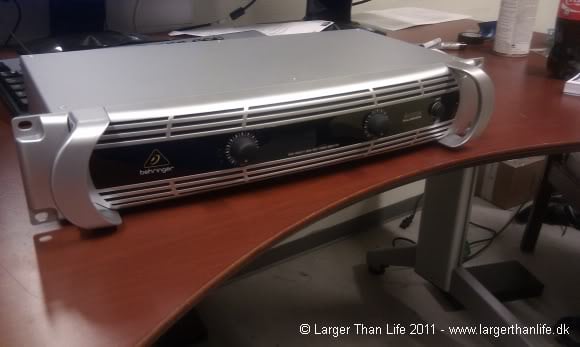
Behringer Inuke Power Amplifiers

Seems as if they are finally shipping. I am wondering if behringer will be able to live back up to the EP series as the EPX and EPQ series didn't seem to do so well. I think they may get a some of peavey's potential customers as the IPR DSP is still vaporware.

I have checked out their DSP software and it is seems better laid out than harman's band manager. Go figure. Anyways only time will tell if this is a will be a bang or a bust. Hopefully there will be some reviews popping up over the next couple weeks.

Someone has already did a review at Djz.dk but it is in danish and we all know how well google translator works. :rolleyes: I could make out that they were getting a 60V swing from the nu3000 without clipping at normal temps.

[Invalid or Expired Link Removed]

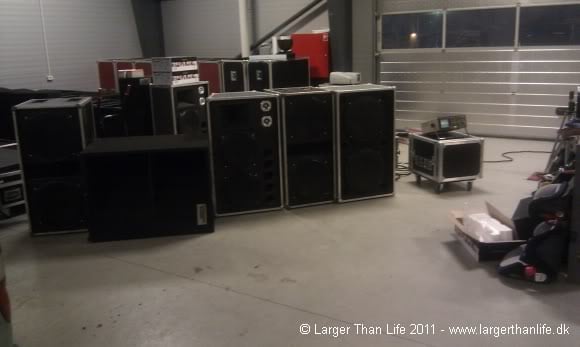
Here are the pics they uploaded.
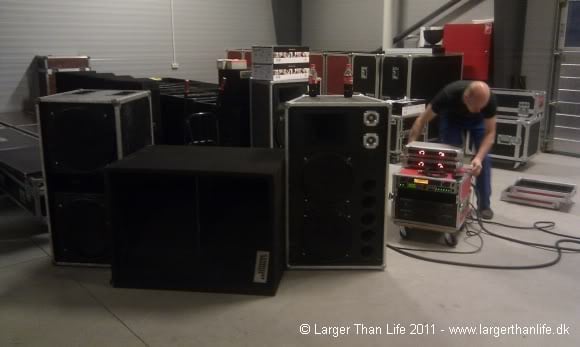
inuke-7.jpg

inuke-6.jpg

inuke-5.jpg

inuke-4.jpg

inuke-3.jpg

inuke-2.jpg

inuke-1.jpg
 
Wow - it actually delivers 600 watts more than advertised.
Good for them.
I wish US had readily available ~230V outlets.

I would like to see a lower watt model with no fan.

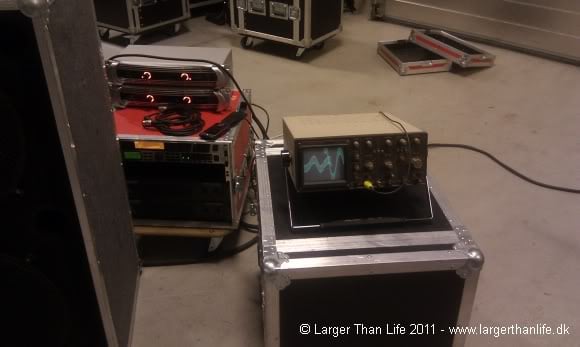
Edit - looking at the scope they may have forgot to filter out the supersonic frequencies. This can throw of readings.
 
I am hopeful for this series. I'm still waiting on them to publish the manual or at least the spec sheet so we can get some "official" power ratings with distortion figures.

I am digging my XTI2000 and it is definitely lighter than my old EP2500 but If I can knock another 10+ lbs off my rack I will take it. I was really hoping Peavey would have the IPR DSP's out by now but if behringer can prove the inukes are as solid as the EP series I would not mind going back to them.
 
Further testing the guys have done. Once again this is translated so it is somewhat hard to decipher.
Right clip LEDs, but without the basket is cut up oscilloscope, which is 1.2 V peak into (0.85 V RMS) delivers 76v Peak (53v RMS) which is in 2 ohm equivalent to 2888 watts. (1568 watts RMS) - and the bulb lights up just fine. Driver we bridged the deliver the 160V peak (106V RMS), which gives 4 ohms 5625 watts peak (yes - I have calculated and measured correctly) - which is 2809 watts RMS 4 ohms. It's really nice, actually promise Behringer 1500W into 2 ohms per. channel and 3000W bridged into 4 ohms.

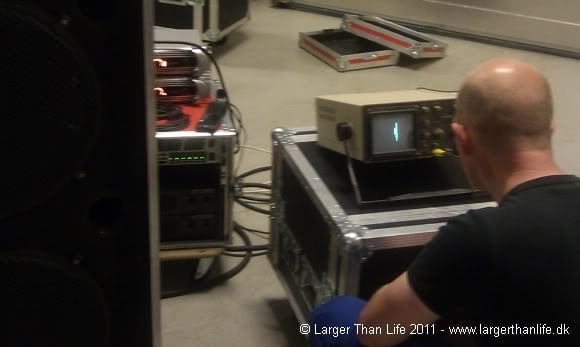
He's doing some kind of bulb testing and has it streaming live here.
Larger Than Life - DanaCup Live

Also got the amp to go into protect mode twice.

Well, they succeeded in forcing an Inuk 3000 to its knees. If I connect 1 x 1000W PAR 64 lamp with 5 300W PAR56 lamps, all together in parallel, the loudspeaker output when it is bridged, and play a sine tone into the amplifier, so So keep it up playing after approx. 1.5 minutes. It goes into protection mode. Mon off so on and on again straight away, and then play it on. The same happens to most other amplifiers. It is rare that you run into an amp that can deliver its full power all tiden.Man be the example. try to ask a Lab Group FP10000 Q to deliver 4 x 2500 watts continuous (ie a tone from a tone generator). It will very quickly either turn a fuse or probably more likely just turn off. 10,000 watts at 230V is about. 43 amps. Now I've connected an audio signal with some 128 BPM house music and still have 6 pairs of lamps set to end. It also runs still bridged. And then play the merry addition of. Peak voltage is still 150V without cutting, and thus an RMS power into 4 ohms at approx. 2800 watts. Power drain on 230V side is smooth at 600-700 watts, with peaks of beats around 3000 watts. So the efficiency of the amplifier is something like 90% at peak. The efficiency falls naturally at lower loads. Thinking whether I should see if I can drive it to its knees by connecting a few more lamps.

Status: When I came here this morning was iNUKE3000 amplifier gone into protection. Hmm, I thought, wondering if there have been too hot in the room. The reason was however found in the signal source. The laptop I had set to play music had gone to sleep, which unfortunately lead to the audio output becomes high-resistant. And with a long unbalanced cable between the laptop and the amplifier, then give it to hum and noise. And since it equips the amplifier to the clip level so then turn it off when it is loaded harder than what it was designed to (5 PAR 56 lamps and a PAR 64 bulb) I have now started the system again and the amplifier is running fine. And then I put the laptop that delivers the musical signal to never turn off.
 
HMM

TYPO!

They have 1000w into 4 ohms on the website, 1000w into 2 ohms on the back panel! HA!
Thats Behringer for you
The 3000 version has 3000W into 4 ohms on site & panel so I'm thinking the typo is on the back panel & its really 4 ohms 1000 W bridged.
 
Peak vs RMS is also misrepresented here... another no no

If you look at the Peavey IRP series they list their RMS rating

So both Peavey & Behringer have the same 3000 series

Peavey IPR 3000
IPR™ DSP 3000

- 1590W RMS x 1 at 2 ohms
- 910W RMS x 1 at 4 ohms
- 450W RMS x 1 at 8 ohms
- 1450W RMS x 2 at 2 ohms
- 815W RMS x 2 at 4 ohms
- 430W RMS x 2 at 8 ohm
 
Peak vs RMS is also misrepresented here... another no no

If you look at the Peavey IRP series they list their RMS rating

So both Peavey & Behringer have the same 3000 series

Peavey IPR 3000
IPR™ DSP 3000

- 1590W RMS x 1 at 2 ohms
- 910W RMS x 1 at 4 ohms
- 450W RMS x 1 at 8 ohms
- 1450W RMS x 2 at 2 ohms
- 815W RMS x 2 at 4 ohms
- 430W RMS x 2 at 8 ohm

Where did you find these specs?
They don't seem to be in Peavey's docs, and Behringer doesn't rate "RMS"?

Thanks
 
Hmmm.....

Peavey seems to list 2 different sets of specs for the IPR3000.
This one (for the DSP version) matches up with what Tunaman posted: Invalid Link Removed
This one gives slightly higher numbers:
Invalid Link Removed

Maybe a poster in the "Quasi-Watts" thread was correct when he stated that PV also lies about specs.
 
There's no FTC, or EIA there.
No rating standard

Same for Behringer

Nobody knows until it's actually measured.
Price wise, and 1 year warranty exchange, the Behringers will be everywhere, and easy to exchange should there be a problem. Problems, if there are any, usually going to happen in the first few months after the purchase.
 
Just to check in I abandoned the Inuke after being told by behri reps that the amp was rated in max. I have asked them for an RMS rating with distortion figures I keep getting told it is in the brochure. I greatly enjoyed my time with the EP2500 but I don't believe another behri power amp is in my future.

I bought a IPR3000 a couple weeks ago and I ordered a minidsp Fri. On another note I believe that Peavey has started shipping the IPR1600dsp.

If the amps are really rated in max( I don't see why they would lie about that) then they are taking away their #1 selling point which is value. The'll be right along with crown and peavey for watts/$ and that being the case, would put behringer at the bottom of the list.

I'd still like to see some proper bench testing from someone in the states.
 
Behringer power amps are now rated in peak rms power so to get a power rating you can compare to others divide by 1.25 . This roughly matches actual measurements done by a German language magazine a while back. I have an iNuke3000 I use in my PA on subs - about the same power as an RMX2450.

Actual measurements by that magazine:
Peak power 20ms/1000Hz
8 Ohm 2x465
4 Ohm 2x870
2 Ohm 2x1700
RMS (sine wave)
8 Ohm 2x312
4 Ohm 2x600 (2x375 after 3 seconds)
2 Ohm 2x1176 (2x750 after 1 second, protect after 5 seconds)

(Implies 1200w into 8 ohms bridged and 2352w into 4 ohms bridged)
 
Hi! I need help.
I am thinking of buying the nu1000 and connect two laneys at 8ohm each.
But I have no clear power per channel. 150w? .... behringer's web say: 8 ohm per channel... 150w.

If I connect my two laneys in serial mode, and nu1000 on bridge mode... Can I get the 1000w?

If you get 2 8 ohm speakers, connected in PARALLEL and run the iNUKE in bridge mode, you get the 1000W as mentioned in their datasheet.

Unfortunately, PEAK watts, if the iNU1000 behaves similar to the iNU3000, this would result in some 700W Rms burst, 500W RMS continuous.

Very good for the price.

Saludos desde España!
 
I cannot get the bridge mode. Read all instructions, they are not clear. NO help from Behringer. They show the wiring configurations. I bought the twist lock and wired it, double checked.
Do I plug into Channel A or B? Do I need A "Y" into both channels?
HELP!! Please.....someone Thanks