
Enjoy the benefits of a premium membership!
Upgrade Account
-
TalkBass has been independent since 1998. Add your voice.
Create a free account to reply to discussions, view embedded media, and browse with fewer display ads.
Join free Log in
Want zero display ads or expanded classifieds tools? Compare plans.
You are using an out of date browser. It may not display this or other websites correctly.
You should upgrade or use an alternative browser.
You should upgrade or use an alternative browser.
Cello Tuning. C-G-D-A
- Thread starter tiredman9
- Start date
More options
Who Replied?
I did it for a couple weeks. Just didn't like it, though. No reason why you can't use it, though. Others do.
I met someone a couple months ago that grew up playing cello and tuned his bass that way cause it was too annoying for him to mess with "standard" EADG kinda tuning.
Do what works for you.
Do what works for you.
well i like to mess around with weird tunings a lot, i'm thinking of trying that one out. what's cool about odd tunings for me anyways if u get stuck in a rut in ur playing. feeling like ur always playing the same things. if u change the tuning u can play the same patterns on ur bass but it sounds different, sometimes crappy sometimes cool, just gotta experiment. so i'd say try it out and see if you dig it.
i always fancied this, i think when (if....) i get a second bass i will try it. i figured it would be good for doing mental arpeggios/chords and crazy tapping, as well as the benefits labgnat suggests. let us know how it works out for you...

- Apr 1, 2000
- 17,405
- 9,845
- Disclosures
- Endorsing Artist: Roscoe Guitars, DR Strings, Aguilar Amplification
Cello tuning gives you nearly the same range as a 5 string with just 4 strings.

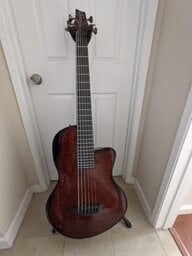
Well, Ive been messin around with this tuning on my backup bass for a little bit now (well a couple weeks before i posted this thread) not all that great musically IMO but it does give me a greater aprreciation for playing multiple octave scales, especially with an emphasis on the 5th (which makes sense because it is tuned in 5ths). I like the tuning for funkier stuff.
The one thing this tuning really did was make me use my ring finger more for the first note starting rifs then playing "behind it" with my index and middle fingers. So it really helps me develop away from just starting with my index finger and playing "forwards" down the fretboard towards my right hand. Does anyone have any good musical applications for this (as the original question was) other than like classical cello.
The one thing this tuning really did was make me use my ring finger more for the first note starting rifs then playing "behind it" with my index and middle fingers. So it really helps me develop away from just starting with my index finger and playing "forwards" down the fretboard towards my right hand. Does anyone have any good musical applications for this (as the original question was) other than like classical cello.

I tried it out for a little bit a few years ago. It was good for getting out of a rut (as previously mentioned), but the C is a bit too floppy if you use standard strings and your bass has the usual scale length. It could be pretty cool with a longer scale and more appropriate strings.
Chris Squire used this tuning sometimes.
Chris Squire used this tuning sometimes.

jeff schmidt
no longer red carded, but my butt is still sore.
labgnat said:if u change the tuning u can play the same patterns on ur bass but it sounds different, sometimes crappy sometimes cool...
This is true - but after you go back to normal tuning - you're still playing the same patterns. Have you really "broken" out of the rut, or just transposed your rut onto another tuning?
One of the benefits for me in using altered tunings is how it forces you to CHANGE the way you play.
If you change the tuning and it sounds lame using your old "4ths" patterns - you should stick with the tuning and change your patterns.
Try to make it sound "right. Scope out how to finger a regular scale or melody with the intervals all moved around.
You'll begin to develop new fingerings, enhance your ear, and when you go back to "normal" tuning you'll have some ways of phrasing and hearing you didn't have before.
Start small - just move 1 string (say the D string) up or down a whole or half step. And then try to play the old melodies and basslines you used to play (not the patterns - the actual notes of the line) if you stick with that - it will bust you out of old "patterns".

jeff schmidt said:This is true - but after you go back to normal tuning - you're still playing the same patterns. Have you really "broken" out of the rut, or just transposed your rut onto another tuning?
That's what I did when I experimented with CGDA - I liked the extra range, but ultimately I just wound up playing the same lines I did with EADG.
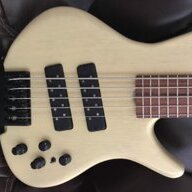
Pacman said:Cello tuning gives you nearly the same range as a 5 string with just 4 strings.
I know you meant with respect to the low range, where all you're missing is the B, but actually it gives more range than a 5 string with the same number of frets. Consider the upper range of the A string vs. G.
- Apr 1, 2000
- 17,405
- 9,845
- Disclosures
- Endorsing Artist: Roscoe Guitars, DR Strings, Aguilar Amplification

Tuning the bass in fifths complicates the playing of "traditional" walking bass lines and scalar passages in view of the number of vertical shifts required. The Chapman Stick tapping instrument (see www.stick.com) tunes the "bass" half of this 10 or 12 string instrument in 5ths (the "treble" half is tuned in straight 4ths). The real advantage of this is to open up a whole new world of chording possibilities, with relatively easy movable patterns for chords frequently used in contemporary music. During my time playing the Stick (before returning to bass) I loved the 5ths tuning in the left hand (bass) for accompanying the right hand playing melody but I hated it for walking bass lines.
Ed daHammer White
Ed daHammer White
jeff schmidt said:This is true - but after you go back to normal tuning - you're still playing the same patterns. Have you really "broken" out of the rut, or just transposed your rut onto another tuning?
well when i use altered tunings i may play some of the similar or same patterns as i would in standard tuning, but if i come up with a cool bassline it's usually not too much hassle to transpose it to use in standard tuning, so it' s really expansive for me anyway

I have it on one neck of my doubleneck. Great for metal, playing chords (especially triads sound much less muddy than in fourths tuning). Tuning in fourths is better for playing lines that frequently move by major thirds - typical walking lines etc.
It was initially probably easier for me than for others - I've had some experience on mandolin, tenor banjo and other instruments tuned in fifths. So it didn't take me very long to get used to it.
It was initially probably easier for me than for others - I've had some experience on mandolin, tenor banjo and other instruments tuned in fifths. So it didn't take me very long to get used to it.
Do you mean 1-5-10 triads?Great for metal, playing chords (especially triads sound much less muddy than in fourths tuning).
You might want to try different string guages for tuning like that. You'd probably need a heavier E string, the same A, and lighter D and G strings. It is a pretty cool tuning just because you do achieve a bigger range on a 4 string than on a standard tuned 5 string.

If I were to use cello tuning, I'd use a...
.105 "C"
.85 "G"
.60 "D"
.35 "A"
... And a correct set up should keep the flopiness on the C to a minimum and the .35 A will be perfect. You can use a .40, but the times ive tuned DADA it seemed pretty tight.
.105 "C"
.85 "G"
.60 "D"
.35 "A"
... And a correct set up should keep the flopiness on the C to a minimum and the .35 A will be perfect. You can use a .40, but the times ive tuned DADA it seemed pretty tight.
Tbirdbassist said:.105 "C"
.85 "G"
.60 "D"
.35 "A"
That light on the C? It's pretty loose using a .100. I'd been thinking something more along the line of .35-.65-.90-.115. Does that seem off bass in any respect? I've only ever played 4-string, so I don't have a very good feel for the heavier gauges.


