
Enjoy the benefits of a premium membership!
Upgrade Account
-
TalkBass has been independent since 1998. Add your voice.
Create a free account to reply to discussions, view embedded media, and browse with fewer display ads.
Join free Log in
Want zero display ads or expanded classifieds tools? Compare plans.
You are using an out of date browser. It may not display this or other websites correctly.
You should upgrade or use an alternative browser.
You should upgrade or use an alternative browser.
Best pick-up Distances from neck and bridge?
- Thread starter MEKer
- Start date
More options
Who Replied?

- Apr 18, 2008
- 16,024
- 1
- 31,758
- Disclosures
- I'm highly opinionated and extremely self-assured
What's the best place to plant a tree?
When is the best time to buy stock?
Where does the best wine originate?
Who is the best builder of custom basses?

Answer to all of these, and your question: it depends on what you have to work with, and what goals you have in mind.
When is the best time to buy stock?
Where does the best wine originate?
Who is the best builder of custom basses?
Answer to all of these, and your question: it depends on what you have to work with, and what goals you have in mind.
Very helpful.
Just so you know---there are in fact some somewhat standard differences in what is experienced by the distances--the Luthiers forum laid out a couple (some decidedly negative), but inferred this forum as a better place for the question. I am interested in what OTHERS actually have experienced in general placement. Its not quite so bland an issue as you evidently think. Just so you know.
BTW, Gibson Grabber 1973-1982 (now reissued) made pick-up distance for fine-tuning an issue when they brought it out into the market.
Just so you know---there are in fact some somewhat standard differences in what is experienced by the distances--the Luthiers forum laid out a couple (some decidedly negative), but inferred this forum as a better place for the question. I am interested in what OTHERS actually have experienced in general placement. Its not quite so bland an issue as you evidently think. Just so you know.
BTW, Gibson Grabber 1973-1982 (now reissued) made pick-up distance for fine-tuning an issue when they brought it out into the market.

Hi MEKer,
the "best" PU hight belongs to
1.) the bass player (beating or caressing the strings)
2.) the type / brand / thickness of the strings
3.) the prefered sound (punchy or HiFi)
4.) the impedance and magnets of the PU
5.) if other PUs are involved (at a PJ set, the J mostly has to put up as high as possible, the P lower than normal)
6.) the preamp of the amplifier
7.) to be continued ...
I think that's what ctmullins wanted to say ...
There is no "perfect distance" like there is no perfect woman for everyone. You have to find out for yourself. You have to try and search yourself.
I think that more than 50% of the PUs are changed only because (bass) players don't want to try what's possible and how their PUs react to different settings ...
Are you unsatisfied with yourself? Blaim it on the PUs!
You simply can't say ...
the "best" PU hight belongs to
1.) the bass player (beating or caressing the strings)
2.) the type / brand / thickness of the strings
3.) the prefered sound (punchy or HiFi)
4.) the impedance and magnets of the PU
5.) if other PUs are involved (at a PJ set, the J mostly has to put up as high as possible, the P lower than normal)
6.) the preamp of the amplifier
7.) to be continued ...
I think that's what ctmullins wanted to say ...
There is no "perfect distance" like there is no perfect woman for everyone. You have to find out for yourself. You have to try and search yourself.
I think that more than 50% of the PUs are changed only because (bass) players don't want to try what's possible and how their PUs react to different settings ...
Are you unsatisfied with yourself? Blaim it on the PUs!
You simply can't say ...
- Apr 18, 2008
- 16,024
- 1
- 31,758
- Disclosures
- I'm highly opinionated and extremely self-assured
I know I can sound sarcastic at times, so sorry for that.
But, as far as I'm concerned, your question is far too vague to be answered.
As Cadfael pointed out, there are so many other factors at work, and most of them highly subjective, that the question, as it stands, is unanswerable.
The only thing worth pointing out is the very well-known generalization that the closer to the bridge, the more emphasis on the upper frequencies.
Now, if you want to provide some more specifics about your particular goals with the custom build, then we can start to discuss it.
But, as far as I'm concerned, your question is far too vague to be answered.
As Cadfael pointed out, there are so many other factors at work, and most of them highly subjective, that the question, as it stands, is unanswerable.
The only thing worth pointing out is the very well-known generalization that the closer to the bridge, the more emphasis on the upper frequencies.
Now, if you want to provide some more specifics about your particular goals with the custom build, then we can start to discuss it.
I understand it can be a hard question as specifics are widely spread via preference and players "used" to only what they have been playing. I see most makers always place the pups in the same position on all their instruments (Eugen comes to mind) and there is some differences between them however slight. I ask in general, overall terms as the pup strength or predilictions can vary by type/maker.Placing pickups right at the butt of the neck was popular back in the 60's. These were usually humbuckers and generally referred to as 'mudbuckers'. But the reason for that was that the amps of the day didn't really deliver much low end, so the mudbucker (with flat strings) was the work around to get some thump. In the late, 60s solid state power supplies became available and amps could suddenly deliver the low end like never before. And they did. And they did it some more. So much so that the amps became the mudbuckets and round strings came to be the work around for that. Today, amplification is sophisticated enough to handle about anything you throw at it.
A pickup right against the neck is going to be muddy and thumpy in the low position, but brighter than a bridge pickup at the top of the fingerboard. Depending on the pickup, this could be a desirable feature for a soloist. But I would want some serious input from a pickup guru first.
The quote is from the Luthier Forum and gave me pause for thought. And that put me in mind of the so-called sweet spot for pups in a general sense. I know there are preferences for placement among players and luthiers. That is what I want expounded on---the overall experiences.
- Apr 18, 2008
- 16,024
- 1
- 31,758
- Disclosures
- I'm highly opinionated and extremely self-assured
One further note, from my own personal experience: I don't care for pickups placed less than about 2.5" from the bridge saddle of the highest string. For me, too much low frequency content gets lost this way. But that's just my own subjective opinion.
One further note, from my own personal experience: I don't care for pickups placed less than about 2.5" from the bridge saddle of the highest string. For me, too much low frequency content gets lost this way. But that's just my own subjective opinion.
That's what I am looking for. And if it seems most agree on the low freq loss at that distance, then that could very well be a guide in placement.

How close (or far) should a pick-up (P, J, Hmbkr) be to neck or bridge to maximize its efficiency?
Thinking of custom build here.
Efficiency is not why pickup positions are chosen. In fact, there is no real science behind pickup locations. Some have tried to say there is a "sweet spot" under a certain harmonic, but that harmonic moves the moment a note is fretted.
So all you're left with are purely subjective criteria: how does a specific type of pickup sound in a specific location and how does it interact with another specific pickup in another specific location?
As far as P and J pickup spacing, Fender has done the work for you but you still have a myriad of choices in terms of pickup type as well as preamp options.
For multi-coil pickups there are basses that use every pickup spacing under the sun. Ken Smith, Warwick, Lakland, Ernie Ball, Fodera, Zon, and Warrior all use distinctly different pickup spacings with different types of pickups & electronics to achieve their desired voicings. Their choices were not based on what was "most efficient" but rather preference.
It is not uncommon for a custom builder to have a shop instrument routed for "sliding pickups" so they can test various spacings. If that's more trouble than you want to go to I suggest you pick an existing bass that makes your ears happy and use that spacing for your build.
Efficiency is not why pickup positions are chosen. In fact, there is no real science behind pickup locations. Some have tried to say there is a "sweet spot" under a certain harmonic, but that harmonic moves the moment a note is fretted.
So all you're left with are purely subjective criteria: how does a specific type of pickup sound in a specific location and how does it interact with another specific pickup in another specific location?
As far as P and J pickup spacing, Fender has done the work for you but you still have a myriad of choices in terms of pickup type as well as preamp options.
For multi-coil pickups there are basses that use every pickup spacing under the sun. Ken Smith, Warwick, Lakland, Ernie Ball, Fodera, Zon, and Warrior all use distinctly different pickup spacings with different types of pickups & electronics to achieve their desired voicings. Their choices were not based on what was "most efficient" but rather preference.
It is not uncommon for a custom builder to have a shop instrument routed for "sliding pickups" so they can test various spacings. If that's more trouble than you want to go to I suggest you pick an existing bass that makes your ears happy and use that spacing for your build.
That might simply be the easiest way to go.

- Aug 21, 2008
- 10,386
- 253
- 68
- Disclosures
- Owner, SGD Music Products
What's the best place to plant a tree?
+1
My answer would have been "yes".
Really, you can put a pickup anywhere under the strings. The closer the neck the deeper it sounds, and the closer to the bridge the brighter it sounds.
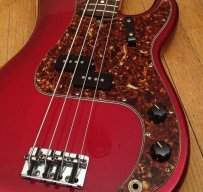
this, and the observation that traditional fender pickup locations were originally arrived at because they sounded good through marginal amps with no onboard EQ, is all there is to it.Really, you can put a pickup anywhere under the strings. The closer the neck the deeper it sounds, and the closer to the bridge the brighter it sounds.

Some have tried to say there is a "sweet spot" under a certain harmonic, but that harmonic moves the moment a note is fretted.
+1 to that. I was recently told that gibson does that harmonic trick. Huh?

I like the tone you get with only one pup in the middle position or sweet spot. If i got to use two pups i would place the two in the middle. That kind of neutral tone works perfectly for everything imo...
- Aug 21, 2008
- 10,386
- 253
- 68
- Disclosures
- Owner, SGD Music Products
+1 to that. I was recently told that gibson does that harmonic trick. Huh?
Lots of pickups are placed more-or-less where the harmonic nodes are, but that's probably because when you divide up the space between the end of the neck and the bridge, those are the locations you end up with. My basses are like that too, and it makes it look uniform. But you don't have to put pickups there.
Fender moved the bridge pickup on the Jazz bass slightly so it would be hidden under the bridge cover. So that shows they weren't concerned with harmonic placement.
If you place a pickup right under a harmonic node, you wont hear that open string harmonic as much as if it's slightly on either side, unless it's a humbucker and the node is right between the coils. But that only matters if you want to play open string harmonics.
So that's why they moved it? Priceless!Fender moved the bridge pickup on the Jazz bass slightly so it would be hidden under the bridge cover. So that shows they weren't concerned with harmonic placement.


Well, since I'm -apparently- on a project kinda similar to OP's I'll just ask here instead of making a new thread.
I have three MM style pick-ups of the same brand and model that have been gathering dust in my desk for like 2 years, I want to put them all in the same bass, I assume they are bridge pick ups by default, being MM pups and that.
So, will I have any problem with the neck one? I mean, with string spacing vs pole spacing and stuff? Is it too wacked and shouldn't be done?
OP, sorry for hijacking your thread, and everyone else, please excuse my Engrish
I have three MM style pick-ups of the same brand and model that have been gathering dust in my desk for like 2 years, I want to put them all in the same bass, I assume they are bridge pick ups by default, being MM pups and that.
So, will I have any problem with the neck one? I mean, with string spacing vs pole spacing and stuff? Is it too wacked and shouldn't be done?
OP, sorry for hijacking your thread, and everyone else, please excuse my Engrish


