
• TalkBass has been independent since 1998. Add your voice.
    Create a free account to reply to discussions, view embedded media, and browse with fewer display ads.
    Join freeLog in
    Want zero display ads or expanded classifieds tools? Compare plans.

Is my wiring diagram correct?

StuartV

Finally figuring out what I really like
Supporting Member
Jul 27, 2006
6,110
1,271
Manassas, VA
My G&L SB-2 is stock, which means P/J with Vol/Vol and no Tone. I want to add Tone. But, I'm anal and don't want to have 1 regular pot and one stacked pot. I also want a Master Vol.

So, I want to do 2 stacked pots. One stack will be Master Vol and Tone. The other stack will be individual Vol for each pickup.

Of course, with Master and Tone both wide open, I want the bass to sound the same as it does now, using just the other 2 individual Vol pots.

So, can any of you tell me if the wiring diagram I've done up will work like I want? I've never done this before, so I am very skeptical that I've gotten it right on the first try.

One obvious thing to ask about is, on the J bass wiring diagrams I looked at for reference, they had the pickup white wires connecting to the middle lug on the Vol pot and I've drawn this with the pickup lead connecting to the outside lug instead. Is that okay, or do I need to reverse those?

I have A500K/A500K stacked pots to use for both. And I got a Orange Drop cap for the tone pot. Don't remember off the top of my head what value. .047uF, I think.
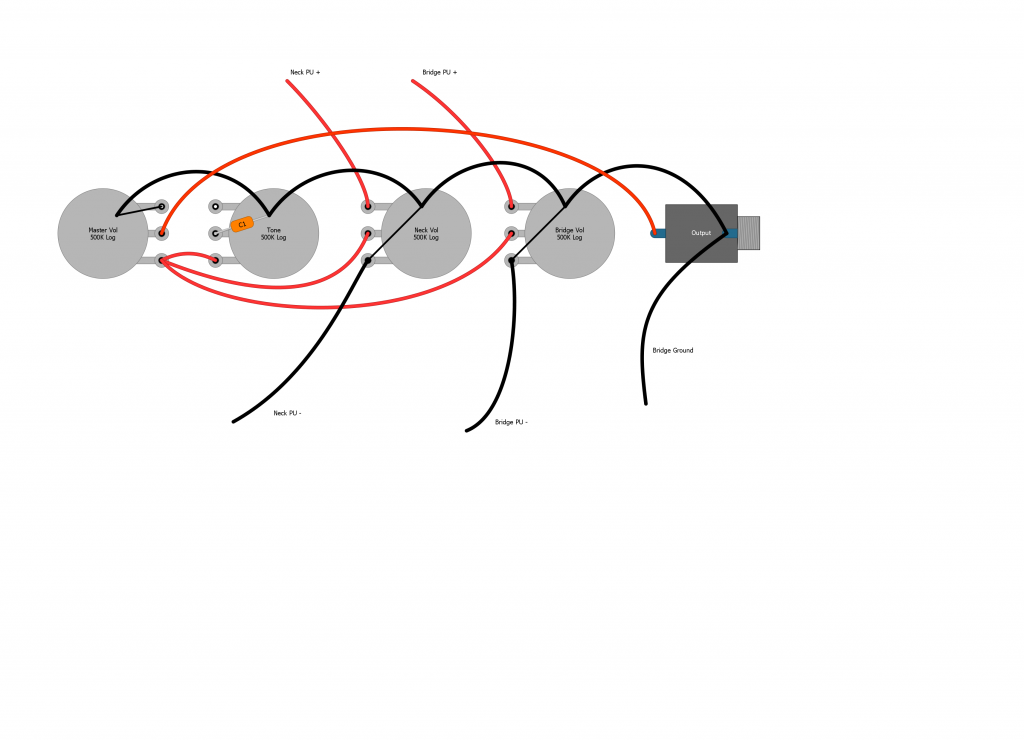
MVVT1.png


If this drawing doesn't show as large enough, somebody please tell me and I'll see if I can export a bigger one from DIYLC (the open source app I used to create the diagram).
 
Thanks, line6man! So, this is good?

Using the wiper lug on the Master Vol, to the output jack is okay? (that's how the P bass wiring diagram was, that I looked at for reference)

MVVT11.png
 
Awesome!

I started to now ask why that change was needed. But, I stared at it for another minute and I can now see that, by virtue of the individual pots' parallel lug connections to the Master, turning the individual vol pots would affect the whole volume (the way I had it at first).

Thanks, again! I really appreciate the help!
 
Did you consider just blend/tone?

I used to be a stark raving proponent
Of vol/vol (and vol/vol/Mvol) but after trying all these in reality for a while, I never did find any of the 'secret sweet spots' that I thought wouldn't exist with a blend...

In other words, simple is better, all things being equal (though who knows maybe they aren't)

I only mention it because people tend to want to avoid excessive pots to ground
 
Looks good unless you want a tone setup like in the SB-1. That is a bit different than the typical Fender style tone circuit, which is what you have diagrammed.

I've never seen an SB-1 in person. I did not know their tone circuit is different. Can you give me the nickel tour on how it's different (wiring-wise and sound-wise)?

I think I want the Fender-style Tone circuit, but I'm open to other choices.
 
Did you consider just blend/tone?

I'm not sure if you mean JUST Blend/Tone, or if you mean Master Vol/Blend/Tone.

If you really mean Blend/Tone only, then, no. I do want a way to turn down the volume. The output sound from the MFD pickups on the SB-2 does change tone when you turn down the volume. You can get an exact* P sound just by turning off the bridge and rolling the neck volume back to around 75%. I want to retain that capability. I would not, if I only had Blend and Tone, with no Volume.

If you really meant Master/Blend/Tone, then that goes back to my earlier post. It's 3 knobs. I'm anal and don't like the look of 1 regular pot and 1 stacked pot. I'd rather have 2 stacked pots. At least this way, I'm still only grounding 2 pot bodies.

* based on a poll I posted a while back. The poll demonstrated that in a blind test, more people picked the SB-2 as the "real" Fender P than picked my actual 1966 Fender P.

http://www.talkbass.com/forum/f8/p-vs-p-like-can-you-tell-difference-838140/
 
Looks good unless you want a tone setup like in the SB-1. That is a bit different than the typical Fender style tone circuit, which is what you have diagrammed.

I just looked at the SB-1 schematic here:

Link Removed

I can see that it's different. To my uneducated eye, it looks like it would work very similarly to what I have diagrammed, except that it would not give you nearly as much treble roll-off.

It looks like the main difference is that they use a .1uF cap, where I'll use a .047. So, mine should take out more treble, right? Or have I got that backwards?

And then, the SB-1 has an inline 6.8K ohm resistor, which means the SB-1 Tone will never bleed off as much of the high end as a Tone without that resistor, right? I could see experimenting with different cap values, but it seems like the resistor doesn't do anything that I couldn't get just by rolling the Tone knob back just a tiny bit, yes?
 
I'm not sure if you mean JUST Blend/Tone, or if you mean Master Vol/Blend/Tone.

If you really mean Blend/Tone only, then, no. I do want a way to turn down the volume. The output sound from the MFD pickups on the SB-2 does change tone when you turn down the volume. You can get an exact* P sound just by turning off the bridge and rolling the neck volume back to around 75%. I want to retain that capability. I would not, if I only had Blend and Tone, with no Volume.

If you really meant Master/Blend/Tone, then that goes back to my earlier post. It's 3 knobs. I'm anal and don't like the look of 1 regular pot and 1 stacked pot. I'd rather have 2 stacked pots. At least this way, I'm still only grounding 2 pot bodies.

[/URL]
i am stupid, i postedbwhen i shouldhave been.working!
 
A 0.1 μfd is slightly over twice the value of a 0.047 μfd capacitor, so the bigger one will pass more treble and therefore roll it off more aggressively. The 6.8K resistor keeps the capacitor from being connected completely to ground. Imagine putting a "stopper" that only let the tone knob be turned down to 1 and not zero - that's basically what that resistor does.
 
Thanks, Crater. So I did have it backwards on the cap value. That's cool. If .047 doesn't let me make it "thumpy" enough, I'll try a .1.

As for the resistor, if I understand it correctly, it means that if you took it out and had the Tone knob all the way "up", the bass would be a little bit brighter, right? Having that resistor seems like a strange thing to do to the SB-1.
 
Thanks, Crater. So I did have it backwards on the cap value. That's cool. If .047 doesn't let me make it "thumpy" enough, I'll try a .1.

As for the resistor, if I understand it correctly, it means that if you took it out and had the Tone knob all the way "up", the bass would be a little bit brighter, right? Having that resistor seems like a strange thing to do to the SB-1.

I'm not sure I have it right, but my understanding is the reverse, the same way a 500k pot is brighter than a 250k pot. Putting the 6.8k resistor in series with a 250k pot makes a 257k pot that you can only turn down 80% of the way. This keeps it from changing the resonant hump when rolled all the way off.

Also the 0.1uf cap lowers the frequency of the high roll off from a 0.047uf cap. It changes where the low pass filter is set more than the amount rolled off.

I'm not sure if I like the Fender style tone circuit or the SB-1 style better as I've only had my SB-1 for a couple weeks.
 
This keeps it from changing the resonant hump when rolled all the way off.

What does that mean?

Also the 0.1uf cap lowers the frequency of the high roll off from a 0.047uf cap. It changes where the low pass filter is set more than the amount rolled off.

So, if (pulling numbers out of the air) the .047 takes out stuff above 1200Hz, then a .1 would take out stuff above something like 600Hz?

Or, I think of rolling the tone off as being like throwing a big, wet blanket over my cab. So, if .047 is a big, wet blanket, then .1 is an even bigger, thicker, wetter blanket?
 
What does that mean?


So, if (pulling numbers out of the air) the .047 takes out stuff above 1200Hz, then a .1 would take out stuff above something like 600Hz?

Or, I think of rolling the tone off as being like throwing a big, wet blanket over my cab. So, if .047 is a big, wet blanket, then .1 is an even bigger, thicker, wetter blanket?

Try rolling off the tone all the way with a Fender style tone circuit, then just the tiniest bit back up. Notice the shift between all the way off and 1% back on? The SB-1 circuit doesn't do that, the tone rolls off smoothly all the way.

I don't know exactly what frequency each cap equates to, but that's the general idea. I've tried all sorts of different values in the past and which sounds best is very pickup specific.
 
Try rolling off the tone all the way with a Fender style tone circuit, then just the tiniest bit back up. Notice the shift between all the way off and 1% back on? The SB-1 circuit doesn't do that, the tone rolls off smoothly all the way.

But, does that mean that the Fender circuit lets you achieve a sound that the SB-1 circuit doesn't? Whereas the SB-1 circuit does not give you anything that the Fender can't match?

I guess what I'm getting at is it sounds like the Fender circuit has an advantage, but not disadvantage.

I don't know exactly what frequency each cap equates to, but that's the general idea. I've tried all sorts of different values in the past and which sounds best is very pickup specific.

Yeah, the specific frequencies weren't the point. It was just to illustrate that the .047 cuts out from a higher frequency on up (if I've understood correctly). So, the cap value determines the Low Pass frequency, and the pot value determines how much you can attenuate those higher frequencies (i.e. the downward slope of the frequency curve)?
 
But, does that mean that the Fender circuit lets you achieve a sound that the SB-1 circuit doesn't? Whereas the SB-1 circuit does not give you anything that the Fender can't match?

I guess what I'm getting at is it sounds like the Fender circuit has an advantage, but not disadvantage.

I wouldn't quite say that. I find that the Fender style tone circuit has 3 or 4 usable settings. All the way up, rolled off a little, rolled off a lot, and all the way off. I can't really tell much gradation in between. Rolled off just a hair sounds very similar to rolled off 25%. Rolled off 75% sounds pretty much the same as almost all the way off.

The SB-1 has a true gradation where it is much more like rolling off the highs from an amp's eq section. It doesn't get the full boomy mud that it would when rolled all the way off if it didn't have the resistor, but with the .1uf cap, it gets close while retaining better note definition. To me it feels like everywhere along the gradient is a little different and usable, whereas the Fender .047uf with no additional resistor goes from bright to slightly less bright and then mud. I do find I miss the mud a little for a song or two, but in exchange I get a fully usable range of tones.

As I said, I'm not sure which I like better, they're just a little different.

Yeah, the specific frequencies weren't the point. It was just to illustrate that the .047 cuts out from a higher frequency on up (if I've understood correctly). So, the cap value determines the Low Pass frequency, and the pot value determines how much you can attenuate those higher frequencies (i.e. the downward slope of the frequency curve)?

Yeah, something like that.