• TalkBass has been independent since 1998. Add your voice.
    Create a free account to reply to discussions, view embedded media, and browse with fewer display ads.
    Join freeLog in
    Want zero display ads or expanded classifieds tools? Compare plans.

To use or not to use this fingerboard blank

Would you use this fingerboard blank?

  • Yes, that little warpage wouldn't bother me

    Votes: 29 70.7%
  • Yes, but I'd try to wet bend it back to straight first

    Votes: 7 17.1%
  • Yes, but I'd plane it down and glue a veneer to it to make it thicker first

    Votes: 3 7.3%
  • No, absolutely not

    Votes: 2 4.9%

  • Total voters
    41
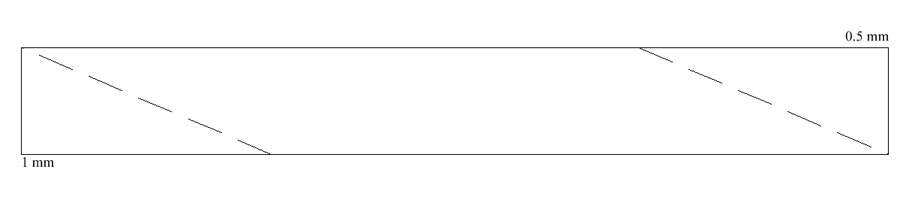
I have a very (!) nice piece of macassar ebony as a fingerboard blank. It's in my shop for four months right now and I'm ready to use it, but it bent or warped slightly. Both opposite corners bent upwards slightly, making it somewhat warped. One corner came up by only 0.5 mm and the other one by 1 mm. I attached a diagram showing the sections that bent upwards. The center part is still perfectly flat. You can also easily press down the fingerboard blank with a finger.

My question, as I'm afraid the fingerboard will bend the neck in the end because ebony is a very dense wood:


Would you use it or not?


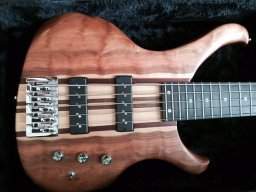
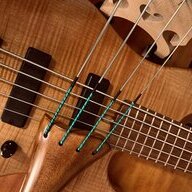
Here's some pictures, not of best quality, but you'll get the idea. The piece is stunning, should make a better photograph soon. The first one shows the actual color best, the second shows the strikes better:

021-macassar-ebony-with-maple.jpg


Link Removed

Here's a schematic drawing of the warpage:
 

Attachments

  • fretboard-schematic.jpg
    fretboard-schematic.jpg
    20 KB · Views: 149
When you say "the center part is still perfectly flat", how much flat width do you have? In other words, when you taper the fingerboard, will you have sawn off all or most of the warped section?

Radiussing the fingerboard could work in your favor here. What radius were you planning?

If it were me, and I was building the instrument for myself, I'd glue it and clamp it and use it. For a commissioned instrument, I'd think twice.

Beautiful chunk of mac, btw!
 
When you say "the center part is still perfectly flat", how much flat width do you have? In other words, when you taper the fingerboard, will you have sawn off all or most of the warped section?

Radiussing the fingerboard could work in your favor here. What radius were you planning?

If it were me, and I was building the instrument for myself, I'd glue it and clamp it and use it. For a commissioned instrument, I'd think twice.

Beautiful chunk of mac, btw!
+1 to all of that.
 
Thank you for your opinions!

Not me. Risky

BUT, I would probably steam/flatten it first to see if it could be done. Of course that makes it not useful immediately...

Doesn't have to be, I have enough time and ordering time of a new one is up to six weeks (or I'll have to buy a regular stock rosewood or ebony blank).

When you say "the center part is still perfectly flat", how much flat width do you have? In other words, when you taper the fingerboard, will you have sawn off all or most of the warped section?

Radiussing the fingerboard could work in your favor here. What radius were you planning?

If it were me, and I was building the instrument for myself, I'd glue it and clamp it and use it. For a commissioned instrument, I'd think twice.

Beautiful chunk of mac, btw!

Thanks, it's very nice isn't it? The center part as in the part between the two dashed lines in the drawing is still perfectly flat. To clarify my drawing I've added the outline of the actual fingerboard in it. See the attachment below.

How could radiussing the fingerboard work in my favor here? The radius I planned is 16".

Oh, and the instrument is for myself, but due to limited time and resources I see it as a commissioned instrument for myself :smug:

If it were my bass, I would give it a go. Maybe do a bolt on neck just in case it does cause problems?

It is indeed going to be a bolt-on, but the neck wood is so nice that I don't not won't to risk it.. :scowl:

Just did exactly this with a jarrah fingerboard on my headless build. The neck should be super stable and the titebond means it will NEVER go anywhere. Do it, you'll be fine.

My neck has two carbon fiber reinforcement rods and a dual action truss rod. It's hard maple with a light flame in it, it's very stable too. So you didn't have problems, how long is the fingerboard on right now?

You've got a nice looking fretboard blank for sure. Besides say making a fretboard there isn't much else you can do with it. I would try and make a fretboard out of it.

True, that's why I actually cannot just lay it aside... :hiding:


Looking it the poll, I see most people wouldn't bother, that reassures me a bit. Besides, I planned the most warped part (lower left) over the body, that should be the most rigid part of the neck..

Here's the updated drawing:
 

Attachments

  • fretboard-schematic-2.jpg
    fretboard-schematic-2.jpg
    14 KB · Views: 102
Rickett Customs said:
If you can get access to a drum sander, this will true it up and remedy the issue, without taking too much off the entire surface.

Thank you, that's a good idea. I do not have access to one or know anyone with a drum sander so I'll have to do some research for that. Also, my piece isn't thick enough to sand off enough.. So I guess this will become my plan B.

miziomix said:
Clamp it or put it under some weight for a day. See if that straightens it up. It should. Macassar Ebony is a great wood ;)

I'll try that right away! Wet or dry clamping?
 
If Plan A does not work and you do happen to find someone in you part of the world, that has one....it sands off extremely thin (not like a planer or jointer). Either way, I hope it works out, to use that piece, Mac ebony is pretty for fretboards.

Thank you, that's a good idea. I do not have access to one or know anyone with a drum sander so I'll have to do some research for that. Also, my piece isn't thick enough to sand off enough.. So I guess this will become my plan B.
 
If the board has reached it's equilibrium and that is all it has moved, I wouldn't be concerned. I had a pau ferro board that had slightly more warp and it completed a fine 6-string neck that has been trouble-free. In this case, if you have a true gluing surface when you clamp it down, you're good to go, IMO.

When you glue it up, it will go through some changes when it takes on moisture from the titebond. I would give it some extra time to stabilize before shaping the neck or fb.
 
Rob, try clamping it dry first. Usually that's good enough. I have done that successfully with boards that had warped more than 1mm.

Well, I did... no change at all.. but it showed that it is clamped straight pretty easily, so I'm not sure if it's really going to be a problem..

If the board has reached it's equilibrium and that is all it has moved, I wouldn't be concerned. I had a pau ferro board that had slightly more warp and it completed a fine 6-string neck that has been trouble-free. In this case, if you have a true gluing surface when you clamp it down, you're good to go, IMO.

When you glue it up, it will go through some changes when it takes on moisture from the titebond. I would give it some extra time to stabilize before shaping the neck or fb.

Thanks, that's reassuring and a good advice. Should I leave it clamped a longer time after the glueing? What's your normal clamp period for such a task?


I checked the glueing surface by sanding it with a very fine coarse sandpaper while clamping it down to the table. This showed me that it's flat, because otherwise I would see spots where the dust collects. I did see those, but well outside the planned outline of the fingerboard. So I'm able to glue it on the neck flat.

I did some grain selection, also selecting the best part of the blank with least warpage and most flat surface:

Link Removed

Right now I feel I should go for it because:
  • Almost 75% voted poll option A, they wouldn't bother either
  • The surface is flat and the warpage minimal
  • It probably reached its equilibrium because it's in my shop for 4 months now
  • I will put the part with the most warpage over the body (upper frets)
  • It's so d*** nice, isn't it?
 
Funny that clamping it didn't make a difference...mmm... should we conclude that Macassar does that only when it acts as a local wood? ;) Given the minimal extent of the warping I wouldn't worry. Killer fingerboard you've got there Rob. Go for it :)

I didn't expect it to actually, but I sure hoped so :smug:. I think it's indeed because it's not a local wood, must have got something to do with it :D.

Thanks for the reassuring and tips, I do indeed think I should go for it! :bassist:
 
Well, I did... no change at all.. but it showed that it is clamped straight pretty easily, so I'm not sure if it's really going to be a problem.. (..)

Funny that clamping it didn't make a difference... (..)

I have to rectify this. I left it clamped for two more days and measured again today: the deviation was 0.4 mm opposed to 1.0 mm three days ago. So it does seem to do something. Let's leave it clamped a little longer... :smug: