- Feb 16, 2008
- 21,240
- 23,633
- Disclosures
- John K Custom Basses
i was noticing that one of my jazzmaster basses (the featherweight, 7lb 9 oz shoreline gold one) had a slight dead spot on only one note. it was the very common 'D' on the G string (7th fret). the surrounding notes were ringing out and sustaining fine, but when i played the D, i could actually feel the neck shake/resonate and it slightly choked out. since the swamp ash body on this particular bass was so light, i made a point of selecting the lightest weight neck that i could find for it which weighed only 1lb 6 oz (most fender type necks are 1lb 8oz - 1lb 13oz).
way back in 1979, when i discussed this issue that's very common on Fender basses with Leo Fender, he pulled out a small C clamp, clamped it on the headstock and said, 'play it now'. sure enough, it was gone, and although it probably moved to a lower note, i sure as heck couldn't find it. this is also the same premise/solution that the 'fathead' (brass plate on the back of the headstock) and later 'fatfinger' (a small c clamp), both of which have been discontinued, were based on, which is adding mass to the headstock to change the neck's resonant frequency.
so, yesterday, i started experimenting with various sized (and weight) C clamps to see if i could solve the dead D problem on my bass. since the body is so lightweight, i wanted to make sure that i added only enough weight to solve the problem and not create any neck dive/balance issues. i'm using gotoh's res-o-lite reverse tuning heads on it, which made it balance perfectly. after a bit of experimentation, i found that the smallest 3 oz C clamp that i had, completely eliminated it. i figured that if i installed a standard weight set of heads (or just two of them) it would solve the problem, but i didn't want two of one type, and two of the other. i also didn't want to just replace the res-o-lites with a whole set of standard weight ones, since 6.5oz would surely create neck dive, plus the res-o-lites are so much smoother and have no slop in them whatsoever. so, i went to my local hobby shop and bought a pack of tungsten 3/8' cylinder weights that are used for pinewood derby cars.
tungsten is the new replacement for lead, since it's non toxic and actually weighs 1.7 times more than the same size piece of lead (which i learned 8 years ago when i was making and balancing my own r/c micro helicopter blades).
anywho, figuring that it was going to take at least 2 oz of weight to solve it, i removed two machine heads and bored two 3/8" holes under each of them to inlay the 1/2oz tungsten cylinders (see pic below with all four inlaid and an extra one laying on top to show it's size)).
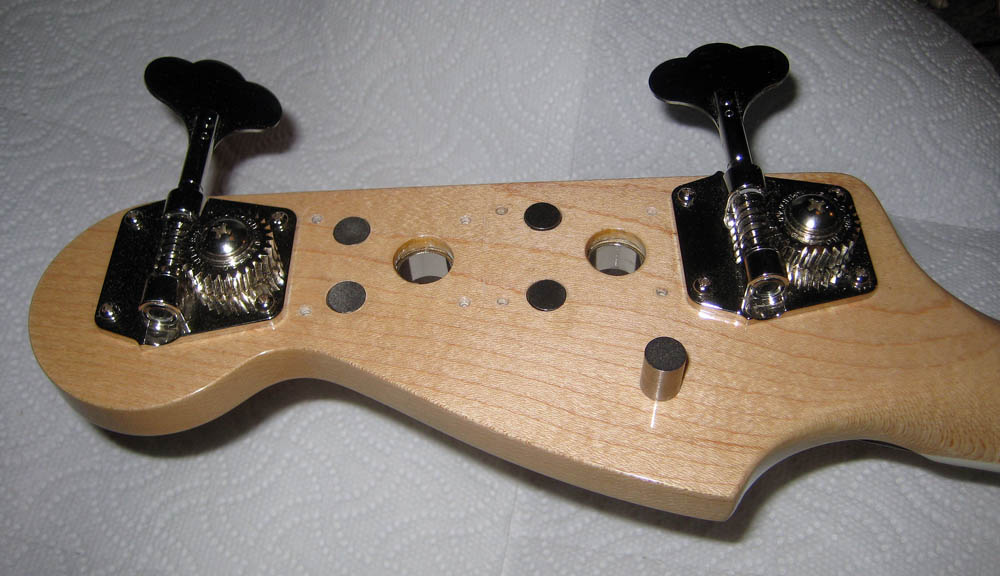
i first tested it with only 1 oz added (under the A string key), and while it was a bit better, the dead spot was still noticeable. while testing, i left the holes slightly shallow so that the base plate of the tuning key would 'clamp it in place'. so i ended up using four cylinder weights (two under the D key and two under the A key). i tested it again and the dead spot was not only gone, but it didn't seem to affect any of the other notes, so i bored the holes so the weights would sit flush and epoxied them in. the 2oz of added weight has not upset the balance of the bass at all, it's still very lightweight at 7lbs 11oz, and all of the notes sustain and ring out beautifully (running a set of TI Jazz flats on it). i couldn't be happier with the bass now.
sorry for the long post, but i just thought that i'd post this as a possible (and an invisible) solution for those of you that may be experiencing a dead spot issue.
way back in 1979, when i discussed this issue that's very common on Fender basses with Leo Fender, he pulled out a small C clamp, clamped it on the headstock and said, 'play it now'. sure enough, it was gone, and although it probably moved to a lower note, i sure as heck couldn't find it. this is also the same premise/solution that the 'fathead' (brass plate on the back of the headstock) and later 'fatfinger' (a small c clamp), both of which have been discontinued, were based on, which is adding mass to the headstock to change the neck's resonant frequency.
so, yesterday, i started experimenting with various sized (and weight) C clamps to see if i could solve the dead D problem on my bass. since the body is so lightweight, i wanted to make sure that i added only enough weight to solve the problem and not create any neck dive/balance issues. i'm using gotoh's res-o-lite reverse tuning heads on it, which made it balance perfectly. after a bit of experimentation, i found that the smallest 3 oz C clamp that i had, completely eliminated it. i figured that if i installed a standard weight set of heads (or just two of them) it would solve the problem, but i didn't want two of one type, and two of the other. i also didn't want to just replace the res-o-lites with a whole set of standard weight ones, since 6.5oz would surely create neck dive, plus the res-o-lites are so much smoother and have no slop in them whatsoever. so, i went to my local hobby shop and bought a pack of tungsten 3/8' cylinder weights that are used for pinewood derby cars.
tungsten is the new replacement for lead, since it's non toxic and actually weighs 1.7 times more than the same size piece of lead (which i learned 8 years ago when i was making and balancing my own r/c micro helicopter blades).
anywho, figuring that it was going to take at least 2 oz of weight to solve it, i removed two machine heads and bored two 3/8" holes under each of them to inlay the 1/2oz tungsten cylinders (see pic below with all four inlaid and an extra one laying on top to show it's size)).
i first tested it with only 1 oz added (under the A string key), and while it was a bit better, the dead spot was still noticeable. while testing, i left the holes slightly shallow so that the base plate of the tuning key would 'clamp it in place'. so i ended up using four cylinder weights (two under the D key and two under the A key). i tested it again and the dead spot was not only gone, but it didn't seem to affect any of the other notes, so i bored the holes so the weights would sit flush and epoxied them in. the 2oz of added weight has not upset the balance of the bass at all, it's still very lightweight at 7lbs 11oz, and all of the notes sustain and ring out beautifully (running a set of TI Jazz flats on it). i couldn't be happier with the bass now.
sorry for the long post, but i just thought that i'd post this as a possible (and an invisible) solution for those of you that may be experiencing a dead spot issue.