Hi everybody.
After a 21-month waiting time, yesterday I received the superb instrument that the great CHRIS STAMBAUGH made for me (I didn't mention anything before because I wanted it to be a complete surprise).
At the beginning of 2010, and after a lot of hard work, I had saved enough money to make one of my dreams come true: Having an instrument that joins all what I like to hear/see/feel from a bass in one single entity. After making an extensive research through TalkBass, I picked a handful of names to finally settle on Mr. Chris Stambaugh as the one who was going to bring my baby to life. After some e-mail exchanges explaining him what I wanted, he sent me a quote and I sent him the advance payment almost immediately. Along with my payment report, I sent him a 9-page document with full specifications, which he perfectly met. I was very picky about most items in the specs sheet, while a few others were direct result of his suggestions since I hadn't a particular preference. There's a long story behind the whole process and I don't want to bore you with excessive details, so I'll go direct to the point:

That's it: A 24-fret 5-string headless multiscale bass with Gaboon ebony fingerboard, Mother Of Pearl block inlays, African mahogany body with a quilted maple top and a maple neck. The neck is bound...

...and there's an ultra-nice detail at the 12th fret:

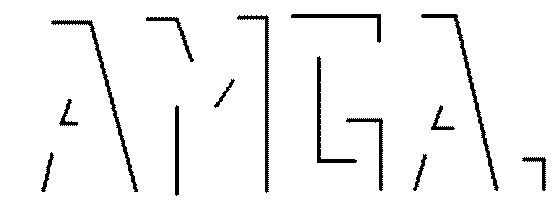
Which is the signature I use for my music transcriptions:

The body shape was my entire design with the exception of the oblique cut at the bottom, since I didn't know what to do to accommodate the slanted bridge saddles. I even emphasized the fact that most basses' horns, viewed as a whole, create sort of an "E" or a backwards "3". I didn't want that. If you recall the Rickenbacker 4003 or the EBMM Bongo shapes, both horns create sort of a crescent moon, and that's what I wanted for my bass.


One of the reasons why the bass took so long to be completed was that Gaboon ebony wasn't readily available. Mr. Stambaugh suggested me to use Macassar ebony, but I preferred to wait. I wanted a real black fingerboard for my instrument.

^^^^ This was extremely important for me. I wanted a bolt-on bass, but I've always disliked the fact that access to the 24th fret on most bolt-on basses isn't that easy compared to a neck-thru instrument. Most people say that the problem is caused by the bulky neck heel, but after some research, I found that the neck heel isn't a problem for me. The problem is the lower horn, which gets in the way when trying to reach the 24th fret with the pinky. My new Stambaugh bass doesn't have that problem. Access to the 24th fret is very comfortable thanks to the way Mr. Stambaugh created the lower horn cutaway, allowing that "exceptional reach", as he called it.
Oh, the multiscale fingerboard. I NEVER played such thing before. I just found the concept logical and interesting and have never been afraid of it. After playing it, I can tell for sure that it's pretty easy to get used to that design.

Three Bartolini X55CBJD (split coil humbuckers). Plenty of tonal options.

Clockwise from right: Master volume - active/passive switch, pickup blend, bass/treble EQ (stacked), lo-mid/hi-mid EQ (stacked), passive tone control, piezo volume (yes, it has piezo saddles), three-position lever for combinations between center and bridge humbucker (center/both/bridge). The piezo saddles were another cause of delay. It seems that a headless tuning system with piezos is not common.


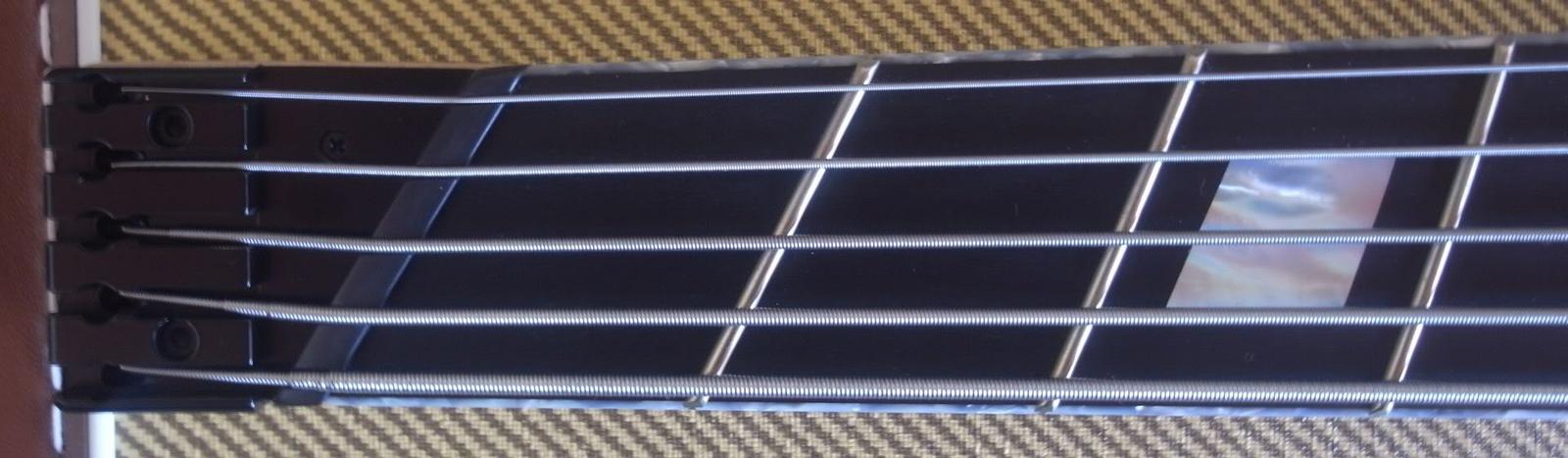
ABM headless tuning system. Accepts both single and double-ball strings.

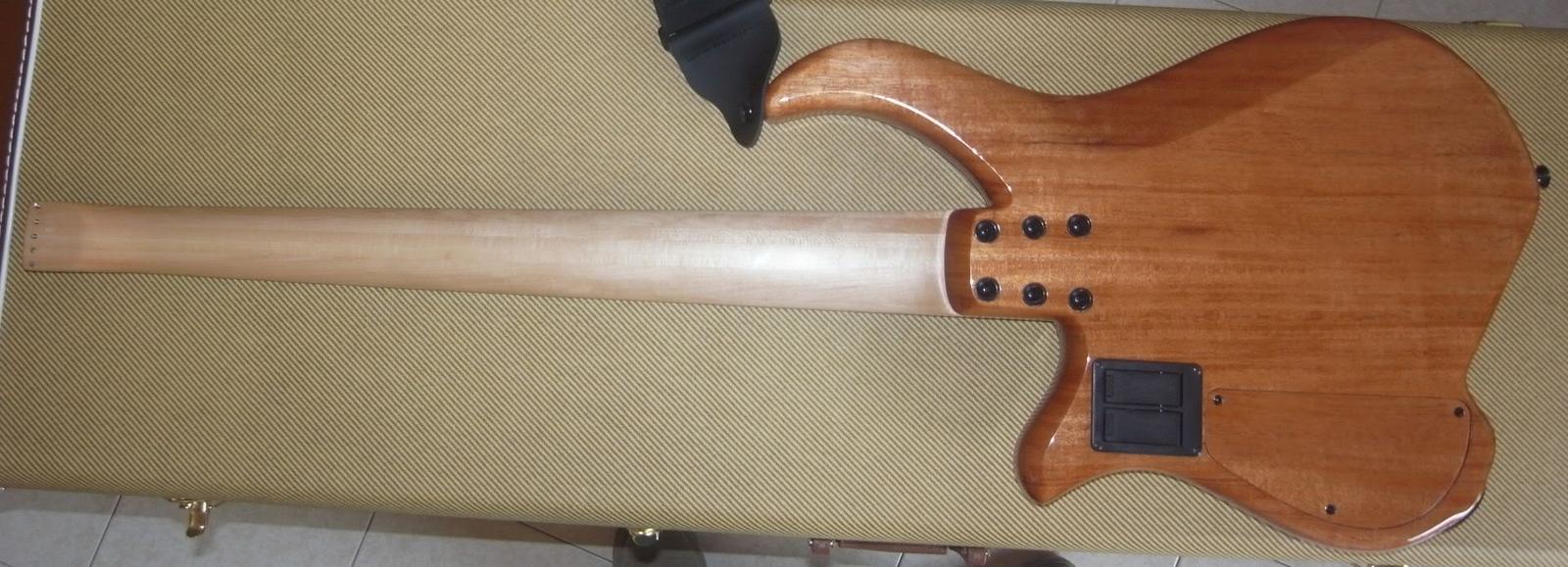
Six-bolt neck joint.

I'm sure that most people prefer different woods so different-colored wood stripes run along the neck. But for a headless neck, I prefer it to be as minimalistic as possible. It would have been a different story if I had chosen the neck to have a headstock (BTW, it would have been similar to that from the Ibanez Musician, which is my all-time favorite headstock). The neck profile is perfect for my taste (another aspect that I emphasized a lot): Wide (side to side) and thin (front to back).
Here's a complete specs sheet:
- Body: African mahogany
- Top: Quilted maple
- Neck: Maple
- Fingerboard: Gaboon ebony
- Fingerboard radius: Compound, 14" to 20"
- Inlays: MOP, block
- 5 strings, 24 frets
- Scale: 33" on the treble side, 36" on the bass side (perpendicular fret: 9th)
- String spacing: 18.25 mm. at the bridge (another "picky" request)
- Headless system: ABM
- Piezo saddles: Graph Tech
- Pickups: Three Bartolini X55CBJD (split coil humbuckers)
- Preamp: Flexcore 2t.2stk Modular Multiband Internal Preamplifier by Michael Pope Design
- Controls: Master volume - active/passive switch, pickup blend, stacked bass/treble EQ, stacked lo-mid/hi-mid EQ, passive tone control, piezo volume, three-position lever for both middle and bridge humbuckers
- Batteries: Two 9V (18V preamp)
Again, and for those who ask what's the point of having a custom-made bass, I can tell from my perspective that nothing compares to develop your own preferences through experience and put them all together in one single instrument. Having an instrument that leaves the player 100% satisfied is very difficult, and I think that a custom-made bass is the way to go in that pursuit, specially if you find a luthier so professional and committed to excellence like Chris Stambaugh. Needless to say, I'm very happy and proud to be able to say "if you want to truly know my personality as a bassist, just play this instrument", no matter that I'm definitely not a world-class player. Thank you for your time!
After a 21-month waiting time, yesterday I received the superb instrument that the great CHRIS STAMBAUGH made for me (I didn't mention anything before because I wanted it to be a complete surprise).
At the beginning of 2010, and after a lot of hard work, I had saved enough money to make one of my dreams come true: Having an instrument that joins all what I like to hear/see/feel from a bass in one single entity. After making an extensive research through TalkBass, I picked a handful of names to finally settle on Mr. Chris Stambaugh as the one who was going to bring my baby to life. After some e-mail exchanges explaining him what I wanted, he sent me a quote and I sent him the advance payment almost immediately. Along with my payment report, I sent him a 9-page document with full specifications, which he perfectly met. I was very picky about most items in the specs sheet, while a few others were direct result of his suggestions since I hadn't a particular preference. There's a long story behind the whole process and I don't want to bore you with excessive details, so I'll go direct to the point:
That's it: A 24-fret 5-string headless multiscale bass with Gaboon ebony fingerboard, Mother Of Pearl block inlays, African mahogany body with a quilted maple top and a maple neck. The neck is bound...
...and there's an ultra-nice detail at the 12th fret:
Which is the signature I use for my music transcriptions:
The body shape was my entire design with the exception of the oblique cut at the bottom, since I didn't know what to do to accommodate the slanted bridge saddles. I even emphasized the fact that most basses' horns, viewed as a whole, create sort of an "E" or a backwards "3". I didn't want that. If you recall the Rickenbacker 4003 or the EBMM Bongo shapes, both horns create sort of a crescent moon, and that's what I wanted for my bass.
One of the reasons why the bass took so long to be completed was that Gaboon ebony wasn't readily available. Mr. Stambaugh suggested me to use Macassar ebony, but I preferred to wait. I wanted a real black fingerboard for my instrument.
^^^^ This was extremely important for me. I wanted a bolt-on bass, but I've always disliked the fact that access to the 24th fret on most bolt-on basses isn't that easy compared to a neck-thru instrument. Most people say that the problem is caused by the bulky neck heel, but after some research, I found that the neck heel isn't a problem for me. The problem is the lower horn, which gets in the way when trying to reach the 24th fret with the pinky. My new Stambaugh bass doesn't have that problem. Access to the 24th fret is very comfortable thanks to the way Mr. Stambaugh created the lower horn cutaway, allowing that "exceptional reach", as he called it.
Oh, the multiscale fingerboard. I NEVER played such thing before. I just found the concept logical and interesting and have never been afraid of it. After playing it, I can tell for sure that it's pretty easy to get used to that design.
Three Bartolini X55CBJD (split coil humbuckers). Plenty of tonal options.
Clockwise from right: Master volume - active/passive switch, pickup blend, bass/treble EQ (stacked), lo-mid/hi-mid EQ (stacked), passive tone control, piezo volume (yes, it has piezo saddles), three-position lever for combinations between center and bridge humbucker (center/both/bridge). The piezo saddles were another cause of delay. It seems that a headless tuning system with piezos is not common.
ABM headless tuning system. Accepts both single and double-ball strings.
Six-bolt neck joint.
I'm sure that most people prefer different woods so different-colored wood stripes run along the neck. But for a headless neck, I prefer it to be as minimalistic as possible. It would have been a different story if I had chosen the neck to have a headstock (BTW, it would have been similar to that from the Ibanez Musician, which is my all-time favorite headstock). The neck profile is perfect for my taste (another aspect that I emphasized a lot): Wide (side to side) and thin (front to back).
Here's a complete specs sheet:
- Body: African mahogany
- Top: Quilted maple
- Neck: Maple
- Fingerboard: Gaboon ebony
- Fingerboard radius: Compound, 14" to 20"
- Inlays: MOP, block
- 5 strings, 24 frets
- Scale: 33" on the treble side, 36" on the bass side (perpendicular fret: 9th)
- String spacing: 18.25 mm. at the bridge (another "picky" request)
- Headless system: ABM
- Piezo saddles: Graph Tech
- Pickups: Three Bartolini X55CBJD (split coil humbuckers)
- Preamp: Flexcore 2t.2stk Modular Multiband Internal Preamplifier by Michael Pope Design
- Controls: Master volume - active/passive switch, pickup blend, stacked bass/treble EQ, stacked lo-mid/hi-mid EQ, passive tone control, piezo volume, three-position lever for both middle and bridge humbuckers
- Batteries: Two 9V (18V preamp)
Again, and for those who ask what's the point of having a custom-made bass, I can tell from my perspective that nothing compares to develop your own preferences through experience and put them all together in one single instrument. Having an instrument that leaves the player 100% satisfied is very difficult, and I think that a custom-made bass is the way to go in that pursuit, specially if you find a luthier so professional and committed to excellence like Chris Stambaugh. Needless to say, I'm very happy and proud to be able to say "if you want to truly know my personality as a bassist, just play this instrument", no matter that I'm definitely not a world-class player. Thank you for your time!