• TalkBass has been independent since 1998. Add your voice.
    Create a free account to reply to discussions, view embedded media, and browse with fewer display ads.
    Join freeLog in
    Want zero display ads or expanded classifieds tools? Compare plans.
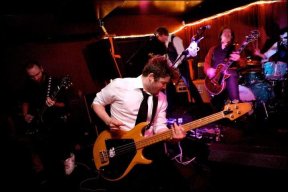
I can't figure out this fretboard

I don't know, but I've been sitting here for like 20 minutes trying to figure out what the hell it would sound like, or even how'd you play some of those notes...


edit: after some google-research (the best kind of research), I think this has something to do with it? I'm just as confused as before, tho :hmm:
 
Ethon said:
I don't know, but I've been sitting here for like 20 minutes trying to figure out what the hell it would sound like, or even how'd you play some of those notes...


edit: after some google-research (the best kind of research), I think this has something to do with it? I'm just as confused as before, tho :hmm:

I would think that all the frets would need to be the same across all strings for that to work. Just pushing some closer together or farther apart and adding in a few extra between where "normal" frets are.

Edit: Unless someone was really thinking and cut out the parts of the frets on the strings that would produce out of scale notes. So that is probably what they did, just left the frets on for the strings that would have notes in scale. Pretty cool idea actually.

Edit Again: And the more I think about it, it would also make it a hell of a lot easier to fret in some places!
 
Judging by the name if the picture (warw_th5jintonat.jpg), I'd say it's set up for playing using just intonation in more than one key.

For instance, in the key of C a just-intoned major 3rd (C to E) would need to be a bit flatter than what you'd normally find on a guitar or bass. However, if you moved to the key of A (and left A where it was), that A-E interval (a fifth) would be too flat, and sound very bad.

Just intonation yields what, for stringed instruments, are the most consonant-sounding intervals within one key. But, you can't just shift keys without re-adjusting all the distances. Equal temperament (what guitars, basses, and most everything else these days use) is a system where the just-intoned intervals are all tweaked just a little bit so that it's not perfectly consonant, but it's equally bad in all keys. :)
 
Brendan said:
It's a microtonal neck, for sure. There are some variations; 22 tet, 31 tet, etc.

http://www.livejournal.com/community/cityoftheasleep/

[Invalid or Expired Link Removed]

Here's a dude who does some pretty cool stuff with it. Check out "Numerology" and "Revenge of the Inorganic Compounds"

And google microtonal.

Some interesting stuff there - but I'm not sure if the sounds I like are any of the really exotic intervals, or just some familiar ones that are also found in those scales.

Also, his little manifesto sounds like someone who doesn't really understand music theory:

Folks, 12-equal is breathing its last breaths. For truly interesting new music, Xenharmonic music is the only way to go. Really, the range of emotion that music is capable of expressing has been horribly restricted ever since Western culture adopted 12-equal and abandoned all other temperaments. In 12-equal, your palette of consonance is limited to "major" and "minor"...a two-party system! Why should you accept such restrictions when there is a wide wonderful world of sub-minor, supra-minor, super-major, sub-major, and neutral intervals waiting to add thought-provoking depth and nuance to your music?

There's a whole lot of subtlety and "in-between" you can get just using the 12-tone scale. Of course, adding more intervals adds more range - I'm not disagreeing with that.

Also, there's a fundamental tie between the timbre of an instrument (the harmonics produced when you pluck the string, for example) and the scale used on it. Some of the music he's written for 22-tet etc may sound much different (perhaps better?) on a different instrument. For example, metallophones used Indonesian gamelan music have a very different overtone series than stringed instruments. They are often tuned in a 9-tone equal temperament, which would sound pretty bad on a stringed instrument but sounds just fine in that context.

Drums are another example. You can tune drums (or cymbals) to 12-tet (Terry Bozzio is only one example) and it sounds OK, but there are other scales out there that fit the overtones better.