A few weeks ago a thread popped up regarding an 8 string ERB build, which prompted a PM or two with John Turner regarding the relative absense of extended range players here at TB. As JT suggested in a PM, extended range guys used to get a bit of a beating here but times have changed .... stricter rules regarding needless bashing of gear have helped to calm the former stormy waters. And it doesn't hurt that an Admin is a significant ERB player ... 
At any rate, JT was right .... a lot of ERB guys have either split or are just lurking and it's time to come back into the light . Hopefully this thread can help to ease the big-necks back onto the TB scene without getting all ugly. So, some suggested guidelines to kind of move this along:
I know a lot of players here don't understand the ERB thing and think that 4 (or 5) strings should be enough, but there are many that like the additional range ERB's provide. Let's make Guideline #1 "Accept the fact that some people like extended range basses" and try not to be mean spirited regarding string count.
There is always debate about what an extended range bass actually is .... 5 string? 6 string? 9 string? It seems to be generally accepted that any bass 6 strings and up is an ERB (since 5 string basses have become so numerous), but in reality any thing that "extends" the bass range beyond EADG could be considered extended range. IMO 6+ strings easily fits most any definition, as do sub-contra range (low F#, C#) or less commonly 5ths tuning or ultra long scale (ex: 39" Knucklebass). But in the spirit of unity, let's make Guideline #2 "String count doesn't matter".
Not all extended range basses are exotic custom made "coffee table top" $5K one of a kinds. Ever since Conklin made the very affordable Groove Tools GT-7 available to ERB players, lesser known factories have been pumping out 6,7 & 8 string basses, too. Brice, Douglas, Galveston, Tennessee, AntonioTsai, etc have been making affordable ERB's for a while now, and they are no longer automatically pieces of junk. You don't need to play a Roscoe, Stambaugh, Skjold, Clement, FBB, LowEnd, Conklin, ACG, Sei, whatever to be in the "club" .... extended range is extended range, regardless of the builder. Guideline #3: "Price doesn't matter"
Another huge misconception is that ERB guys are all soloing/tapping/shredding wankers that don't care about the groove. This may be a good opportunity to have the masses find out that, in fact, most ERB guys are groovers first and foremost. Don't let the YouTube vids fool you, there is a whole lot more to extended range than playing video game themes. So, let's try for Guideline #4: "An extended range bass is, indeed, a bass", not a harp or piano ...
Just for clarity, these guidelines are only suggested and not rules of any sort. Additions, deletions, corrections are more than welcome. I've never been a "club member number guy", but if that works for anyone we can do that, too. Let's see how far we can get, keeping it civil and informational .....
edit: Numbers being issued after all .... see post # 31
At any rate, JT was right .... a lot of ERB guys have either split or are just lurking and it's time to come back into the light
. Hopefully this thread can help to ease the big-necks back onto the TB scene without getting all ugly. So, some suggested guidelines to kind of move this along:I know a lot of players here don't understand the ERB thing and think that 4 (or 5) strings should be enough, but there are many that like the additional range ERB's provide. Let's make Guideline #1 "Accept the fact that some people like extended range basses" and try not to be mean spirited regarding string count.
There is always debate about what an extended range bass actually is .... 5 string? 6 string? 9 string? It seems to be generally accepted that any bass 6 strings and up is an ERB (since 5 string basses have become so numerous), but in reality any thing that "extends" the bass range beyond EADG could be considered extended range. IMO 6+ strings easily fits most any definition, as do sub-contra range (low F#, C#) or less commonly 5ths tuning or ultra long scale (ex: 39" Knucklebass). But in the spirit of unity, let's make Guideline #2 "String count doesn't matter".
Not all extended range basses are exotic custom made "coffee table top" $5K one of a kinds. Ever since Conklin made the very affordable Groove Tools GT-7 available to ERB players, lesser known factories have been pumping out 6,7 & 8 string basses, too. Brice, Douglas, Galveston, Tennessee, AntonioTsai, etc have been making affordable ERB's for a while now, and they are no longer automatically pieces of junk. You don't need to play a Roscoe, Stambaugh, Skjold, Clement, FBB, LowEnd, Conklin, ACG, Sei, whatever to be in the "club" .... extended range is extended range, regardless of the builder. Guideline #3: "Price doesn't matter"
Another huge misconception is that ERB guys are all soloing/tapping/shredding wankers that don't care about the groove. This may be a good opportunity to have the masses find out that, in fact, most ERB guys are groovers first and foremost. Don't let the YouTube vids fool you, there is a whole lot more to extended range than playing video game themes. So, let's try for Guideline #4: "An extended range bass is, indeed, a bass", not a harp or piano ...
Just for clarity, these guidelines are only suggested and not rules of any sort. Additions, deletions, corrections are more than welcome. I've never been a "club member number guy", but if that works for anyone we can do that, too. Let's see how far we can get, keeping it civil and informational .....
edit: Numbers being issued after all .... see post # 31


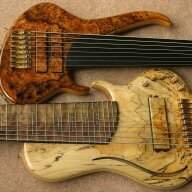







 I may have to give it up though, shoulder problems, another "age thing"
  but have to say, the bass plays SO easily!! I may just resign it to sit down jobs and home recording because it is SO much fun to play, and there's another big plus to ERB's too,....they intimidate the HELL out of guitar players!