
Hi everyone!
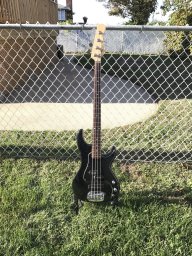
Couple of months ago I picked up a Brice sixer (HB406) as my backup bass. I intended to use it primarily for the outside gigs when the heat index is over 100 and humidity is around 90% (yeah welcome to South Carolina ) or any other place where I would not feel comfortable bringing any expensive gear with me. Since I've had it for a little while now, I thought I'd write a review on it. As you can not play it before buying it, it is helpful to know as many details as possible.
Most TB'ers who have reviewed this bass always agreed that "for the money" they are pretty good. Well, I'd like to take out "for the money" part and just look at this bass from the player's perspective: how it performs on daily basis and what to expect from it live or in a more controlled environment.
When I initially got this bass I was quite surprised, as the workmanship was pretty good - no rough edges on the frets, smooth neck, decent hardware. The neck is very comfortable - the profile is quite slim front to back - and fast if you are accustomed to narrow string spacing (16mm). It is not heavy and can easily be used for extended sets without breaking your back. After closer inspection though you can definitely tell that corners were cut to keep the price down: the neck pocket is not too tight - you can slip in a business card between the sides of the neck and the body. The body itself is not too ergonomic: it is not rounded much and feels a bit slab-like. It does not interfere much when playing, but it definitely is not as comfortable as many other basses.
Out of the box it requires a thorough setup. The nut was way too high and needed to be filed extensively . It is as if it was pre-slotted, but not fully finished. There were couple of high frets - not too high, but once you lower the action, you can spot them. I was very happy to find out that there were no dead spots on this bass. On the other hand, the neck needed to be shimmed in order to achieve even moderately low action. It is acceptable if you use tapered strings and like medium action, but if you like standard strings with low action, shimming may be necessary. In other words, you can hardly call it gig-ready on arrival. After some work though, it can be set up to play comfortably and you do not have to fight it when playing live.
The B string though is exceptionally week. Given that it is 35' and has dual truss-rods it borders on unacceptable. There are standard cures - heavier gauge strings, etc - I am still in the process of figuring out what works best for it. But if you expect a good B string out of the box, you'll send it back right away. It has overall a little bit peculiar attitude towards stings. It can be strung through the body, which means it needs extra long strings. DR Longnecks (tapered) fits it perfectly, but most other strings would have to be strung through the bridge. It seems the design team threw all features that look good on paper, but no one took the time to balance it out and actually test it.
It sounds OK. Not good, but not too bad either. Generic would be appropriate term I guess. I works great for a smoky bar, but it is does not have much character or growl. It is on the darker, warmer side. If you have a decent amp which can color it enough, it can work. But it definitely needs some help in this department. Pre-amp is noisy and does not do too much. Bass boost adds a lot of mud, high boost peak is set between highs and high-mids, so it ends up boosting both and does not add character to either. Once again it is generic. Pickup and preamp upgrade would be very high on the list if you want to keep it.
I have decided to keep it. It is good enough to be a backup, and solid enough to last (or so it seems). I will most definitely upgrade pickups if I am able to completely solve the B string issue. The jury is still out on that matter but I think I will be able to figure it out. Overall I think it was a good purchase, as long as you do not expect the quality of a boutique bass. I this case you get what you pay for.
Couple of months ago I picked up a Brice sixer (HB406) as my backup bass. I intended to use it primarily for the outside gigs when the heat index is over 100 and humidity is around 90% (yeah welcome to South Carolina
) or any other place where I would not feel comfortable bringing any expensive gear with me. Since I've had it for a little while now, I thought I'd write a review on it. As you can not play it before buying it, it is helpful to know as many details as possible. Most TB'ers who have reviewed this bass always agreed that "for the money" they are pretty good. Well, I'd like to take out "for the money" part and just look at this bass from the player's perspective: how it performs on daily basis and what to expect from it live or in a more controlled environment.
When I initially got this bass I was quite surprised, as the workmanship was pretty good - no rough edges on the frets, smooth neck, decent hardware. The neck is very comfortable - the profile is quite slim front to back - and fast if you are accustomed to narrow string spacing (16mm). It is not heavy and can easily be used for extended sets without breaking your back. After closer inspection though you can definitely tell that corners were cut to keep the price down: the neck pocket is not too tight - you can slip in a business card between the sides of the neck and the body. The body itself is not too ergonomic: it is not rounded much and feels a bit slab-like. It does not interfere much when playing, but it definitely is not as comfortable as many other basses.
Out of the box it requires a thorough setup. The nut was way too high and needed to be filed extensively . It is as if it was pre-slotted, but not fully finished. There were couple of high frets - not too high, but once you lower the action, you can spot them. I was very happy to find out that there were no dead spots on this bass. On the other hand, the neck needed to be shimmed in order to achieve even moderately low action. It is acceptable if you use tapered strings and like medium action, but if you like standard strings with low action, shimming may be necessary. In other words, you can hardly call it gig-ready on arrival. After some work though, it can be set up to play comfortably and you do not have to fight it when playing live.
The B string though is exceptionally week. Given that it is 35' and has dual truss-rods it borders on unacceptable. There are standard cures - heavier gauge strings, etc - I am still in the process of figuring out what works best for it. But if you expect a good B string out of the box, you'll send it back right away. It has overall a little bit peculiar attitude towards stings. It can be strung through the body, which means it needs extra long strings. DR Longnecks (tapered) fits it perfectly, but most other strings would have to be strung through the bridge. It seems the design team threw all features that look good on paper, but no one took the time to balance it out and actually test it.
It sounds OK. Not good, but not too bad either. Generic would be appropriate term I guess. I works great for a smoky bar, but it is does not have much character or growl. It is on the darker, warmer side. If you have a decent amp which can color it enough, it can work. But it definitely needs some help in this department. Pre-amp is noisy and does not do too much. Bass boost adds a lot of mud, high boost peak is set between highs and high-mids, so it ends up boosting both and does not add character to either. Once again it is generic. Pickup and preamp upgrade would be very high on the list if you want to keep it.
I have decided to keep it. It is good enough to be a backup, and solid enough to last (or so it seems). I will most definitely upgrade pickups if I am able to completely solve the B string issue. The jury is still out on that matter but I think I will be able to figure it out. Overall I think it was a good purchase, as long as you do not expect the quality of a boutique bass. I this case you get what you pay for.








 , but I have played $600 basses that weren't made as well as this Brice and $900 basses that played worse.


