So if you mod the short to take a complete long scale string ...and the longscale string on the short is now exactly as it would have been on the long (thanks to a changed anchor point)...then the tension on that string is the same as if you hadn't done anything at all and just put a shortscale string on?
Well, yes and no. The actual tension in the string is the same. The tension is determined by the scale length (the distance between the bridge saddle and the nut), the gauge/construction of the string, and the note that it is tuned to. Adding extra length at either end, between the saddle and the anchor point/tailpiece, or between the nut and the tuner, does not change the tension of the string.
However, adding that extra length at either end
does change the sound and feel of the string. It's a factor I call the "snap" of the string, which is often confused with the tension. It works like this: When you pull sideways on the string, as you are plucking it, the string is stretching like a long spring. Then you release it, and it snaps back to straight, overshoots it, and goes into the back and forth oscillation.
When you add extra length to the string at either end, you are making that spring longer. So, you have to pull it farther sideways to get the same feel on your fingertip, because the string stretches easier.
For example, suppose you have two basses, same scale length, same string, tuned to the same note. One has the standard short distance between the bridge saddle and the anchor point. The other has an extra 3" of length back to the anchor point. Again, the actual tension in both strings will be the same.
But, if you pull the string sideways with a force of, say, 1 pound on your fingertip, there will be a difference. With the extended string, you have to pull the string a longer distance to the side to reach that 1 pound load. It's because there's more length of string to stretch.
Now, when you release the strings of these two basses, the extended string has a longer distance to travel to get back to center. The physics of it is that they will both accelerate at the same rate, because the tension is the same. The extended string will take longer to reach center, but it crosses over center at higher velocity and goes farther to the other side before rebounding. This is the effect that I call "snap". Increasing the overall length of the string increases the snap, regardless of the scale length.
How does this affect the sound? Increasing the snap mainly changes the attack curve of the note. It increases the pulse at the beginning of the note, which is why I call it snap. Think of the percussive sound of upright basses. They have a huge amount of snap because of the very long overall string length. The increased pulse can be heard through the amp, and also unplugged.
The funny thing about increasing the snap is that players will describe it in opposite ways. Some will say that the tension is higher, because they hear that extra pop on the note. Others will say that the tension is lower, because the string feels softer to their fingertip. But actually, the tension is exactly the same.
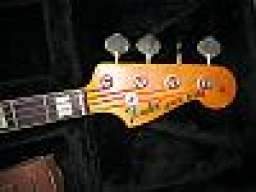
It's the same factor in all those long arguments about reverse headstocks, and how increasing the length between the nut and the tuner of the B string will increase the "tension" of the string to improve the sound, etc. It doesn't actually increase the tension, but it increases the snap. Which may make the B string sound more like the other strings.
Anyway, that's why we do it. Increasing the overall string length to increase the snap is most effective on instruments that are made to be plucked hard in an upright-like style. If you play with a light touch and low action, then you probably wouldn't notice the difference.
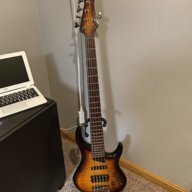
1stnamebassist and GIbrat51 pointed out my SSB line as an example of this design feature. It's 30 1/2" scale length, but uses standard Fender-length 34" scale strings. I fit in all the extra string length with both a long headstock and a real long distance back to the tailpieces. I designed the bass that way primarily to get that extra percussive snappy sound.
Being able to use standard length strings is an extra benefit, but it wasn't the main reason I did it.