
Enjoy the benefits of a premium membership!
Upgrade Account
-
TalkBass has been independent since 1998. Add your voice.
Create a free account to reply to discussions, view embedded media, and browse with fewer display ads.
Join free Log in
Want zero display ads or expanded classifieds tools? Compare plans.
You are using an out of date browser. It may not display this or other websites correctly.
You should upgrade or use an alternative browser.
You should upgrade or use an alternative browser.
Did They Ever Make A Shortscale That...
- Thread starter ZenG
- Start date
More options
Who Replied?

Bruce Johnson makes exquisite copies of Ampeg basses, and makes a short scale bass (the SSB) specifically designed to use long scale strings. He posts here on TB frequently; or you can get in touch with him at Bruce Johnson's Extremely Strange Musical Instrument Company. And, My Gretsch Broadkaster (a short scale bass) has no trouble with long scale strings (there's a set of them on it now, in fact). But it's a rather large-bodied hollow body bass (basically a 4-stringed Tennessee Rose guitar), with a trapeze tailpiece; and it's a very long way from there to the upper tuners on the headstock...

Even their HY5s are designed to install 35" stringsBirdsong basses are made to be used with longscale strings.


Since short scale strings are very scarce and the string thickness .110 makes it even harder and with the CAD $ in the crapper. I can not see myself ever buying short scale strings. That said...I have been using long scale strings on short scale basses for several years and never had one break. I have used both Flat and round wound.
The Cougar basses made by Crucianelli take long scale strings because there's quite a bit of space between the bridge and the tailpiece.
I'm sure there are more types that have a similar set up.

Not unheard of but infrequent. For example, all but a couple of D'Addario bass strings, as per their tension chart, have one linear mass value ("unit weight") per type and gauge, across the four different length options:Would there not be problems with string tension? I imagined that short scale strings were made to counter the lack of tension in a shorter scale.
http://www.daddario.com/upload/tension_chart_13934.pdf
There are exceptions: for example the XB50S -70S -85S and -105S (short scale nickel-plated steel rounds) are more massive than their LS counterparts.
Other makers offer shortie sets with different gauges from long-scale ones, and they might also have unit weights tailored towards the intended application (more massive thus tighter on shortie basses they're meant for).
For the most part, though, short-scale strings tend to be identical to long-scale strings from the same product line, only wound shorter.

What kind of strings do you want but you can't have? Sure, there are more long scale options, but there are plenty of good short scale options available.By utilizing a certain design, can use longscale strings?
I Know they've used longer strings with through-body design on such basses as the Mustang.
But those aren't full longscale strings....
I'm thinking if a shortscale body is cut a certain way....and uses through-body string design ...it could be done. Long scale strings aren't all THAT MUCH longer than shortscale...
Perhaps a slight protrudingextension on the end of the body itself ( call it a duck-tail) plus string-through design should it.
Scale length would still be short. Bridge/saddles left in exact position for scale length. Just change the anchor point of the strings by design to facilitate use of longscale strings.
Then all of us short worshippers would have zero trouble getting strings.(Much more selection and availibility)
And I imagine the bass would, on the whole , sound better too.
I can see a body design in my mind that would do it........just wondering if it's been done before....I'll draw up a sketch and post...
Would there not be problems with string tension? I imagined that short scale strings were made to counter the lack of tension in a shorter scale.
Not really the situation here, the strings are simply sorter and typically lighter gauge to make playing even easier. Both factors lowered tension. Even using long scale sets in typical long scale gauges the tension will still be lower.

I cut down long scale strings for short scales on occasion, I know it's supposed to cause trouble wrapping "real string" around the tuners, but honestly, it has rarely, if ever, caused me any problems. YMMV, but in my book, any short scale bass is "designed" to take long scale strings, it's the other direction that's more problematic. 

Not sure if this is related, but Status Graphite has the 'Bendwell' that was inspired by Mark King. It's a 32" scale option with an extension beyond the nut that enables bending/tremolo effects and allows the bass to take 34" strings, regular or double ball. I have it but don't use it for effects, just for the 32" scale to make it easier on my aging hands.
As suggested below, most hollow bodies are like that.By utilizing a certain design, can use longscale strings?
I Know they've used longer strings with through-body design on such basses as the Mustang.
But those aren't full longscale strings....
I'm thinking if a shortscale body is cut a certain way....and uses through-body string design ...it could be done. Long scale strings aren't all THAT MUCH longer than shortscale...
Perhaps a slight protrudingextension on the end of the body itself ( call it a duck-tail) plus string-through design should it.
Scale length would still be short. Bridge/saddles left in exact position for scale length. Just change the anchor point of the strings by design to facilitate use of longscale strings.
Then all of us short worshippers would have zero trouble getting strings.(Much more selection and availibility)
And I imagine the bass would, on the whole , sound better too.
I can see a body design in my mind that would do it........just wondering if it's been done before....I'll draw up a sketch and post...
If you want to use long scale strings, just add something to function as the tailpiece 3 inches back from the bridge or if it's a design with the bridge at the tail of the instrument, around back with something to guide the strings around (a rounded piece of wood would work nicely.
As far as going through the body - if it's a full thickness body that should more or less do it. as you say there's only a few inches difference. You are just trying to avoid wrapping the untapered part of the string around the tuner - which is really only a problem on the E anyway.
OR just use long scale strings! I have never bought short scale strings for my danelectros (I'm not opposed to them, just can't even find them when I want them) and they are super short string-wise and have skinny little guitar tuners - you just live with the fact that the string looks funny and sits weird on the headstock - it doesn't affect functionality.
would you settle for a medium scale bass that feels small when playing it and uses long scale strings?
Traveler Guitar TB-4P Electric Bass Travel Guitar
It's more radical but Traveler also makes a 30 inch in four and five strings:
[Invalid or Expired Link Removed]
[Invalid or Expired Link Removed]
[Invalid or Expired Link Removed]

Birdsong basses are made to be used with longscale strings.
I did not know that!
Not only that, but the B-string of my 31" scale Birdsong Hy5 is extra-long, in order to accommodate the twice-through-body stringing devised by (genius builder) Scott Beckwith!
So the issue is the speaking length of the string being suitable to the short scale, yeah?
I don't think that is generally the issue although it could be at the bridge end with some bridge designs. The problem or at least the perceived problem is that the fully wound part of the strings is going to extend past the tuners at the headstock end. Most people here say that putting the fully wound part of the string into the tuner is a no-no either because it won't fit or it will lead to string breakage and cutting down the windings will lead to the string unraveling. Maybe even cutting the string to length which is going to be done in the fully wound portion on a short scale bass will lead to unraveling.
If I understand what some short scale owners are saying above, those concerns are all nonsense. I have a short scale, a Squier VI, but so far I have only used strings made specifically for it so I can't offer any personal experience with either cutting down string windings or just cutting long scale strings to length. In fact the tremolo tailpiece on that bass anchors the strings well past the bridge so the string length needed is close to the full scale length anyway.

I saw a custom short scale 5 string bass on here a year or so ago that had the strings wrap all the way around the end of the bass. The ball ends went into keyhole slots on the back of the instrument.
The guy who designed it wanted extra string tension (myth) and the ability to use his favorite string that was only available in long scale (worked).
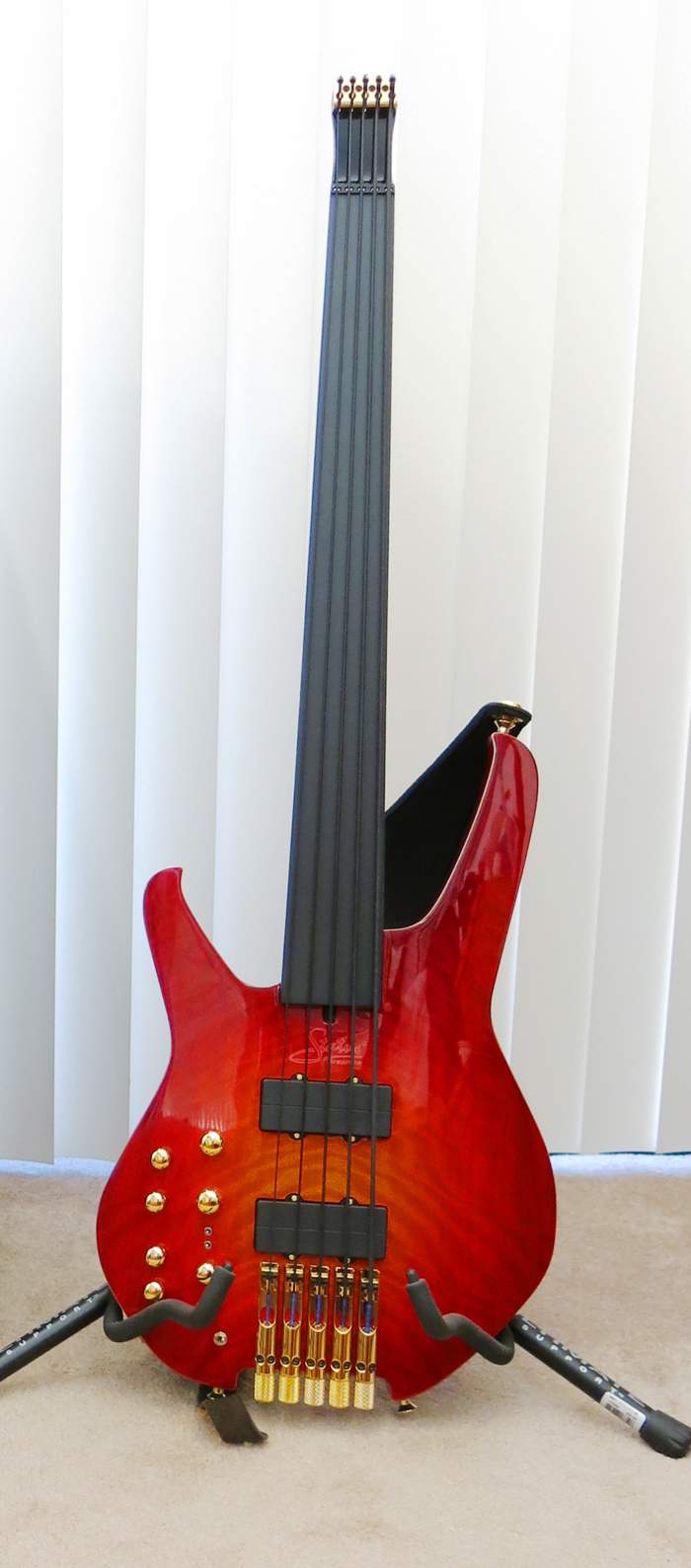
Like someone else said, reverse headstock is the easiest way to not have problems with ball-end-to-tuner string length. No special hardware required. Too bad most manufacturers don't get that.
The guy who designed it wanted extra string tension (myth) and the ability to use his favorite string that was only available in long scale (worked).
Like someone else said, reverse headstock is the easiest way to not have problems with ball-end-to-tuner string length. No special hardware required. Too bad most manufacturers don't get that.

It's more radical but Traveler also makes a 30 inch in four and five strings:
[Invalid or Expired Link Removed]
[Invalid or Expired Link Removed]
[Invalid or Expired Link Removed]
i used to own one - serial number 20 - but ended up selling it before i ever changed the strings. it doesn't feel right to play sitting down, and tone wasn't great to me. the TB-4P feels good to me and sounds at least better. i quite like the TB-4P, and it's on my potential buy list for 2016.

I play a Squier bronco upside down so the headstock is reversed. A long scale E string tapers down just before the post. The others do wrap around the thickest part of the string a little but the E string is fine.By utilizing a certain design, can use longscale strings?
I Know they've used longer strings with through-body design on such basses as the Mustang.
But those aren't full longscale strings....
I'm thinking if a shortscale body is cut a certain way....and uses through-body string design ...it could be done. Long scale strings aren't all THAT MUCH longer than shortscale...
Perhaps a slight protrudingextension on the end of the body itself ( call it a duck-tail) plus string-through design should it.
Scale length would still be short. Bridge/saddles left in exact position for scale length. Just change the anchor point of the strings by design to facilitate use of longscale strings.
Then all of us short worshippers would have zero trouble getting strings.(Much more selection and availibility)
And I imagine the bass would, on the whole , sound better too.
I can see a body design in my mind that would do it........just wondering if it's been done before....I'll draw up a sketch and post...

I'm commenting just to confirm that yes, it is sometimes very difficult to use long-scale strings with some short-scale basses, in some applications, regardless of whatever theoretical opinions some folks might have. While I don't doubt that some the posters here have successfully used long-scale strings on a short-scale basses, in the specific circumstances they faced, it does not work for all basses and situations.
For me, I specifically had issues using higher-gauge strings on my short-scale Flying V bass. I attempted to use long-scale strings, but it simply wasn't feasible. Once cut to the appropriate length, the E string was simply simply too fat to be reliably wound on the peg. I ultimately found a set of short scale strings that worked "well enough," although not ideally, due to the vastly reduced string options at that length (particularly at non-"standard" thicknesses). Also, just as a side note, I'm not talking about absurd gauges, but rather relatively typically "heavy" gauges for long-scale basses (around 115 or so for the E).
For me, I specifically had issues using higher-gauge strings on my short-scale Flying V bass. I attempted to use long-scale strings, but it simply wasn't feasible. Once cut to the appropriate length, the E string was simply simply too fat to be reliably wound on the peg. I ultimately found a set of short scale strings that worked "well enough," although not ideally, due to the vastly reduced string options at that length (particularly at non-"standard" thicknesses). Also, just as a side note, I'm not talking about absurd gauges, but rather relatively typically "heavy" gauges for long-scale basses (around 115 or so for the E).

Let me clarify. There seems to be some confusion as to what I'm getting at here.
(1) There is more choice for longscale strings. Where I live you can't even buy shortscale strings off the shelf. And if you go on the string sites , the choices for longscale strings are far wider.
(2) I'm NOT talking about whether or not it's ok to cut longscale strings for use on a shortscale.
(3) I'm assuming (erroneously or not), that if you use a complete longscale string on a short (after doing the necessary mods like on the SSB) that the tone may be superior.
(4) On any bass , as you long as you keep the scale length correct in relation to the saddles. the actual anchor point of the string ball is not an issue.( Like farther back)
(5) Possible concern:> Long scale strings generally wind at a higher tension than shorts....so if this was done on a short, the string tension might be a bit higher than on an average short.
So one would need a neck that could take it. On the other hand, people string their shorts with higher tension strings all the time and I've only read of a couple of instances where the neck wasn't strong enough to take the tension.
(6) I am NOT talking about whether or not it's ok to cut longscale strings for use on a short.
(7) I am talking about modding the short so it takes a complete longscale string.
(8) Because it could result in better sound and far wider choice of strings.
(1) There is more choice for longscale strings. Where I live you can't even buy shortscale strings off the shelf. And if you go on the string sites , the choices for longscale strings are far wider.
(2) I'm NOT talking about whether or not it's ok to cut longscale strings for use on a shortscale.
(3) I'm assuming (erroneously or not), that if you use a complete longscale string on a short (after doing the necessary mods like on the SSB) that the tone may be superior.
(4) On any bass , as you long as you keep the scale length correct in relation to the saddles. the actual anchor point of the string ball is not an issue.( Like farther back)
(5) Possible concern:> Long scale strings generally wind at a higher tension than shorts....so if this was done on a short, the string tension might be a bit higher than on an average short.
So one would need a neck that could take it. On the other hand, people string their shorts with higher tension strings all the time and I've only read of a couple of instances where the neck wasn't strong enough to take the tension.
(6) I am NOT talking about whether or not it's ok to cut longscale strings for use on a short.
(7) I am talking about modding the short so it takes a complete longscale string.
(8) Because it could result in better sound and far wider choice of strings.


