

Enjoy the benefits of a premium membership!
Upgrade Account
-
TalkBass has been independent since 1998. Add your voice.
Create a free account to reply to discussions, view embedded media, and browse with fewer display ads.
Join free Log in
Want zero display ads or expanded classifieds tools? Compare plans.
You are using an out of date browser. It may not display this or other websites correctly.
You should upgrade or use an alternative browser.
You should upgrade or use an alternative browser.
Sub-Short Scale Talk
- Thread starter SBassman
- Start date
More options
Who Replied?
Just received a couple of photos on the progress of the SG EB-0 mini bass (22.8" scale) being made by Brian Fanner in Cape Town, South Africa.
View attachment 3562811
That looks awesome! I'm thinking of doing an SG guitar->bass conversion myself, probably starting from a kit. Just have to convince myself to pull the trigger.
I'm thinking of getting it with just a slotted fretboard so I can get some small frets on there instead of the standard medium jumbo. Should get me a little more room to finger the high notes! And I can get it undrilled for a bridge, so I can figure out something to go on there. Maybe single-string bridges so I can play with spacing.

I have a question for you connoisseurs of the sub-short. I have a Mahalo MEB-1 (fretted) that I've put the new Gallistrings/Kala flatwounds on. The sound great, but the intonation is off. At the 12th fret, all strings are about 1/8 step too high in pitch. What options to I have to fix this, except going fretless?

Sounds like the scale length or slotting of the frets has been botched from the factory. Without a bridge with adjustable saddles, I don't see how you could fix the former. I could possibly have something to do with your choice of strings (if they "bend" too much when you fret them). Was the problem there before you installed them?I have a question for you connoisseurs of the sub-short. I have a Mahalo MEB-1 (fretted) that I've put the new Gallistrings/Kala flatwounds on. The sound great, but the intonation is off. At the 12th fret, all strings are about 1/8 step too high in pitch. What options to I have to fix this, except going fretless?


Your experience points to the Galli/Kala flatwound set, which I assume is this one, the KA-BASS-4FWI have a question for you connoisseurs of the sub-short. I have a Mahalo MEB-1 (fretted) that I've put the new Gallistrings/Kala flatwounds on. The sound great, but the intonation is off. At the 12th fret, all strings are about 1/8 step too high in pitch. What options to I have to fix this, except going fretless?
Kala Flatwound 4-String Set by Gallistrings - Kala Brand Music Co. *
being stiffer than either normal uke-bass polymeric or nylon-core roundwound strings, even though they're nyloncores themselves.
Since Invalid Link Removed, a luthier should be able to move the bridge back a little bit without too much hassle. Making the mod reversible, in case you prefer keeping the possibility of going back to other kinds of strings, may be a little complicated. Then again, in case you do go back to Aquilas or Pahoehoes, perhaps you could keep the bridge in the new position and learn to compensate for a less stiff string (by having an intentionally harder fretting hand), if the needed bridge move turns out to be minimal.
*(site is down on my end: by the way, did you buy them from this link or somewhere else?)
Thanks! Moving the bridge back seems like the logic thing to do, right? There is some space to work with there, before the through-body holes. I guess it doesn't hurt if there is a bit more angle to the strings, over the saddle.
The hardest part will be to decide how far back it needs to go. I'll take the bridge off and see if I can fixate it temporarily, with strings on, to try it out.
Something like this (GoldTone ME-Bass) would be ideal, but I will have to do with what I have:
[Invalid or Expired Link Removed]
The hardest part will be to decide how far back it needs to go. I'll take the bridge off and see if I can fixate it temporarily, with strings on, to try it out.
Something like this (GoldTone ME-Bass) would be ideal, but I will have to do with what I have:
[Invalid or Expired Link Removed]
Oh, and I got one set of strings from The Southern Ukulele Store, and one set directly from the Gallistrings web site.
Hmmm.Thanks! Moving the bridge back seems like the logic thing to do, right? There is some space to work with there, before the through-body holes. I guess it doesn't hurt if there is a bit more angle to the strings, over the saddle.
The hardest part will be to decide how far back it needs to go. I'll take the bridge off and see if I can fixate it temporarily, with strings on, to try it out.
Something like this (GoldTone ME-Bass) would be ideal, but I will have to do with what I have:
[Invalid or Expired Link Removed]
As I said/implied, my first idea, as to the mod, was having the bridge mounting holes filled with wood plugs, and new holes drilled off-centre from the old ones, at the appropriate location.
However, you could indeed leave the bridge floating – with new feet to retain height adjustment – but/and the holes unfilled, and some sort of spacer of appropriate thickness inserted along the front edge of each hole, so that the bridge would sit still in the correct intonating position (to be determined through trial & error) with its new feet against the spacers, and not move forward even with the increased break angle behind the saddle.
A far cry from on-the-fly intonation adjustment (courtesy of individual adjustable saddles or the horizontal screw system used on guitar wraparound bridges, as in your picture), of course.

This discussion of the wood bridge really gets me thinking. I had one of those bridges made by my builder a few weeks ago, Eric's Guitar in Van Nuys, CA, because I couldn't find them online anywhere. I could have him make another with oval holes and set screws to add adjustment like the Gold Tone ME (I actually had one for a short while).
Wouldn't an easy option be - to simply not glue the bridge plate on? There is enough string pressure to hold it in place. Much more than enough.
The classical instrumental world counts on this. I always wondered why the same concept wasn't used on acoustic guitars and basses.
The classical instrumental world counts on this. I always wondered why the same concept wasn't used on acoustic guitars and basses.
Depends on the two angles the strings make at either side of the saddle, I guess: if they're identical or Link Removed the bridge stays put; if the neckward one is much shallower than the one toward the string anchoring, the bridge may want to move forward.Wouldn't an easy option be - to simply not glue the bridge plate on? There is enough string pressure to hold it in place. Much more than enough.
I strongly agree. Flat-top acoustic guitars with floating bridges used to be common in my neck of the woods, and could be easily strung with either nylon or steel strings with a relatively quick bridge scootover; the mighty dreadnought (and the conventional, fixed-bridge classical) ended up all but replacing them eventually.The classical instrumental world counts on this. I always wondered why the same concept wasn't used on acoustic guitars and basses.
Well, I knew I would get great help with generating ideas here. And sure enough!
I've settled for a really simple solution, for now. Trying out the sweet spot, by moving the bridge backwards, I found it to be as in the photo. I put those nails there, because without them it would move forward when pushed a little. Now it's fixated and the nails don't bother me (maybe my eyes, but not my hand), so I'll play it like this for now.
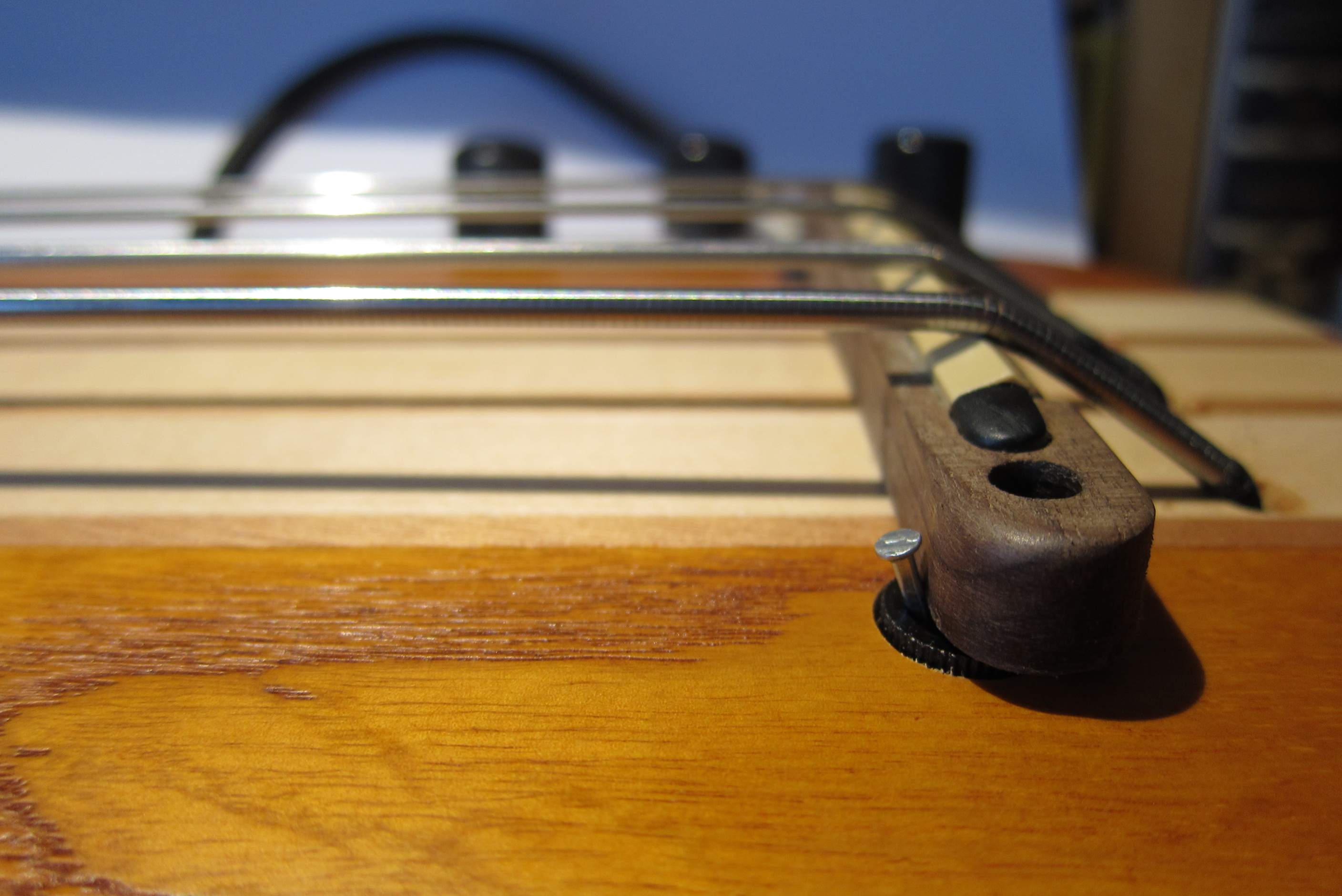
If it wasn't for the piezo cable going through the bridge, so it would include soldering to remove the bridge completely, I may have gone into making a new bridge right away. A wider bridge with oval holes + fitting screws will be my first choice if a decide to put more work into this later. Now I can get to playing instead!
Thanx again!
I've settled for a really simple solution, for now. Trying out the sweet spot, by moving the bridge backwards, I found it to be as in the photo. I put those nails there, because without them it would move forward when pushed a little. Now it's fixated and the nails don't bother me (maybe my eyes, but not my hand), so I'll play it like this for now.
If it wasn't for the piezo cable going through the bridge, so it would include soldering to remove the bridge completely, I may have gone into making a new bridge right away. A wider bridge with oval holes + fitting screws will be my first choice if a decide to put more work into this later. Now I can get to playing instead!
Thanx again!
I always wanted to experiment with using a violin/hofner bass replacement bridge. It is height adjustable, has some limited but legit intonation adjustment capability, and the base is wood.
I always wanted to experiment with using a violin/hofner bass replacement bridge. It is height adjustable, has some limited but legit intonation adjustment capability, and the base is wood.
That’s what I’m thinking for my SG build. There are narrow string spacing bridges from a number of manufacturers, but I think most of them won’t work on something with a neck angle. Maybe I could crank the saddles all the way up, but I think a hofner bridge would work better.

Howdy all!
I've been looking for a tiny bass for a travel option. I actually had a Hofner Shorty for about a nanosecond, but they forgot to send me the gig bag, didn't have an extra gig bag, and I didn't like it that much so I sent it back for a refund.
I've been on the hunt for the Corsair MC1 and may have found them at a UK dealer -- but when I asked for the total length they gave me this: "Dimensions: 106.7 x 10.2 x 43.2 cm"
And I don't think that's right -- they've either given me the wrong measurements or it's a different bass. Plus, I've not been able to pin down the Corsair Mini total length -- does anyone here know if it is 31.5 or 34" from headstock to strap button?
I'm waiting to hear back from them but in the meantime am looking at other options. I'm kinda flabbergasted by the prices of the SmallGuitar offerings, though that's pretty much what I want -- as short as possible. I have an email in to the makers of the MonoPrice Indio Mini bass -- they say the scale length is 28.5" so I'm guessing that's...your basic short scale and probably larger than what I want (I have a mustang pj and the VM special Jaguar SS).
I've skimmed through this wonderful thread and found reference to the JStar, which I also have bookmarked.
All help, suggestions, feedback, gratefully appreciated!
I've been looking for a tiny bass for a travel option. I actually had a Hofner Shorty for about a nanosecond, but they forgot to send me the gig bag, didn't have an extra gig bag, and I didn't like it that much so I sent it back for a refund.
I've been on the hunt for the Corsair MC1 and may have found them at a UK dealer -- but when I asked for the total length they gave me this: "Dimensions: 106.7 x 10.2 x 43.2 cm"
And I don't think that's right -- they've either given me the wrong measurements or it's a different bass. Plus, I've not been able to pin down the Corsair Mini total length -- does anyone here know if it is 31.5 or 34" from headstock to strap button?
I'm waiting to hear back from them but in the meantime am looking at other options. I'm kinda flabbergasted by the prices of the SmallGuitar offerings, though that's pretty much what I want -- as short as possible. I have an email in to the makers of the MonoPrice Indio Mini bass -- they say the scale length is 28.5" so I'm guessing that's...your basic short scale and probably larger than what I want (I have a mustang pj and the VM special Jaguar SS).
I've skimmed through this wonderful thread and found reference to the JStar, which I also have bookmarked.
All help, suggestions, feedback, gratefully appreciated!
If you looking for an MCR1 type scale - search for Raptor bass on eBay. It's 26" scale. I have it. Depending on your needs, you Might want to upgrade bits, or maybe not.
Well, that is a distinctive looking bass. I worry the horn on the body might make it a little less travel worthy -- but I just messaged the seller to see how long it is.
Is this the Raptor?
Raptor 38" Kid's 3/4 Size Junior Kid's 4 String Electric P Bass Pack - 5 COLORS | eBay
I wish it weren't quite so long -- the 38" refers to the total length, no?
Appreciate the help.
Very frustrating -- I did hear back from the UK seller and they said their importers had given them the dimension info. So it's either the wrong measurements, or they have the wrong product up there. Or maybe as @kohanmike suggested, it's the box length.
I'm sorta not optimistic that they actually have the MCR-1.
As an eBay Associate, TalkBass may earn a commission from qualifying purchases.


