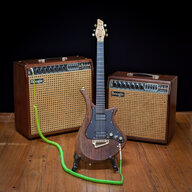
I wanted to start this post since I am looking for feedback into an instrument that I've been working on for almost 2 years for the purpose of future design direction. A brief history- I started thinking about the project in late 2004. The concept was a baritone ukulele sized bass with the goal of having a small light instrument that still achieved a full natural bass tone. It is built as an acoustic-electric with emphasis on the electric part due to the small volume of the sound box. The initial proto was done using nylon 'weedwacker' line or nylon harp strings and was tuned E-A-D-G. The sound produced by the nylon was very natural, but one octave higher than an acoustic double bass due to the limitations of the low mass and high stiffness of the nylon. The first few basses I built were done with the nylon strings.
The next step in development was to find a material that will achieve the desired sustain in the correct bass octave while still feeling comfortable to play. I ruled out the Ashbory silicone strings since they did not have a good feel and the G strings had a propensity to early breakage. I worked with a supplier of synthetic elastomers to come up with a polyurethane string configuration that worked with proper E-A-D-G bass tuning that fit the 20" scale that I'm using. The bass works very well and the acoustic/electric style aids in the natural woody tone.
The initial response from the ukulele community (OK, I'm a uke builder) has been quite favorable, but this is really a short scale bass, so I'm addressing my product development questions to the bassists out there.
Now here's the part where I'm looking for additional feedback. Would a 5 string low B version be something bass players would want in such a short scale instrument? With string diameters up to .25", the nut width would need to be about 2.1" to 2.2" and the fingerboard would be about 2.6" to 2.7" at the 12th fret to have adequate playing room for all styles. By comparison, the 4 string version will be about 1.7" wide at the nut and about 2.2" wide at the 12th fret (actually up from about 1.9" based on player feedback of wanting more room on the fingerboard). The other thing is string action. Some people like a low action and play with a soft touch. Others like the slap and pop on the fingerboard. Since I think that a height adjustable would take away from the tone, my thought is to do 2 different height saddles and include both with the unit. These could be easily replaced simply by just pulling the old saddle from the bridge slot and popping the alternate in. Last question is on fingerboard radius. I'm using about a 15" radius. Would more radius be better given the above mentioned fingerboard widths?
Many advance mahalos,
Owen Holt
http://www.bassuke.com
The next step in development was to find a material that will achieve the desired sustain in the correct bass octave while still feeling comfortable to play. I ruled out the Ashbory silicone strings since they did not have a good feel and the G strings had a propensity to early breakage. I worked with a supplier of synthetic elastomers to come up with a polyurethane string configuration that worked with proper E-A-D-G bass tuning that fit the 20" scale that I'm using. The bass works very well and the acoustic/electric style aids in the natural woody tone.
The initial response from the ukulele community (OK, I'm a uke builder) has been quite favorable, but this is really a short scale bass, so I'm addressing my product development questions to the bassists out there.
Now here's the part where I'm looking for additional feedback. Would a 5 string low B version be something bass players would want in such a short scale instrument? With string diameters up to .25", the nut width would need to be about 2.1" to 2.2" and the fingerboard would be about 2.6" to 2.7" at the 12th fret to have adequate playing room for all styles. By comparison, the 4 string version will be about 1.7" wide at the nut and about 2.2" wide at the 12th fret (actually up from about 1.9" based on player feedback of wanting more room on the fingerboard). The other thing is string action. Some people like a low action and play with a soft touch. Others like the slap and pop on the fingerboard. Since I think that a height adjustable would take away from the tone, my thought is to do 2 different height saddles and include both with the unit. These could be easily replaced simply by just pulling the old saddle from the bridge slot and popping the alternate in. Last question is on fingerboard radius. I'm using about a 15" radius. Would more radius be better given the above mentioned fingerboard widths?
Many advance mahalos,
Owen Holt
http://www.bassuke.com