• TalkBass has been independent since 1998. Add your voice.
    Create a free account to reply to discussions, view embedded media, and browse with fewer display ads.
    Join freeLog in
    Want zero display ads or expanded classifieds tools? Compare plans.

Double Bass 1/4 Size upright, any fullsize people playing them?

I get the concept, and I've noticed that I liked playing my thicker-necked Kays better than the thin one until I replaced the thin fingerboard. All good. The question that begs asking, though, is why a thin-necked bass is unplayable, yet I hear that many adults, even master musicians, play the cello all day long.

The cello requires less force to depress the strings and the traditional arco sitting position takes the whole balance the bass on the peg against your body issue out of the technical equation. I would say that anyone who really feels like a child's instrument is the best thing for them would be well advised to sit. That would make what will always be a problematic proposition less complicated.

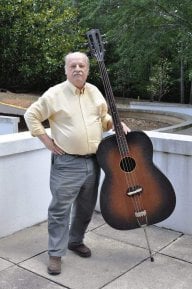
If a small instrument worked acceptably well don't you think more bass players would be using them? Double bass players are as lazy as the next guy and there are reasons we put up the size of the thing....there is no better mouse trap. Due to chronic tendon issues I'm pretty much done playing the DB and I've explored "upright-like" options to somewhat fill the void it will leave. Based on ten years with the Azola Deco pictured below as my main instrument a high quality fretless ABG is something that can be acceptable sonically and visually to many people looking for a double bass player. For several years I was very successful doing acoustic après ski bar gigs with this bass. You do have to be prepared to loose gigs with people for whom the looks are more important than the sound like with the rockabilly crowd but this bass satisfied many acoustic diehards who would never have hired a guy with a "Fender".

deco w_armstrong mag.jpg


ABGs like this that look and sound the part are expensive and hard to find though. Steve Azola is no longer building and the best of them right now is probably the Ribbecke Halfling. I think the regular "production" model (still built one at a time to order) is around $8500. This one in the link for $10K is off Tom's bench and about half what one built by Tom himself would normally cost (without the two year+ wait). It's a very good price for what no doubt is a magnificent bass.

Another option might be the 34" scale NS Design Omni Bass. They're kinda weird to play but they do have a neck profile that allows good left hand technique.

I guess after hearing this question several times over the years I'd say to a bass guitarist looking for a cheap, easy to play solution to getting upright gigs without raising any eyebrows is that there isn't one. It's a difficult expensive instrument not to be taken casually in terms of time, effort and money if you have any real intention of meeting the expectations people hiring you to play it will have.
 
  • Like
Reactions: noodler
I went to the music store today -- a place that specializes in stringed instruments. They had five uprights, 3 of which were set up for jazz. The guy operating the store, a bass player of many years, showed me how to hold it, how to hold my hand -- how to press the strings and position my thumb, and how to pluck. Also how to go up into the upper register.

I absolutely hated the experience of playing a 3/4 sadly. I have a hard time even reaching the E-string while holding my wrist and elbow in the right position. We compared hands. He's about average height. His distance from bottom of his palm to the tip of his middle finger was 1.5" longer than mine. They didn't have anything smaller than 3/4 at the time, and they all cost over $5000 and were properly set up for jazz, he said. He said he thought my problem might be with my hand size. He recommended a 1/2 size to see if it goes better, but they don't have any or stock them.

I left empty handed. They are getting a 1/4 size this week so I might try it.

The hit you take with a 1/4 size is they fall in price dramatically after you buy them new. I searched the online forums and online ads and saw an englehardt M3 1/4 size. It sells for $1100+ without a setup or new strings, and they go for $500 used. So if you buy a 1/4 size, you're doin it for yourself, as an expense...and if it doesn't work out, it's an expensive lesson.
 
Last edited:
Slick looking ABG you're showing there Jeff!

Size seems to be a hot topic at the moment; in my view one should play whatever one like best, for whatever set of personal reasons. Acoustically even a full-size bass is small for the lowest notes. Too thin a neck may strain the hand muscles.
 
  • Like
Reactions: PauFerro
I left empty handed.
Don't give up too soon! In my experience, even shopping for a mainstream 3/4 bass was a several month process.

I suspect that all basses take a hit on value in their first few years. The ones that have appreciated are either way outside our price range, or much older than a few years.

In addition to the fractional sizes, other reasonable accommodations include lighter weight strings. If the E is a problematic reach, you could go with a lighter E and middle weight for the other strings. Another thought is to sit down and turn it so you're playing more like a cello, which would rotate the fingerboard towards your left hand, and avoid having to support the instrument with your thumb. Of course you can do these things on a smaller bass too. I've met a couple of cellists who play 7/8 size instruments, in both cases nobody notices unless they're in a section with other cellos.

As for setup, we're probably talking about instruments considered to be for student use, which are probably set up similarly for jazz and classical. Something like a range of 6 to 8 mm from G to E is probably a reasonable starting point.
 
  • Like
Reactions: PauFerro
Don't give up too soon! In my experience, even shopping for a mainstream 3/4 bass was a several month process.

Thanks. I go back this week to try out a 1//4 size. Too bad there aren't more shops close to home.

In addition to the fractional sizes, other reasonable accommodations include lighter weight strings. If the E is a problematic reach, you could go with a lighter E and middle weight for the other strings. Another thought is to sit down and turn it so you're playing more like a cello, which would rotate the fingerboard towards your left hand, and avoid having to support the instrument with your thumb. Of course you can do these things on a smaller bass too. I've met a couple of cellists who play 7/8 size instruments, in both cases nobody notices unless they're in a section with other cellos.

Thanks for the tips...appreciated.

As for setup, we're probably talking about instruments considered to be for student use, which are probably set up similarly for jazz and classical. Something like a range of 6 to 8 mm from G to E is probably a reasonable starting point.

Actually, no, these were $5000 basses plus in a pro shop that specializes in these wooden, stringed instruments. They didn't have a student model in the entire store for upright. And they had been professionally set up already, I was told.

There were five of them, and two he said were set up for classical music so I didn't even play them. I played a gut one, and two that had steel strings. I liked the gut one better, but I'm not sure if it was the way the upright was set up (it really growled compared to the others) or if it was the strings.
 
  • Like
Reactions: mtb777
Thanks. I go back this week to try out a 1//4 size. Too bad there aren't more shops close to home.


Thanks for the tips...appreciated.


Actually, no, these were $5000 basses plus in a pro shop that specializes in these wooden, stringed instruments. They didn't have a student model in the entire store for upright. And they had been professionally set up already, I was told.

There were five of them, and two he said were set up for classical music so I didn't even play them. I played a gut one, and two that had steel strings. I liked the gut one better, but I'm not sure if it was the way the upright was set up (it really growled compared to the others) or if it was the strings.

So Pau, here's the thing: you need to decide your priorities. I've already mentioned that I've played with women 5'4" or less playing a 3/4 upright who kick my a$$, and I'm more than half decent and 6 inches taller, so, that shouldn't be your deciding factor. YOUR SIZE HAS NOTHING TO DO WITH HOW WELL YOU CAN PLAY A 3/4 SIZE URB. Cool, I can hear the whining now, but you're still factually wrong. You have proven to yourself that most URBs smaller than 3/4 are student ply basses, but it seems that your VANITY about appearing behind a big instrument is vying for your goal of appearing to "play a URB".

IME, people who play a URB do so because they love the tone, not because they hope to get a few more gigs, and that's because playing a URB is a decade-long endeavor for most of us with miniscule economic gain. If optics is your primary concern, you'll probably be "most economically served" by only playing your BG and ignoring the occasional gigs that demand a URB.

OTOH, if you truly want to "capture" those URB gigs, DUH, play a URB. Oh, I forgot, it's not obvious to you, I meant a 3/4 size URB which is what your bandleaders are asking for. You CAN do it, but, your resistance is memorable.
 
Last edited:
  • Like
Reactions: Jeff Bonny
If size -- height, hand breadth, whatever -- had nothing to do with the issue, then the only option for adult bassists would be a 4/4 bass with a 44" mensure. In spite of efforts to downplay size, it does make a difference. There is no credible 'one size fits all' argument that can be made.

I'm sure most of the munchkins in The Wizard of Oz had adult hands. I'd like to see how they'd do on a 3/4 DB.
 
  • Like
Reactions: mtb777 and PauFerro
If size -- height, hand breadth, whatever -- had nothing to do with the issue, then the only option for adult bassists would be a 4/4 bass with a 44" mensure. In spite of efforts to downplay size, it does make a difference. There is no credible 'one size fits all' argument that can be made.

I'm sure most of the munchkins in The Wizard of Oz had adult hands. I'd like to see how they'd do on a 3/4 DB.

Playing a 41" scale DB with Simandl 1-2-4 fingering isn't any more of a stretch than playing a 30" scale bass guitar with 1-2-3-4 fingering. But hey if you want to support to the OP's misconceptions and encourage him to buy an instrument with a neck profile that will kill his left hand.....well, I guess interweb advice is worth what it costs.

And just for the record when I was living on a boat I talked to Seth Kimmel about building a small bass. His instruments start around $18K so I don't have anything whatsoever against the idea of small basses...far from it. I played every small bass I could get my hands for as long as I could during that period. Everything I'm saying is based on personal experience. How many of you guys saying "go for it" have actually played a 1/4 size DB for more than a few minutes?
 
Me (though I didn't exactly say "go for it"). Not recently & not in a public performance, but in practice sessions & home use. It was not a good instrument.

I'm not denying what you say, and in fact I agree with virtually all of it. But you have provided this information, and it is up to anyone to assimilate it, together with other information & personal preferences to come up with his/her own judgement and make his/her own choice & decision. Then that's a choice based on his/her set of personal reasons, and that choice I will respect. It may not be your choice, it may not be my choice, but it is not up to you or me to decide how someone else spends his/her money & life.
 
IME, people who play a URB do so because they love the tone, not because they hope to get a few more gigs, and that's because playing a URB is a decade-long endeavor for most of us with miniscule economic gain. If optics is your primary concern, you'll probably be "most economically served" by only playing your BG and ignoring the occasional gigs that demand a URB.

It's not the visual presentation or optics -- I don't think I ever said that. If my body didn't reject it so much, -- it's the experience of doing it. When I played 34" electric basses, I practiced but it never felt right. I barely progressed. Got a 30" and I couldn't put it down. The fit of the instrument does have an impact. That's why I like Pedulla's one-time slogan under one of their basses "Find out how good you really are". They implied how well you fit the instrument influences how much practice and therefore, how much you progress.

It's not the visual aspect -- it's my ability to play the note and to reach the E string comfortably -- that is an example of the kinds of issues I'm facing. In Blue Bossa and other bossa tunes, I hammer on the C on the A string, and then the G on the E string, alternating in near quarter notes (kind of). I had a hard time reaching the e string so I could hammer on the "finger fretted" G note on the 3/4 I played. Particularly going back and forth between the finger fretted C and G relatively quickly.

You CAN do it, but, your resistance is memorable.

Thanks, we'll see how this plays out.

Me (though I didn't exactly say "go for it").

...you have provided this information, and it is up to anyone to assimilate it, together with other information & personal preferences to come up with his/her own judgement and make his/her own choice & decision. Then that's a choice based on his/her set of personal reasons, and that choice I will respect. It may not be your choice, it may not be my choice, but it is not up to you or me to decide how someone else spends his/her money & life.

This I agree with. Sometimes you have to make mistakes to really internalize something you just can't accept. I would be interested in knowing the distance from the top of your wrists to the end of your longest fingers just to compare. My distance is 6.5". My waist is also really big (i'm working on getting that down, AGAIN), but that seems to affect the comfort of playing the instrument and how easy it is to reach around the neck to fret the notes -- particularly given the small radius fingerboard on an URB. Apparently the smaller basses also have a smaller body.
 
  • Like
Reactions: Jeff Bonny
Any pro bass teacher will get you playing a 3/4 bass just fine. No pro teacher would recommend a 1/2 bass after a little thumping around in a music store.
A 1/4 bass is no solution as the only bass of a serious bass player. An NS short scale in addition to bass guitars is probably your best bet for a non-committal situation.

As far a hybrid cracking, caved tops crack, just get it fixed and you will have a better playing experience.
The hybrid will amplify better if you play it better.
 
Referencing Jeff's post #48 above, I have played entire coffee house shows on a 1/4 DB: seated, unplugged, backing guitars and vocals going through the PA, and filled the house just fine -- and suffered no ill effects. But that is the only application for which I would use a 1/4 DB; in fact, that is *why I have* 1/4 DBs.

But I would not be this guy.

https://i.ytimg.com/vi/OJm4HM0or14/hqdefault.jpg

As to the "small neck = sore hands" argument, I have seen this broached in several threads, especially in reference to Kay DBs, and I still do not understand it. With regard to 1/4 size DBs I suspect the argument is irrelevant, since any difference between those necks and EB necks likely will be minimal. But with larger instruments, I need some dots connected.

I have small hands and short arms, so on DBs I tolerate a 42" inch mensure although I do not love it. On EB, what causes me problems is when the neck feels thin compared to its width -- like on Precisions above the seventh fret. That, I find uncomfortable and fatiguing after awhile. I do not have this problem with Peaveys, or even Gretsches.

The only thing I can figure with this argument is, that if there is a lot of space between the thumb web and the back of the DB neck, then fatigue will set in. But as stated above, I really do not understand the argument.
 
  • Like
Reactions: mtb777 and PauFerro
The only thing I can figure with this argument is, that if there is a lot of space between the thumb web and the back of the DB neck, then fatigue will set in. But as stated above, I really do not understand the argument.
Before I try to better give you my understanding of the problem I wanna apologize for being too forceful earlier. There is a huge amount of of value in the process of following your heart and making mistakes. "Common" wisdom only really becomes common to an individual after he's experienced something firsthand. In light of how much I've had to learn the hard way it's pretty hypocritical of me not to be more graceful in making allowances for others to do the same.

Ok, here are a couple of pics I posted sometime ago but danged if can remember exactly where so here they are again slightly updated.

It's all about how the basic structural integrity of an arch reduces mechanical stress.
Pic #1 shows an approximation of what's going on with a neck that has enough girth for the hand to maintain a better arch. The shape of the hand allows for more strength, much less fatigue and the fingers feel more....for lack of a better technical explanation "ready to move" which facilitates smoother pivots and position changes.
Pic #2 shows the hand as it needs to be shaped to play a neck profiled for a child's hand. Less arch, less strength and ultimately less fluidity. The arrows point to where I've experienced the arch breaking. It's not a perfect illustration but hopefully it provides some food for thought as you play different basses.
BASS GRIP 3:4 VS 1:2 SIZE_161204.jpg
 
Last edited:
  • Like
Reactions: Ortsom
Before I try to better give you my understanding of the problem I wanna apologize for being too forceful earlier. There is a huge amount of of value in the process of following your heart and making mistakes. "Common" wisdom only really becomes common to an individual after he's experienced something firsthand. In light of how much I've had to learn the hard way it's pretty hypocritical of me not to be more graceful in making allowances for others to do the same.

Ok, here are a couple of pics I posted sometime ago but danged if can remember exactly where so here they are again slightly updated.

It's all about how the basic structural integrity of an arch reduces mechanical stress.
Pic #1 shows an approximation of what's going on with a neck that has enough girth for the hand to maintain a better arch. The shape of the hand allows for more strength, much less fatigue and the fingers feel more....for lack of a better technical explanation "ready to move" which facilitates smoother pivots and position changes.
Pic #2 shows the hand as it needs to be shaped to play a neck profiled for a child's hand. Less arch, less strength and ultimately less fluidity. The arrows point to where I've experienced the arch breaking. It's not a perfect illustration but hopefully it provides some food for thought.View attachment 1002584 awareness as you play different basses.

First, Jeff, no need to apologize. We all get caught without a Snickers bar once in awhile and are not ourselves. Now, as to your illustrations, I think I get it. Risking oversimplification, it appears the determining variable could be the measurement of the distance between the tip of the finger(s) and the tip of the thumb (with the neck and fingerboard in between, of course). This would explain why I feel discomfort on a P-bass neck but nor on a Gretsch 5440LSB. The Gretsch neck is just as wide as the P's, but deeper; chunky, in fact. But playing it is less fatiguing for me.

Also, just to keep things in context and perspective, my defense of the 1/4 DB, in this thread and elsewhere, is purely from the folkie point of view -- from minstrel shows right on through old string bands, spasm bands, jug bands, primitive blues; situations where it would be a challenge just to have any bass at all. And I will adhere to my position that, if one wants an acoustic bass that has the tone and volume of a DB but is as easy to play as a Fender, then the 1/4 DB is as close to that as we are going to get right now (not forgetting Toby Chennel's Arco Bass).

So I will use a 1/4 played across the lap in small venues like coffee houses or house parties, and a half-sizer for busking. But for large venues like auditoriums, concert halls, large clubs . . . I will use a 3/4 played in the conventional manner.
 
  • Like
Reactions: mtb777 and 7615
I appreciate Jeff's comments a lot.

In the short term, I'm trying out a 1/4 size...since the store has only that coming in this week. And see how it feels. Costs $150 a month to rent it, or a larger size.

But until then, here is a pro player, albeit classical. She plays an amazing bit of solo classical bass. And appears to have amazing technique. And she plays a 1/2 size instrument...not to be missed. I'm amazed at her speed. When I played the upright the other day, even with the coaching from the guy at the store who is an upright player, it was slow as molasses. Her speed is amazing to me as well as the finger positions...

 
And she plays a 1/2 size instrument.

FYI - Ms. Pierce plays a "5/8" see below.( Also - the "mensure"/string length is more relevant than "size" of the bass overall.) On any size bass, accurate & fast shifting is an absolute necessity.

"Current Setup:
Guasti & Bottoni bow - Pernambuco wood
Italian made 5/8 bass - unknown maker, ca. 1850s
 
Last edited:
I got it off her website....here is the quote and link:

Description
Lauren is a double bassist in Austin, Texas, just trying to convince everyone she doesn't play the cello.

Lauren plays on a half-sized Italian instrument, made ca 1850 by an unknown maker. For solo music, she uses Pirastro Original Flatchrome solo strings.

Contact me:
For booking, Peter Karp ([email protected])
For general inquiries, [email protected]

Link:
Lauren Pierce
 
I got it off her website....here is the quote and link:

Description
Lauren is a double bassist in Austin, Texas, just trying to convince everyone she doesn't play the cello.

Lauren plays on a half-sized Italian instrument, made ca 1850 by an unknown maker. For solo music, she uses Pirastro Original Flatchrome solo strings.

Contact me:
For booking, Peter Karp ([email protected])
For general inquiries, [email protected]

Link:
Lauren Pierce

Oh. OK. Her profile here on TB is what I quoted.
Sorry.
Thanks.
 

Latest posts