• TalkBass has been independent since 1998. Add your voice.
    Create a free account to reply to discussions, view embedded media, and browse with fewer display ads.
    Join freeLog in
    Want zero display ads or expanded classifieds tools? Compare plans.

Double Bass 1/4 Size upright, any fullsize people playing them?

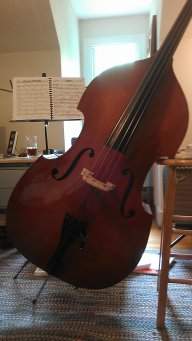
I looked into a rental today of a bass. It wasn't nearly as expensive as I thought. I played the basses another time and the experience got more comfortable on anything at a 1/2 size or lower. Problem is that I still can't reach the E string very well, particularly in the middle of the fingerboard length. This is between the nut and where it joins the body, and higher on a 1/2 size. On a 3/4 size it was nearly impossible, even at the G note position on the E string.

But a few good things happened -- my left leg became a kind of backstop for the bass automatically as I picked them up and got into position a few times. I saw the wisdom of keeping the bass largely perpendicular as it meant less stress on my body to keep it supported. I was also able to tell differences in tone between a couple basses, and get a preference going. They also attached a tuner to the bridge and I was able to play with better intonation in the bottom five frets -- or at least, get closer and closer to good intonation on certain notes on the 1/2 and 1/4 size by monitoring the tuner.

Also spoke to the resident luthier and learned a few things.

1. The higher end plywood basses are different from the cheap Ebay basses because he believes there are supporting wood blocks in more places on the inside than on the cheap Chinese basses.

2. He seemed misinformed -- most people say carved tops crack easier than laminate tops. He seemed to think carved tops are more durable than laminate. Not according to my own reading, but I didn't want to contradict him and be a pain in the butt.

3. For me, a really strong growl, consistently, at any point on the neck, is important. I played a 1/2, 1/4 and 3/4 bass and found the E and A strings really growled in all positions in the lower register on all three basses, but the D was lesser, and the G nearly non-existent in terms of growl. The luthier said he needed to slope the treble side of the bridge down to get the string closer to the fingerboard to make the upper frequency strings growl.

Also, they stock Ametto basses, which they say are higher quality than the stuff you find on eBay that everyone says you should avoid. So, these basses I played were Ametto's at about $1400 to $1900 each for a 1/4 or 1/2 size. And the quarter size was even more expensive than the 1/2 size, which I thought was odd. They seemed to think they were like Englehardts and Shen's in terms of quality - better quality at the low end of the market than the ones you see on eBay (Cecelia, Palatino, Grace etcetera).

And so, the journey continues.
 
Last edited:
  • Like
Reactions: gnypp45 and RedVee
I looked into a rental today of a bass. It wasn't nearly as expensive as I thought. I played the basses another time and it got more comfortable on anything at a 1/2 size or lower, although I still can't reach the E string very well, particularly in the middle of the fingerboard, between the nut and where it joins the body, and higher on a 1/2 size. On a 3/4 size it was nearly impossible, even at the G note position on the E string.

But a few good things happened -- my left leg became a kind of backstop for the bass automatically as I picked them up and got into position a few times. I saw the wisdom of keeping the bass largely perpendicular as it meant less stress on my body to keep it supported. I was also able to tell differences in tone between a couple basses, and get a preference going. They also attached a tuner to the bridge and I was able to play with better intonation in the bottom five frets -- or at least, get closer and closer to good intonation on certain notes on the 1/2 and 1/4 size by monitoring the tuner.

Also spoke to the resident luthier and learned a few things.

1. The higher end plywood basses are different from the cheap Ebay basses because he believes there are supporting wood blocks in more places on the inside than on the cheap Chinese basses.

2. He seemed misinformed -- most people say carved tops crack easier than laminate tops. He seemed to think carved tops are more durable than laminate. Not according to my own reading, but I didn't want to contract him and be a pain in the butt.

3. For me, a really strong growl, consistently, at any point on the neck, is important. I played a 1/2, 1/4 and 3/4 bass and found the E and A strings really growled in all positions in the lower register on all three basses, but the D was lesser, and the G nearly non-existent in terms of growl. The luthier said he needed to slope the treble side of the bridge down to get the string closer to the fingerboard to make the upper frequency strings growl.

Also, they stock Ametto basses, which they say are higher quality than the stuff you find on eBay that everyone says you should avoid. So, these basses I played were Ametto's at about $1400 to $1900 each for a 1/4 or 1/2 size. And the quarter size was even more expensive than the 1/2 size, which I thought was odd. They seemed to think they were like Englehardts and Shen's in terms of quality - better quality at the low end of the market than the ones you see on eBay (Cecelia, Palatino, Grace etcetera).

And so, the journey continues.

This thread is like a reality TV show: I keep trying to ignore it but keep getting dragged back in. Okay, two things:
1) if your motivation to play URB is to get more gigs, you will be the exception if you stick with it because it's a very tough axe and typically takes 10 years or so to master,
2) if those gigs are for band leaders concerned about the traditional jazz band looks, then nothing less than a 3/4 size, dark stained, unpainted instrument will be useful because those BLs are concerned about the appearance before the sound, so, if you don't look like the Miles Davis Quintet, don't bother applying, and
3) why do resist visiting a local, qualified, reputable jazz URB instructor for first hand guidance rather than the sources you've consulted thus far? As has been pointed out before, the web is full of questionable info, your local music store clearly has an agenda that doesn't likely align with yours, and your own personal experience is beyond limited, it's ignorant. So why not hire a professional to help you with this decision? If you gotta, travel 90 minutes one way. This is where the TB could be very helpful to you: to recommend local pro teachers to you.
 
I played the basses another time and it got more comfortable on anything at a 1/2 size or lower, although I still can't reach the E string very well, particularly in the middle of the fingerboard, between the nut and where it joins the body, and higher on a 1/2 size. On a 3/4 size it was nearly impossible, even at the G note position on the E string.
Make sure you use proper hand shape and thumb placement. With a "baseball bat" grip I guess it could be hard to reach the E-string with small hands. Here is a video about left hand shape, where in particluar 6:55-8:15 demonstrates the role of the thumb. When you press down the E-string, the thumb moves to the G-side and vice versa:
 
This thread is like a reality TV show: I keep trying to ignore it but keep getting dragged back in.

I am going to start selling advertising within my posts, as it appears they have become a commercial success!!

1) if your motivation to play URB is to get more gigs, you will be the exception if you stick with it because it's a very tough axe and typically takes 10 years or so to master,

That is a precisely why I haven't ruled out a smaller instrument.

I am 53 years old, so, with the timelines given above, I will be 63 before I am able to play it masterfully...if I make it at all. For me, that's a case for going the easy route and getting something smaller. One of the basses I played recently I felt I could take it to gig and play some of the easier tunes we do (Comin Home Baby, Cold Duck Time, a couple of my originals, Watermelon Man, C Jam Blues, Jody Grind, Little Sunflower) immediately. If it's going to take 10 years to master a 3/4, then with a smaller instrument I can enjoy the experience of playing upright for audiences while I'm still alive and relatively healthy. That is what I get from your comment above (I hope that's not too maddening, but that was my initial reaction!).

2) if those gigs are for band leaders concerned about the traditional jazz band looks, then nothing less than a 3/4 size, dark stained, unpainted instrument will be useful because those BLs are concerned about the appearance before the sound, so, if you don't look like the Miles Davis Quintet, don't bother applying

The good news is that I am the guy who hires myself. I book almost all the gigs -- about 20-30 a year lately, not including the ones I probably lose because we don't look like or sound like a traditional jazz band. I have one guy who books a couple a year but it's not regular. I didn't realize the non-natural basses were "painted". I did build electrics for about 4 years after taking weekly lessons from a full-time luthier turned pattern maker (he built wooden models of precision auto parts from which the zinc die casting molds were then made, working in thousands of an inch and allowing for heat shrinkage - after his full time luthier career ended after he had his first child -- he was self-employed as a luthier).

I had a professional spraying system, complete with a filtration system that would remove moisture from the hoses, an air compressor and a higher end sprayer. To me, coloring agents were all just stain, some translucent, some opaque, that we covered with a top coat, either nitro cellulose (dangerous) or a water-based stain. Sometimes we tinted the lacquer with colorants. I think heavy paint would definitely mute the sound and would be undesireable - if that is what the manufacturers are using on uprights.

3) why do resist visiting a local, qualified, reputable jazz URB instructor for first hand guidance rather than the sources you've consulted thus far? As has been pointed out before, the web is full of questionable info, your local music store clearly has an agenda that doesn't likely align with yours, and your own personal experience is beyond limited, it's ignorant. So why not hire a professional to help you with this decision? If you gotta, travel 90 minutes one way. This is where the TB could be very helpful to you: to recommend local pro teachers to you.

I am finding there is a lot of conflicting evidence or uninformed discussion no matter where I go -- experts online, seasoned people here, luthiers who repair them. The same was true with my electric bass when I was younger, although not to the same extent. Also, the entry barriers are much higher for getting into upright bass.

I liked one suggestion and that was to get a lesson or two on a teacher's bass. There's a guy who subs for me when I'm not available, and he plays with all the top players in town. I've never met him, or heard him play, but we have talked at length on the phone and he's not arrogant, and seems very kind. Qualities of a good teacher. The reports from the drummer and killer keyboard player I've put with him is that he's an awesome player.

And to boot, he owns a 3/4 and "a smaller bass" he just bought. I don't know what size. Another keyboard player I perform with, a former member of the Tommy Dorsey orchestra, and a really good trombone player too, has an upright player he uses in his own band, with a studio, and about five really expensive uprights, some of German origin. I played them at his home years ago when my daughter took lessons from his own daughter. He is another candidate as a teacher, although he's 20 feet tall. So I don't expect him to have much empathy.

So, I'm not adverse to a teacher. Just working through this.

I have to confess, I am influenced by all my white hairs...although people always tell me I sound young, and apparently, am young-minded, the number of times people have assumed I can just step into a 5'8" man's world has cost me a lot of money over the years. I have wasted money on tripping back packs, clothes, electric basses, baseball gloves, shoes, suit jackets....

And although the majority of people here are firm advocates of 3/4 basses (at times, making me wonder if I will get cancer if I don't play one) the advice is not consistent, even among people with obvious credibility. And I've always been an out of the box thinker. For some reason, convention doesn't resonate with me (no pun intended).

For example, for years, I bought my winter coats in the boy's section of department stores because they fit me. And I told everyone my electric story -- After years of frustration with 34" electrics (having to pull the upper horn toward me just to be able to reach the G-string tuner on a Fender style), I got a 30" against everyone's advice, and it skyrocketed my ability, practice time, and love of the instrument....

If this is too annoying, feel free to ignore me. I'm used to it. My wife does it all the time :)
 
Last edited:
  • Like
Reactions: gnypp45
Back in Aug of 2012 @Ed Fuqua said this:
"I didn't start playing upright until I was 25 or 26. The reason that I started playing it was because I started "hearing" that sound, internally, more and more until I had to start playing. Had to, not wanted to. Double bass is double bass, it's not a more robust fretless bass guitar. If this is something you HAVE to do, then do it."

Had to, not wanted to. This is similar to my experience and what a lot of other double bass players would say too. The DB is difficult to play, a pain to transport, expensive to buy, to string and repair, expensive and frustrating to amplify. If you don't have to play it why on earth would you? You have some kind of romantic notion that you're going to get one and in a couple of months be doing gigs and cashing in on an "investment" don't you? Try a couple of years....if you work hard at it. It's no get rich quick scheme...hell, it ain't even a get rich slow scheme. People are saying what they're saying to sincerely try and help you succeed man. The only self serving motive might be that someday one of us will have to actually listen you play the DB.....

Look, find a teacher, rent the bass s/he recommends and take weekly lessons for six months. During that time play every bass you can get your hands on and start learning what's out there and what's really best for you. If that turns out to be a child's instrument then at least be making that choice with the support of a teacher and some fundamental baseline of knowledge that you currently lack. Fantasies of getting more gigs and the fear of a big dog ain't enough.....
 
Back in Aug of 2012 @Ed Fuqua Had to, not wanted to.

I'm there. I've been toying with this for years and years, and its bugging me I never did it. I keep hearing the tone on some of the CD's I've listened to, particularly this Jamie Aebersold record years and years ago. And when I heard the tone on all of the basses I played, on the low E and A, it was mesmerizing. When I picked up the instrument and found it naturally lay against my leg and started feeling comfortable, I walked out of the store knowing I had to start playing something, sometime soon.

You have some kind of romantic notion that you're going to get one and in a couple of months be doing gigs and cashing in on an "investment" don't you?

You've mentioned that at least once -- it's not my motive. Sure, it would be nice if it happened, the gigs, but I like the sound, that growl, and it has always bothered me I don't play upright.

I book them all the gigs myself so I'm not expecting to get calls when I start playing the thing. In the last year, I think I lost one gig due to not playing upright, and I think that was actually an excuse because the guy wanted to be a band leader, calling his own shots.

Try a couple of years....if you work hard at it. It's no get rich quick scheme...hell, it ain't even a get rich slow scheme. People are saying what they're saying to sincerely try and help you succeed man. The only self serving motive might be that someday one of us will have to actually listen you play the DB.....

Look, find a teacher, rent the bass s/he recommends and take weekly lessons for six months. During that time play every bass you can get your hands on and start learning what's out there and what's really best for you. If that turns out to be a child's instrument then at least be making that choice with the support of a teacher and some fundamental baseline of knowledge that you currently lack. Fantasies of getting more gigs and the fear of a big dog ain't enough.....

Thanks for the advice, I have this feeling I'm frustrating everyone. But in terms of finding a bass that works for me, it's truly and adventure for someone like me who plays fretless, piccolo, fretted, started building them years .
 
Last edited:
I've taught boys who buy certainly buy their coats in the boys section on 3/4 basses. The problem with the bass size misconception is that is a common misconception, not a one just applies to you.
The fingering systems are made for smaller people.
Get with a teacher who can take you through some things on a well set up 3/4 make decisions from there.
 
  • Like
Reactions: ColdEye
PauFerro, considering your age and situation, if your goal is to pick up an instrument that immediately feels comfortable and have fun with it, go for it. I don't see a problem. You don't necessarily need to pursue this as seriously as a young career minded musician. This may bring you satisfaction. If not, you can try something else.
 
I'm looking for a bass with normal string length but with a small body for traveling and for loud volume gigs(thinking about a magnetic pickup). I don't mind that they won't have a lot of bass, my problem is that they tend to have a kind of "boxy" sound. Is there a way around this? Now I'm talking pizz, I like the bowed sound.

I have been spending a lot of time with different sized instruments, and I found that if I use a lot of the side of my finger to pluck, and go kind of to the side and down to the fingerboard, it gives a really gorgeous mwah tone playing pizz. A seasoned player could probably tell you definitively if that works across the board. I have found it varies from one instrument to another somewhat. One instrument I played seemed to have almost no resonance at all. It was like playing an EUB except the body was hollow.
 
Last edited:
I have been thinking long and hard about this for a while. I gig regularly around town. I play mostly fretted bass but can do fretless in rehearsal or on recordings with OK results. I play jazz almost exclusively, so not being an upright player bothers me now and then. I want to be well-rounded. And I have lost two jazz gigs in the last year because I don't play upright.

I am very attracted to the 1/4 size. The fact I can use regular fingering, transport it easily, and have it look proportional to me is very attractive. And give my former history with basses, I will probably enjoy playing it more. I found that to be true when I played a 1/4 in a store a while ago.

I started a thread on this in the upright forum a while ago, and most people discouraged using the 1/4 size. But I keep going back to my life lessons (I am 53 now). When I started on bass as a teenager, the only decent electrics were full 34 inch scale. And they were way too big for me. I am only 5'3.5" and have small hands. I liked the music, being in a band, etcetera, but the instruments were really cumbersome for me. I had to pull the upper horn toward me to reach the most distant tuner, for example.

Then I started playing a Fender Mustang Bass and my life changed. All of a sudden it felt right (except for the neck dive). I practiced for hours. I enjoyed tuning it and picking it up. I could move faster on the neck. I looked better on stage because everything was proportional. And I have been playing short scale instruments exclusively for decades now, getting regular gigs, and no complaints from the jazz musicians I work with. The Fender Mustang went out of production, and mine developed an irreparable problem, so I played a musicmaster with Bartolinis for years and years and years.

In the beginning of my bass journey, I asked a luthier to build me a 30" bass and he discouraged me from it, saying the low E won't resonate enough. Regular players discouraged it, although some had never even picked one up, fooled by the "student model" moniker some manufacturers use to describe these instruments, or that they are for children. He is partly right, but I am seeing more and more short models on the market, and more and more musicians using them regularly.

So, these kinds of decisions need to be taken with the full range of considerations -- a person's body, the amount of time they have to relearn their fingering on upright, the space they have in their car, and what is right for the musician.

What good is a 3/4 size upright if your body rejects it every time you try to play it? And how much better is your life if you really enjoy playing your 1/4 size upright.


My advice (as someone on the verge of buying a 1/4" scale upright is to do what fits your situation the best. When you get gigging, I will be very surprised if people know or care about the fact it's 1/4" scale.

Now, there are a few hits you have to take, but I am not sure how bad they are -- you decide.

1) I can't see anything but plywood basses in the 1/4" size. Which isn't necessarily bad, because they are more durable than carved top or hybrid basses, says Golihur music. But apparently the carved top gives a better, more complex tone.

2) When I played 1/4 sized instruments in a music store, I did find the volume was much lower than on 3/4 size upright. So that means you will have to amplify it.

Anyway, I know this is an old thread, but it came up when I was searching the topic as I think seriously about getting a 1/4" upright to get me started. Nice to see it led me back home to TalkBass!
I play short scale and long scale electric basses and find there are some great short scales - however the shorter scales have more fundamental and less overtones. I have a 1964 Gretsch 6071 - the Tennessean - it is a 29" inch scale and it resonates beautifully in the low end.

On upright I have a plywood 41" with all gut strings - no metal wrapping- and a carved 42" with synthetic core orchestral strings.

First - both gut and synthetic core are hand savers. Gut despite their thickness are low tension and the synthetic core saved my hands. That may make a significant difference for you.

For amplification with a contact mic - plywood is better in my experience. Sustain on the carved was such it sounded like bass organ.

I think you should get at least a 39" scale and avoid metal core strings which in my experience is where strength is the factor. Also scale and size of the sound box are not always related,however, every small bass I have played has poor acoustic qualities and if an UB sounds lousy acoustically frankly what's the point.

On electric I have been switching all my basses to Thomastiks - at $80 bucks a pop - as they have great output and are softer on the hands due to the alloys.
 
Last edited:
I'm looking for a bass with normal string length but with a small body for traveling and for loud volume gigs(thinking about a magnetic pickup). I don't mind that they won't have a lot of bass, my problem is that they tend to have a kind of "boxy" sound. Is there a way around this? Now I'm talking pizz, I like the bowed sound.
If you want to bow you need to mic a bass - the amplified vibrating wood - a pick up or a contact mic does not accurately produce the sound that comes out of the f holes.
 
Last edited:
  • Like
Reactions: PauFerro
I bought a 1/4 size instrument.

I will say that I really agonized over this decision. Even lost sleep over it given the advice to go onto a 3/4 here on Talkbass. Some really experienced players were firm on it, but whenever I went to plunk my money down on a 3/4, I walked away. I just couldn't do it. No disrespect meant to those people. But I had to do what I felt was best. The fact that I am a career teacher of 22 years in other contexts also influenced my decision. Early exposure to any topic is as much about faith and enjoyment and attitude in one's ability, as it is about technical content. And many teachers make the mistake of inadvertently discouraging their students with tasks that are too challenging. Students conclude, sometimes mistakenly, they have no talent or ability on the instrument, and quit.

No regrets at this point. As I made the decision, it dawned on me that I wouldn't have the motivation to practice if I had a 3/4. The thing was just too big and awkward for me to enjoy it at first. Comments here on Talkbass that it would take 2 to 10 years (if I made it at all) to perform with a band was a major deterrent in my decision to buy a 3/4. Also, you aren't going to see me on the session player list in this town, nor in a degree program anywhere. Nor am I trying to get on anyone's first call list.

My teacher is a guy with a degree in music on upright bass from one of the local universities. He plays classical and is also a composer. He agreed that lots of short people play full sized instruments. But he saw how I struggled with mental motivation on the 3/4 we used in my first lesson. He was supportive of learning on a 1/4, and said that some electric players he knows view it as a transition instrument.

I gigged with it last week (New Year's Eve), doing two songs I'd rehearsed heavily. As well as for hours on three different basses of the same model in the store. They kept selling them out from under me as I mulled over the decision. I was surprised. Finally, the third instrument they brought in had the right combination of decent finish and most importantly, tone and playability, so I took it immediately.

At the gig, I did smple songs in the lower register (All Blues, Jodi Grind). I did a solo in one of the tunes as well, all in the lower register, live. It was not really an improvised solo -- one I had crafted so I could hit notes that were in tune easily, but I did it. Owner stood near the band area and watched, since I'd never played an upright in the last 10 or 11 gigs I've had there. Good news -- he asked us back for another gig in February.

That was of great psychological importance to me -- the idea that I can use it in a band situation relatively soon, rather than being in the closet for two years, all the time wondering if I'd even make it through the initial learning period.

Major support from the band about what I'm doing,which was part of the decision to do the 1/4. They don't give a flying about the size of the instrument, as long as it sounds good. As one of them said "no one is going to show up with a tape measure".

Granted, the 1/4 is not as loud as a 3/4, but we stuck a mic in front of the bridge area and got it loud enough to work in the restaurant with about 60 people in it. Am working on using different amplification with it now. Have a K&K pickup coming from Gollihur. Will experiment with other amplification methods.

It cost $1495 plus tax, with a quartersawn, adjustable bridge, laminate top, back and sides, carbon fiber tailpiece, jazz setup, hardwood, blackened fingerboad, carbon fiber end pin and upgraded assembly there, with Hellicore Hybrids as strings. Violin, brownish, shaded finish. Bow is not the greatest quality, with plastic in it, along with brazilian rosewood, or something.

It's not a cheap chinese bass (CCB), but a brand the stringed instrument music store carries they stand behind. I spent a long time with the luthier learning about its construction and how it's different from the CCB's on ebay. Brand is Ametto. Frankly, I would have rather had an Estle Louis, or maybe an Englehardt, but I was skittish about having it sent to me sight unseen, notwithstanding the better quality ebony fingerboard and better choice of strings with the Estle Louis from Gollihur. One thing I learned at the store is that basses of the same brand can vary widely, and i didn't want to take a chance.

I've been getting louder and more agile on the 1/4 as I practice the 1,2,4 fingering. As well as right hand technique and body position. I wake up in the morning feeling my large muscle groups developing in my arm and shoulders, and it seems to be making playing the instrument easier. Each day is a mixed bag though.

As Esperanza Spalding said in an interview, your body rejects the instrument at first. For some reason, my body REALLY rejected it, perhaps due to my life experiences...

The good news is that I went back to the store for a minor nut and bridge adjustment on the upper G string. After many hours with the instrument, I realized there was very little growl on that string in any position and it bothered me. So, they fixed that. While I was there, I played a 1/2 size and it didn't seem quite as daunting as before. The 3/4 was still a deterrent, but it was a bit better, particularly with gut strings.

I see the 1/4 size as a gateway instrument. It is getting me started on a journey I never would have started if I had to begin on a 3/4. As I get more comfortable on it, I can see myself moving onto a larger sized instrument eventually. When I sell the 1/4 some day (if I do), I will look at the loss in value like a rental fee. at $150 per month to rent at our local store, that means it can decline in value $900 in 6 months and still be similar to a rental.

The fact that I could perform immediately with the 1/4 was a huge motivator and factor in the decision.

My next gig is on the 15th of January, and I've expanded my repertoire to Killer Joe, and Cold Duck Time, and Fingerprints, which makes five songs I can do live. I like the teacher. He's supportive and knowledgeable and helped me figure out how to hold the instrument and apply pressure to the strings in a way that minimizes hand strain.

I agree the URB is a different instrument than an electric. The theory and understanding of note reading and note positions on the fingerboard applies from electric bass, but the rest of it -- how to hold it, fingering, how to get the best tone out of it, intonation, technique etcetera is a whole new ball of beeswax.
 
If the strings are so low they are buzzing then you have a setup problem. You don't want buzz, but some "growl" or "mwah" should be acceptable. I put a new set of strings on my bass and have some buzz on the G, due to installing a light gauge string into a nut that was cut for mediums. Bugging the hell out of me, i may put the old G string back on.
 

Latest posts