
Enjoy the benefits of a premium membership!
Upgrade Account
-
TalkBass has been independent since 1998. Add your voice.
Create a free account to reply to discussions, view embedded media, and browse with fewer display ads.
Join free Log in
Want zero display ads or expanded classifieds tools? Compare plans.
You are using an out of date browser. It may not display this or other websites correctly.
You should upgrade or use an alternative browser.
You should upgrade or use an alternative browser.
15 inch peavey black widow speaker/ cabinet
- Thread starter TCW5SPEED
- Start date
More options
Who Replied?
Well I'm 69 years old and with plenty of time on my hands so I enjoy building stuff .
DIY cabinet on the right .
And yes I play pedal steel guitar.
What sort of volume do you use? Do you need to reproduce much in the way of deep low frequencies?
Shouldn't we be considering the application here, with regard to cabinet design? Don't know much about pedal steel, but one chart I looked at suggested the lowest note is 74Hz, and I'm not sure how much fundamental most pedal steel players actually need to reproduce. My hunch is that a 15" BW will probably be under less stress with pedal steel than bass guitar, as it will be (efficiently) reproducing mostly mids and highs rather than carrying the bottom end of the band with 40-60Hz fundamentals, also meaning that it probably won't be pushed to xmax. Methinks perhaps we ought to be thinking of this as more of a guitar application in terms of enclosure design.

- Feb 12, 2006
- 61,095
- 5
- 221,230
- Disclosures
- Development Engineer-Mesa Boogie, Development Engineer-Genzler (pedals), Product Support-Genz Benz
I'm still not clear, is this for pedal steel or for bass guitar? I understand that you play pedal steel but do you also play bass and are needing a bass amp?

I disagree, especially with the older Peavey BW's. Limiting the power to the RMS rating (NOT 65-80% of the program rating which is 1.6X - 1.8X the RMS rating) is far better for reliability reasons. There's not enough Xmax on the older drivers to support anything more and in most cases you will be well beyond Xmax well before the thermal power rating is reached.
I don't think the 1508 baskets will fit the older motors without a significant loss of performance, and the (real) power handling won't be increased either.
That's what I read with the Peavey white papers and taught from their various engineers. The extra power is for headroom. Xmax while can be an issue from overpowering, I know the BW speakers especially the older ones to be especially stout. In the 20 years that I have played with BW speakers, the only one that's ever failed on me was from a fatigued tinsel wire going to the voice coil. A little bit of surgery with some new tinsel wire and it was back up and running again!
I agree with you though if you match an amps RMS wattage to the RMS wattage of the speaker yes that is the safest bet since most people don't know how to adjust their signal chain properly to prevent clipping. I believe you are right as well on the point that the new baskets will not fit the older magnets but I cannot confirm that for sure.
By having this conversation with you I can see that you are very knowledgeable of this equipment and I want to thank you for the information .
What I want to do is build another diy cabinet and install the same BW speaker as the original.
Now you had mentioned that I needed to run these cabs in series.
What I had in mind was to purchase a 1/4" splitter jack to come from the speaker output jack of the TC to the two cabinets after I finish building the second one .
Now tell me what I need to do differently .
Thanks.
Ronnie
What I want to do is build another diy cabinet and install the same BW speaker as the original.
Now you had mentioned that I needed to run these cabs in series.
What I had in mind was to purchase a 1/4" splitter jack to come from the speaker output jack of the TC to the two cabinets after I finish building the second one .
Now tell me what I need to do differently .
Thanks.
Ronnie
- Feb 12, 2006
- 61,095
- 5
- 221,230
- Disclosures
- Development Engineer-Mesa Boogie, Development Engineer-Genzler (pedals), Product Support-Genz Benz
It's not the clipping, it's the limited axial displacement from too much power. That's the reason the newer models were introduced.That's what I read with the Peavey white papers and taught from their various engineers. The extra power is for headroom. Xmax while can be an issue from overpowering, I know the BW speakers especially the older ones to be especially stout. In the 20 years that I have played with BW speakers, the only one that's ever failed on me was from a fatigued tinsel wire going to the voice coil. A little bit of surgery with some new tinsel wire and it was back up and running again!
I agree with you though if you match an amps RMS wattage to the RMS wattage of the speaker yes that is the safest bet since most people don't know how to adjust their signal chain properly to prevent clipping. I believe you are right as well on the point that the new baskets will not fit the older magnets but I cannot confirm that for sure.
View attachment 5069690 View attachment 5069691 View attachment 5069692 View attachment 5069693 View attachment 5069695
View attachment 5069696
Low frequency reproduction places a lot of stress on drivers. Many of the improvements in LF drivers are focused on improving the performance as power levels increased over time.
I have 3 sessions 500 / 2 Nashville 1000 , that I'm trying to get away from because of the weight. The 500 weight in at 75 pounds / the 1000 just a little under that .I would consider selling your amp & cab and look for a used Peavey Nashville 400 or Session 500 combo. They're among the best steel amps ever made and don't cost much because they're all old and heavy.
That the reason for the TC 200 that weight in at about 1. pound .
- Feb 12, 2006
- 61,095
- 5
- 221,230
- Disclosures
- Development Engineer-Mesa Boogie, Development Engineer-Genzler (pedals), Product Support-Genz Benz
Not in parallel, that would be a 2 ohm load which is not safe for your amp. This is why some of us have been recommending the 8 ohm version of your driver.Okay let me ask you this ?
Will the TC Electronic BAM 209 watt amp handle the two speakers that I have mentioned ?
I surely don't want to overload this little 200 watt amp .
Your opinion...

Roland GR 88
Commercial User
If you can live with reduced power from the amp this box might help. Your amp will see an 8ohm load and produce about 120watts or so.
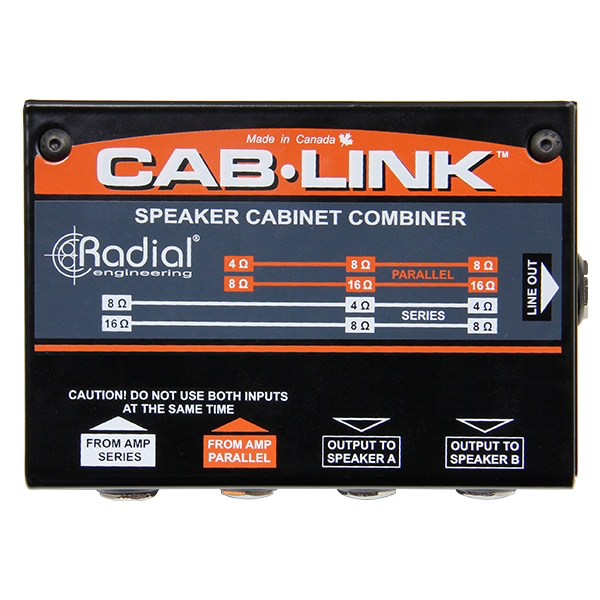
Not in parallel, that would be a 2 ohm load which is not safe for your amp. This is why some of us have been recommending the 8 ohm version of your driver.
With the TC 200 Watt and the 2 Peavy BW how can I use them with the amp ?
- Feb 12, 2006
- 61,095
- 5
- 221,230
- Disclosures
- Development Engineer-Mesa Boogie, Development Engineer-Genzler (pedals), Product Support-Genz Benz
If you have 2 x 4 ohm cabinets, you could wire them in series for an 8 ohm load, but your amp's rated output power falls to a little over 100 watts.Also please give me an answer in layman's terms ?
If you have the 8 ohm driver variant, you could wire the cabinets in parallel for a 4 ohm load and your amp will deliver ~200 watts.


If you rig up those two 4 ohm speakers with a splitter and two cables, you will fry your amp. If you daisey chain the two together in parallel, you will fry your amp. 4 ohm + 4ohm in parallel =2 ohm. Not good for your amp. The smoke will come out.
The two 4 ohm speakers you have must be wired together in SERIES to work with your amp. That would require a special speaker cable.
4ohm + 4ohm in series = 8 ohm. Go for it.
check out a thread called " I ran my Streamliner at 16 ohms".
This is a thread about wiring cabinets in series to show the amp more resistance. Two 8ohm cabs in series = 16 ohm. This made the amp push harder at lower volumes. A handy discussion on building series speaker cables ensued.
You can use the two speakers you have, but you need to wire them correctly, and you might not get what you are looking for. Building a series cable is not a big deal, I did it with parts I had on hand, in half an hour.
The two 4 ohm speakers you have must be wired together in SERIES to work with your amp. That would require a special speaker cable.
4ohm + 4ohm in series = 8 ohm. Go for it.
check out a thread called " I ran my Streamliner at 16 ohms".
This is a thread about wiring cabinets in series to show the amp more resistance. Two 8ohm cabs in series = 16 ohm. This made the amp push harder at lower volumes. A handy discussion on building series speaker cables ensued.
You can use the two speakers you have, but you need to wire them correctly, and you might not get what you are looking for. Building a series cable is not a big deal, I did it with parts I had on hand, in half an hour.
Last edited:
I have been using the diy cabinet by itself with the 1502 Peavy BW 4 ohm speaker and the TC Electronic Bam 200 watt amp for about two months now .
The only issue I can see is that the amp runs a little warm to touch .
The only issue I can see is that the amp runs a little warm to touch .
Don't do that. The replacement TC Bam 200 will cost you $180.
A series cable for two cabs will have three ends, one end at the amp, and one end at each cab. I know that sounds like a splitter, and it kinda is, but there's a bit more to it so the speakers are in series. And the cable ends need to be clearly labeled since the TC Bam's speaker out is 1/4" and all three ends will probably be 1/4 mono plugs. Make sure you use speaker cable.
Nobody is trying to be discouraging, we're just telling you what needs to happen. It's the law, OHM's law. The laws of physics. The fine for breaking Ohm's law runs anywhere from a safe shutdown to buying a new amp.
If you use a mono, 1/4" splitter, something you might find at radio shack, the amp will see 2 ohm. Hopefully, it would go into safety mode and shut down. Another point, these types of splitters are generally for low signal stuff, not the output of an amp.
To accomplish your original idea of using these two 4 ohm drivers, in two cabinets, ten foot apart, you'd build a SERIES speaker cable. One leg would be 10-12' long, the other just needs to reach from the amp to the nearest cab.
So, you need to build one or two cabs, install the drivers, build the cable, and test it out.
Other options are a powered wedge monitor for the drummer and send a signal over with the DI from your TC. Or put your one cab up higher, closer to the drummer's ears.
A series cable for two cabs will have three ends, one end at the amp, and one end at each cab. I know that sounds like a splitter, and it kinda is, but there's a bit more to it so the speakers are in series. And the cable ends need to be clearly labeled since the TC Bam's speaker out is 1/4" and all three ends will probably be 1/4 mono plugs. Make sure you use speaker cable.
Nobody is trying to be discouraging, we're just telling you what needs to happen. It's the law, OHM's law. The laws of physics. The fine for breaking Ohm's law runs anywhere from a safe shutdown to buying a new amp.
If you use a mono, 1/4" splitter, something you might find at radio shack, the amp will see 2 ohm. Hopefully, it would go into safety mode and shut down. Another point, these types of splitters are generally for low signal stuff, not the output of an amp.
To accomplish your original idea of using these two 4 ohm drivers, in two cabinets, ten foot apart, you'd build a SERIES speaker cable. One leg would be 10-12' long, the other just needs to reach from the amp to the nearest cab.
So, you need to build one or two cabs, install the drivers, build the cable, and test it out.
Other options are a powered wedge monitor for the drummer and send a signal over with the DI from your TC. Or put your one cab up higher, closer to the drummer's ears.


