
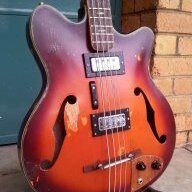
How the heck would you wire that? Not that I'm planning to since the cavity on my P Lyte won't allow for it, but how do you make that happen?

TalkBass has been independent since 1998. Add your voice.
Create a free account to reply to discussions, view embedded media, and browse with fewer display ads.
Join free Log in
Want zero display ads or expanded classifieds tools? Compare plans.
How the heck would you wire that? Not that I'm planning to since the cavity on my P Lyte won't allow for it, but how do you make that happen?
I had an interesting conversation with a Gent named Means on here who explained to me that if you are running active pickups as well as an active pre, then changing from 9 to 18volts doesn't actually give you more headroom because you are upping the output/headroom of both, so the ratio between them stays the same...
What he recommends in this situation is running an 18volt system but with the pickups wired off from between the two batteries so that they run at 9volts while the pre gets the full 18, thus allowing you the increased headroom
And to all those that don't hear any difference between 9 and 18volts, the headroom is much like running an amp with more watts that you aren't really using... Some can hear a difference, some can't, do whatever suits your tastes and ears...
I had an interesting conversation with a Gent named Means on here who explained to me that if you are running active pickups as well as an active pre, then changing from 9 to 18volts doesn't actually give you more headroom because you are upping the output/headroom of both, so the ratio between them stays the same...
What he recommends in this situation is running an 18volt system but with the pickups wired off from between the two batteries so that they run at 9volts while the pre gets the full 18, thus allowing you the increased headroom
with respect, this makes no sense, and is incorrect. I've never seen a circuit where the gain is controlled by the voltage rails.



with respect, this makes no sense, and is incorrect. I've never seen a circuit where the gain is controlled by the voltage rails.

Why 18 Volts?
With a nine volt system the signal will start clipping at about six volts (peak to peak). When you put any thumb into your bass, the peak voltages are higher than what any nine volt system can reproduce... period. In other words, if you are playing your bass the way a bass is supposed to be played, you are not getting all of your sound and punch to your amplifier.
Here's why
Start with a fresh nine volt battery. Subtract .7 volts for the diode we have to put in series to keep from destroying your electronics if the battery is connected backwards. This leaves 8.3 volts. The operational amplifiers used in these designs will output about 2 volts less than the applied DC voltage. So, 8.3 volts minus two volts leaves you with a 6.3 volt maximum output signal with a fresh battery. Your maximum output will decrease from there as your battery voltages decreases with use.
so that system won't work like that if wired up?
. As I mentioned in my first post, I recommend 18v for this type of stuff as well.the way it's supposed to be played

The MC33178 as of three months ago is no longer available in a through-hole DIP package, but the SMD package is still in production. Its a really nice low current audio amplifier.
When distortion data is missing, there is a reason why maybe that is part of the MM tone?
Do you think they are getting anywhere close with these digital versions of these old units?

Yea, but i imagine charge pumps would eat up too much current to be practical onboard.. not sure if there are any but it would nt be my first instance of ignorance


