• TalkBass has been independent since 1998. Add your voice.
    Create a free account to reply to discussions, view embedded media, and browse with fewer display ads.
    Join freeLog in
    Want zero display ads or expanded classifieds tools? Compare plans.

1962 Jazz $20K on the bay

1.) You still don't understand. Fender guitars are mass produced. Have been, always will be. Period. That means, there are dozens of factors that can be used to easily authenticate or debunk them. Not like a painting, where it is unique to a sole artist with a sole creative sense and style unique to him/her - who has been possibly dead in some cases for hundreds of years. Apples to oranges.

Once again, never said that all experts could authenticate all Fenders throughout all history. Also never said that counterfeits don't exist under the radar that cannot be "debunked". Merely said the chances of this specific instrument being a fake are very slim - and the chances that a collector/expert of epic proportions isn't buying it is zero. $30k slims down the playing field, folks.

I was never talking about this instrument. You keep up, now.

If you insist there is no relevance between paintings and instruments, we must agree to disagree. I'm sorry I brought it up.

As soon as you get into 20K+ vintage pieces there is a real and present danger of it being a counterfeit. The only reason there IS a market for instruments without provenance, that have interchangeable parts, is that the demand has gone so high as make sure that a good counterfeits and properly cobbled together parts basses with period correct hardware will be able to be sold on. You do realize that the majority of 100% original Fenders from the '50s and 60's were put back to that state after having parts swapped out during their lives?

I'm trying to address your arguments here, but I must ask where your information is coming from. Are you basing your opinions on what you know to be true, or what you would like to be true or an assumption? I do not know a single reputable dealer who would claim he cannot be fooled ever, and that there are no counterfeit pre-CBS Fenders in circulation right now.
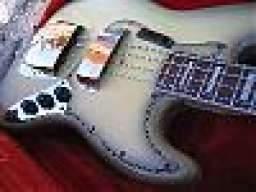
 
Someone ought to hit up ol' tune-o-matic and ask him some questions about the legitimacy of this bass.

:hiding:

he has the most incredible collection of vintage peices of the most extraordinary quality, and I am not in any way inferring or implying that this bass is anything but as described.

I have followed auctions of his where it has become evident he has bought a bass that was less than original, and where he has swapped hardware to bring it back to period correct specs, and then sold it as 100% original. Not a big deal, as most buyers make their evaluation based on the parts being correct to the period, and do not really expect them to all have lived on the same bass from the factory. Or at least they should have!

It was brought up earlier in this thread that the description of this bass is rather, err, limited. I find it interesting that he used to always claim originality, etc. for his instruments on Ebay. Maybe he felt it unnecessary here, or didn't bother, but in fact it does leave him in a rather fortunate position of being legally responsible for only an extremely vague description, namely that it is clean, and is a Fender jazz bass from 1962. Hamana hamana indeed.
 
I have read many threads over several forums throughout the years about tune_o_matic, legitamacy, ect. I'd say he's a business man with a huge mouth when it comes to defending his product, but nobody has really been able to nail him to the wall for selling fakes, afaik. He just sells stuff I'm not all that interested in, personally. Best of luck to him and the buyer.
 
A couple of years ago there was a thread here about a $40k bass, and some TB members said it was too steep. So the seller came on here and compiled a collage of photos of those TB members where he trashed them for being fat, old, ugly, and in my case poor because he found a pic of me with a VM Squier.

Might have been tune_o_matic, but can't remember.
 
A couple of years ago there was a thread here about a $40k bass, and some TB members said it was too steep. So the seller came on here and compiled a collage of photos of those TB members where he trashed them for being fat, old, ugly, and in my case poor because he found a pic of me with a VM Squier.

Might have been tune_o_matic, but can't remember.

BINGO.

Hey T_O_M, if you're lurking, would you post a quick YouTube vid of your playing?
 
A couple of years ago there was a thread here about a $40k bass, and some TB members said it was too steep. So the seller came on here and compiled a collage of photos of those TB members where he trashed them for being fat, old, ugly, and in my case poor because he found a pic of me with a VM Squier.

Might have been tune_o_matic, but can't remember.

If you can find this post, please let me know.
 
+1 I've seen more than a few counterfeits and they all have tell-tale signs; just depends on how much you know. For one that knows it all (or close to it), would have no problem with something like this.

Merely saying that it's alot easier than people think to ID a mass-produced instrument - if you have the knowledge.
OK, so you know it all. Share the secrets with us?
 
Well, the ones with tell-tale signs are simply bad ones. The better they get the harder they are to rumble. Obviously only the ones you have recognized as counterfeits are what you are talking about here- if it was a better made one and it fooled you, you wouldn't be calling it a counterfeit, would you?

Any dealer worth his salt will tell you (if he is being honest with you) that he couldn't tell a good counterfeit from the real thing without holding it in his hand, and then a very good one is often only rumbled by the tiniest detail, or sometimes by an effort at reproducing too many 'tell-tale' details on the same instrument, etc. Many of the best and most experienced dealers have related coming across instruments that they knew to be counterfeits but which they themselves could not discern.

I agree it is expensive and difficult, but to argue that it is impossible and that no counterfeit will convince an experienced dealer is a complete nonsense and has been proven to be so by previous documented examples. I guarantee there are fake instruments out there that have been bought, sold, and bought again with no one the wiser.

Where years ago very few people had the experience, the internet has brought a lot of information previously available only first-hand into the public domain, and made counterfeiting easier. It's really not that hard if you have the experience, the tools, and the desire to either copy an instrument as a tribute, or to copy one to sell on as a counterfeit.

I'm not making this stuff up; I've had some very interesting talks with dealers about this situation. It's an old one and goes back literally thousands of years and involves every single type of object whose value is based on rarity. There is very little that cannot be copied, and copied well, and as long as there is money to be made someone will try it on.
I knew it!

Hey, what if one of these experts who knew it all used their powerful skills for evil instead of good and helped make a forgery? Would something like that be possible? Could you really duplicate the simple mildly skilled production line of the 1950's using modern technology? Sure the Mona Lisa was just revealed as being a forgery made by a student but that's different ;)
 
Pre CBS, there weren't exacty an army of employees at fender cranking out thousands of basses per day. I wouldn't refer to them as being mass produced as the term meant something a lot different then as it means now.

Nah, the words mean the same thing. Fenders were made on an assembly line with interchangeable parts. Most workers learned only their task and could be easily replaced by another worker without any change to the product.
 
I was never talking about this instrument. You keep up, now.

If you insist there is no relevance between paintings and instruments, we must agree to disagree. I'm sorry I brought it up.

As soon as you get into 20K+ vintage pieces there is a real and present danger of it being a counterfeit. The only reason there IS a market for instruments without provenance, that have interchangeable parts, is that the demand has gone so high as make sure that a good counterfeits and properly cobbled together parts basses with period correct hardware will be able to be sold on. You do realize that the majority of 100% original Fenders from the '50s and 60's were put back to that state after having parts swapped out during their lives?

I'm trying to address your arguments here, but I must ask where your information is coming from. Are you basing your opinions on what you know to be true, or what you would like to be true or an assumption? I do not know a single reputable dealer who would claim he cannot be fooled ever, and that there are no counterfeit pre-CBS Fenders in circulation right now.

We are talking about this instrument. By we, I mean the present thread. The specific instance of people wondering if this "closet classic" is authentic. That was my particular point - that only collector's of the expert kind would even bother to have serious interest in this bass.

*sigh* never once did I say anything about a dealer who cannot be fooled ever; nor did I ever say there weren't any pre-CBS counterfeits. In fact, I've re-iterated the opposite. I'm talking about this specific bass; have been for every post (except the one's in response to other postings which may have been more generalized).
 
That was my particular point - that only collector's of the expert kind would even bother to have serious interest in this bass.

Nah, it's collectors of the rich kind. An expert would know you don't pay top dollar for an investment, you look for bargains. This bass is going to some rich dude with minor knowledge and lots of confidence and definitely not a player. That's my guess based on seeing tons of similar sales.
 
michael_atw said:
"Mass Production involves making many copies of products, very quickly, using assembly line techniques to send partially complete products to workers who each work on an individual step, rather than having a worker work on a whole product from start to finish."

The definition has not changed. Fender absolutely was and is "mass production". Mass production is not defined by quantity but by the system they are created. Standardization was my point - that Leo Fender modeled his factory after Henry Ford and standardized the process with which they were created.

The definition did not change - just the subjective perception by yourself of the definition.:)

You missed the point. I won't elaborate because others have already.
 
Off the Original Topic but a Relevant Read.....

Vintage Guitar Myths


After the author ranted about so-called "experts", he utters this line:

"Many big name experts bought copies. In fact there is a book out now from Italy. A book of vintage strats with a blatantly fake '64 in its pages. So a bunch of people will be looking at that for reference. Sheesh."

Oh the irony:hiding:. I guess he's more of the "I can ID a Fender by the pictures in a book" kind of guy rather than the "I can ID it from across the room."
 
You missed the point. I won't elaborate because others have already.

Nope, the point was made. Fender was mass production. Quintessential. Leo Fender brought mass production to musical instruments just about single-handedly. It started with the Broadcaster and Telecaster in the early 50's - and really took off right before the acquisition by CBS.

But I digress. It was merely a side-point. My point, which originated the side-conversation, was "I personally by default believe it is authentic due to the nature of the people who would be purchasing it for the amount of money."