• TalkBass has been independent since 1998. Add your voice.
    Create a free account to reply to discussions, view embedded media, and browse with fewer display ads.
    Join freeLog in
    Want zero display ads or expanded classifieds tools? Compare plans.

1966 Precision, small plug below neck plate

Anyone know what that tiny plug below the neck plate is? I know they nailed a stick inside the neck pocket for when the body was getting sprayed but wonder what this little hole was for? not exactly a burning need for this trivial info but curious to know! (yes, there's some letters carved into the back, "US" and what looks like "PARTY", there's also "1934" scratched into the headstock on the tip)
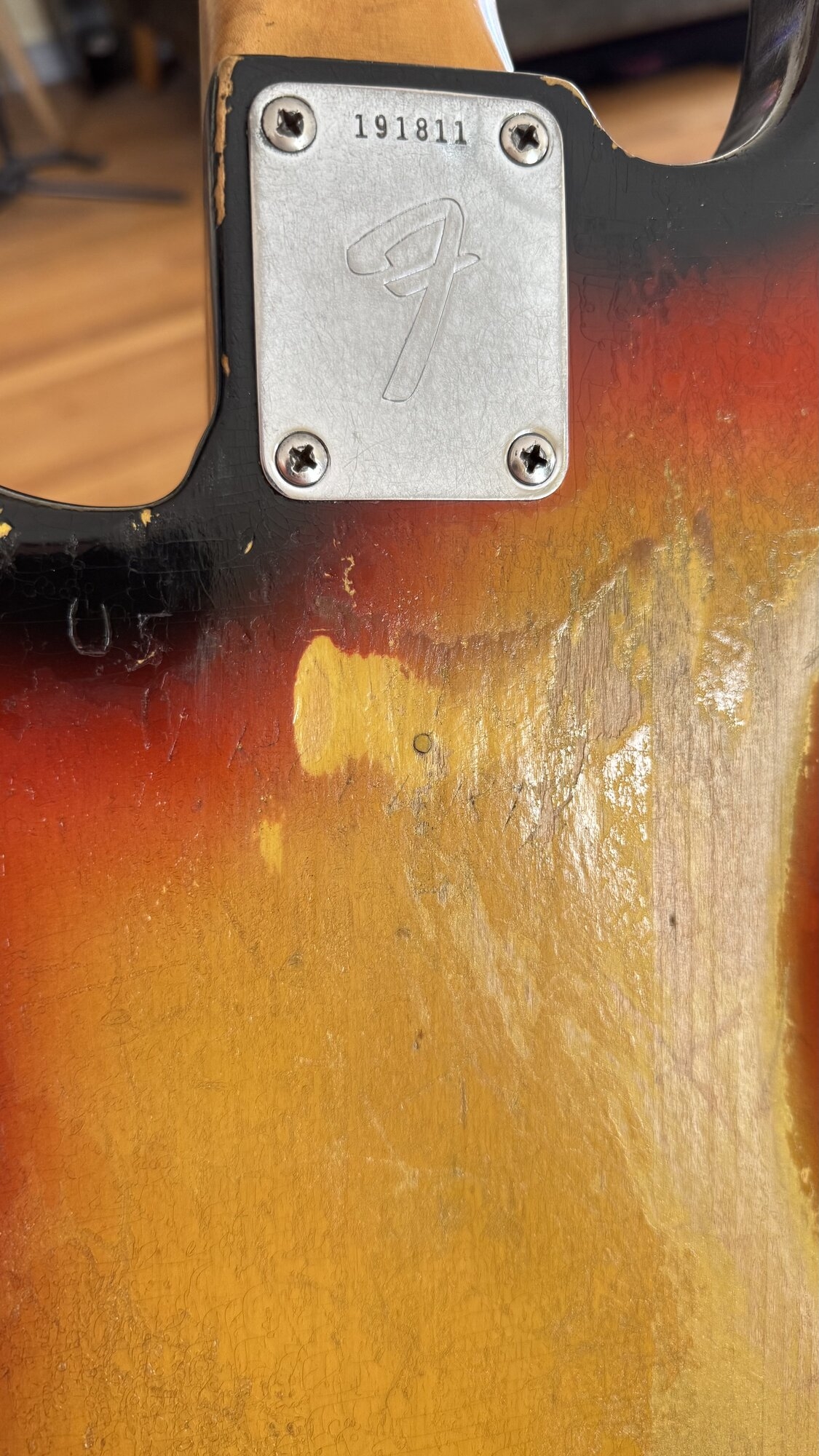
IMG_4402.jpeg
 
Anyone know what that tiny plug below the neck plate is? I know they nailed a stick inside the neck pocket for when the body was getting sprayed but wonder what this little hole was for? not exactly a burning need for this trivial info but curious to know! (yes, there's some letters carved into the back, "US" and what looks like "PARTY", there's also "1934" scratched into the headstock on the tip)View attachment 7336161
Clearly a Musicman Stingray sting .......
 
  • Like
Reactions: RColie and GIBrat51
They're just screw holes used during body routing, that later got drilled out, and filled with dowels. The body blank got screwed to a routing template, creating the two screw holes.

People usually erroneously state that those holes were for the "pins" in a pin router. They sure look like you could have stuck "a pin" of some sort in them. That's not how a pin router works, though. The "pin" on a pin router is a post mounted to the table, which is perfectly aligned with the cutting blade above. The edge of the template rides along this post, guiding the template as the blade cuts. There are other forms of pin routers, but the only ones I've seen used in guitar factories, for following templates that are mounted to the blank, are the ones as I described.
 
Last edited:
There are 2 dowel plugs, if you look further down.

The holes were for the pin-router guide used to shape the body..

Further Clarification
The holes are from the metal "pins" commonly used on metal templates like the ones Fender used to cut out the initial body shape.
These "pins" hold the template in place.

The "pin" on a pin-router actually guides the router along the template.
 
  • Like
Reactions: AllieM
Further Clarification
The holes are from the metal "pins" commonly used on metal templates like the ones Fender used to cut out the initial body shape.
These "pins" hold the template in place.

The "pin" on a pin-router actually guides the router along the template.
The holes were not for pins. The templates did not have pins. They had countersunk screw holes. The templates were screwed to the body blanks with wood screws. After routing, the screw holes in the body were bored out to approximately 1/8", so they could be cleanly doweled with off-the-shelf dowel stock.