

Enjoy the benefits of a premium membership!
Upgrade Account
-
TalkBass has been independent since 1998. Add your voice.
Create a free account to reply to discussions, view embedded media, and browse with fewer display ads.
Join free Log in
Want zero display ads or expanded classifieds tools? Compare plans.
You are using an out of date browser. It may not display this or other websites correctly.
You should upgrade or use an alternative browser.
You should upgrade or use an alternative browser.
1968 Gibson Les Paul Bass Prototype restoration
- Thread starter Basvarken
- Start date
More options
Who Replied?

Wow! Thanks for posting! This could be really useful for me: I commissioned a build from a nice fellow one Canadian province over of, basically, this bass; I just didn't know it. Basically, I wanted another Triumph but more modern-looking and with way fewer options. I only liked one tone on the real one I owned, but dang if it wasn't the best tone ever out of any short scale; I never used the phase switch. We're wiring it for only one setting, which I think is 1, the most "all in" in terms of output (I owned mine too briefly to remember what order the settings were in). Basic three-knob setup. The hardest thing to find was the transformer. Never spent more on a bass part, especially per cubic centimetre. Neck's gonna be Warmoth, body his own. Thanks again!
- Dec 3, 2010
- 1,744
- 10,611
- Disclosures
- Hobby Luthier / Gibson Bass Book
Wow! Thanks for posting! This could be really useful for me: I commissioned a build from a nice fellow one Canadian province over of, basically, this bass; I just didn't know it. Basically, I wanted another Triumph but more modern-looking and with way fewer options. I only liked one tone on the real one I owned, but dang if it wasn't the best tone ever out of any short scale; I never used the phase switch. We're wiring it for only one setting, which I think is 1, the most "all in" in terms of output (I owned mine too briefly to remember what order the settings were in). Basic three-knob setup. The hardest thing to find was the transformer. Never spent more on a bass part, especially per cubic centimetre. Neck's gonna be Warmoth, body his own. Thanks again!
The transformer is not that hard to find really. The Shure A95U has exactly the same one built inside. If you take that out, you're all set.

Beautiful work Rob! That was a very enjoyable read!AND HERE'S THE RESULT AFTER THE RESTORATION
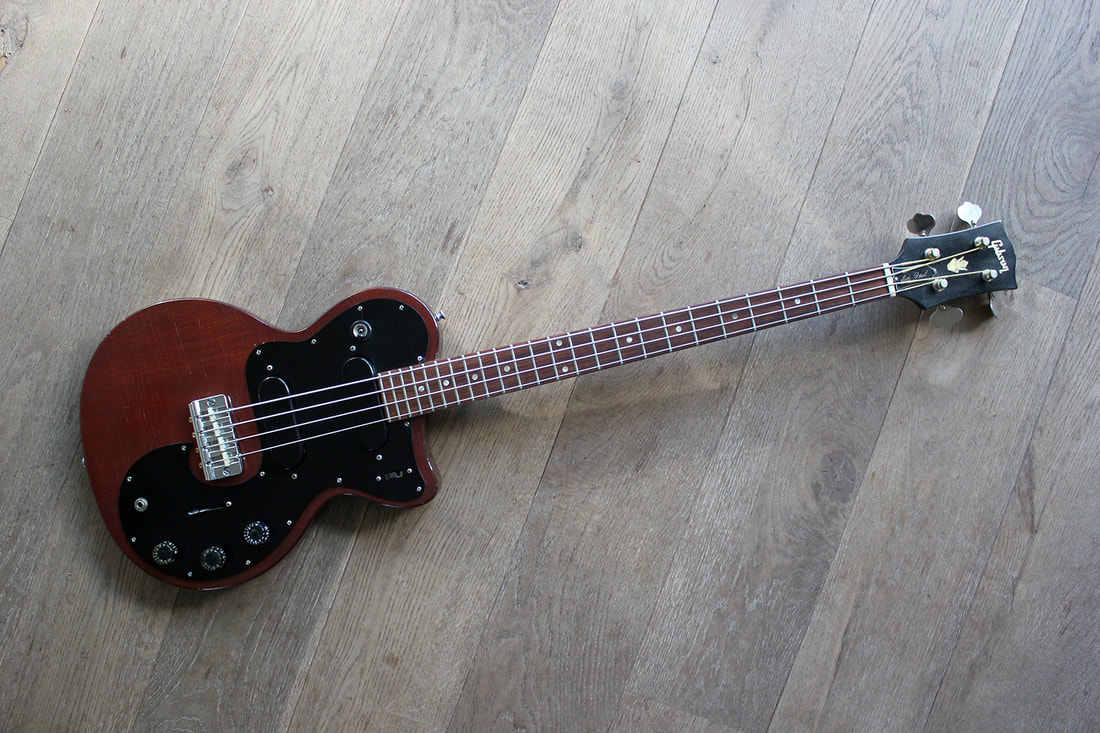


I'm happy to have the bass back in it's original condition. They way old Les intended it ;-)
Then boy do I feel silly for tracking down a period one!The transformer is not that hard to find really. The Shure A95U has exactly the same one built inside. If you take that out, you're all set.

I think it would be interesting to find out from Gibson or a venerable employee of Gibson the history of this particular bass.
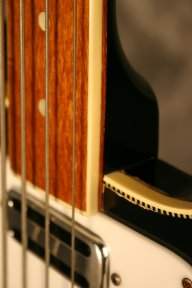


But I did create some minor damage on the sides. And an all -over craquelée-effect with a similar pattern to the hairlines that it had prior to the restoration.
Great job!
How did you do the craquelée effect?
- Dec 3, 2010
- 1,744
- 10,611
- Disclosures
- Hobby Luthier / Gibson Bass Book
That would be great. But Gibson is completely clueless about their own bass history. The best chance would be the venerable pensionado. Perhaps one of the guys that started The Heritage when Gibson left Kalamazoo?I think it would be interesting to find out from Gibson or a venerable employee of Gibson the history of this particular bass.
I can't even imagine how a better job could have been done!! BEAUTIFUL!!!!


Wow! Fabulous job. Can you provide additional information on getting the neck out, like how large/hot an iron you used and for how long and where? Did you heat just the end of the neck, or did you also heat the sides where the neck fit into the heel? The "common practice" seems to be to remove a fret, drill a hole or two, and inject steam through the hole(s) to soften the glue. This looks like an interesting alternative.
How did you determine the amount of wood to remove from the heel to get the angle right? I believe the recommended "pitch" is supposed to be fifteen degrees or something like that.
How did you determine the amount of wood to remove from the heel to get the angle right? I believe the recommended "pitch" is supposed to be fifteen degrees or something like that.
Wow! Fabulous job. Can you provide additional information on getting the neck out, like how large/hot an iron you used and for how long and where? Did you heat just the end of the neck, or did you also heat the sides where the neck fit into the heel? The "common practice" seems to be to remove a fret, drill a hole or two, and inject steam through the hole(s) to soften the glue. This looks like an interesting alternative.
How did you determine the amount of wood to remove from the heel to get the angle right? I believe the recommended "pitch" is supposed to be fifteen degrees or something like that.
How did you determine the amount of wood to remove from the heel to get the angle right? I believe the recommended "pitch" is supposed to be fifteen degrees or something like that.
I’m seeing a grand total of 5 photos, all in the first post.
Same here, can't see any pics after the first post


