• TalkBass has been independent since 1998. Add your voice.
    Create a free account to reply to discussions, view embedded media, and browse with fewer display ads.
    Join freeLog in
    Want zero display ads or expanded classifieds tools? Compare plans.

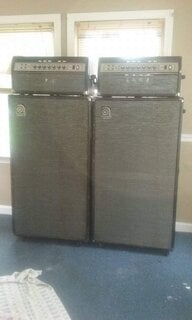
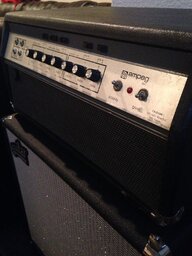
1970s Ampeg SVT

This thread scares me.

OP: You could die if you don't know what you're doing when working on a tube amp. Seriously

HI

I feel the same.
I have over some 15 years experience (repairing and building tube gear + SS electronics) before I build my SVT clone. It was quite challenging project: complicated and dangerous. As Ampeg SVT's service manual says: "It only takes one mistake..." And this warning is only for opening the amp and changing a few resistors, not building the whole amp. The high anodevoltage -some 700 V- can KILL!
I will not participate this project, sorry.
 
Wow, I was a military electronics technician for 8 years, and even find some simple pedals to be challenging. A single bad solder joint can lead to hours of troubleshooting. Bad soldering technique can fry a component in a way you can't see with your eye. You could spend a week alone trying to lay out a board if you are an expert at reading schematics.

I would not even try to build a flanger. Maybe start with some simple DIY projects that will teach you how to properly wire a switch, wire a jack, bias components, read resistor values from color codes, etc. Try like some OD pedals, bypass boxes, or compressors first. You can buy those in a kit pretty cheap.

You will not save money on this project. The tube set alone is like 250 bucks.
 
If you want an SVT, "do-it-yourself" and even save some money (why not take it?), then search a used SVT via the internet. If you found one, choose to pick it up yourself. Dont waste money on a postal delivery.

Leave your car in the garage. WALK all the way - then spit in your hands and carry the SVT home ALL the way - no matter how far it is.

Thats a lot of do-it-yourself. As I own one of those heavy beasts I can guarantee this is going to satisfy you.

And its cheaper and saver than building it yourself.

Go for it, champ! :D
 
Regardless of how you read most of the comments here I think it's fair to say we wish you success in this project. I hope you read the negative comments more as suggestions rather than negativity.


As long as your in the planning / feedback stages I'm wondering about duplicating the transformers used in the early versions of this technology. If I understand this correctly the plate structure and orientation as well as the winding material and orientation all have a distinct relation to the voicing of the circuit. I believe this is one of the reasons restoring an original unit is so desirable. Anybody, please correct me if I'm wrong.

On the other hand if it's not that big of a deal this will certainly be an interesting project to follow.

All the best
Vic
 
Regardless of how you read most of the comments here I think it's fair to say we wish you success in this project. I hope you read the negative comments more as suggestions rather than negativity.

I wasn't being negative......I just think it's a unbelievable project for a guy that admits he can't even read schematics in order to identify the components......like I said I admire his attitude.....


BUT THIS IS JUST GONNA BE FREAKIN DANGEROUS FOR HIM, I hope he doesn't go ahead - the risks are too high. I know qualified techs that don't like working on SVT's.

Lets not beat around the bush - to the OP, I know you want to save money and achieve this for yourself, but how much is this really worth to you - YOUR LIFE?? and no....I'm not being dramatic - just ask anyone with tech experience around here.

DONT DO IT. IS MY VHO.

Frosty
 
Regardless of how you read most of the comments here I think it's fair to say we wish you success in this project. I hope you read the negative comments more as suggestions rather than negativity.

Right. Your project can be done, and it would be cool to play an amp you made yourself. Just build your skills up to where they need to be for a complex project. Start small.

Don't learn to mountain climb by tackling Mount Everest in a pair of flip flops with a cigarette in your mouth, all the while hoping a sherpa will carry your weight.
 
If you're serious about approaching this, I can' recommend more highly one of Kevin O'Connor's (of London Power, www.londonpower.com) books "The Ultiimate Tone Vol 3". I have a copy of this myself. Here's a link to the book on his website:

Invalid Link Removed

Kevin really knows his stuff. Chapter 12 tells you how to build a simplified SVT "clone" using readily available components, i.e. all Hammond iron and chassis, simplified in that it does not have the midrange control in the preamp, just bass and treble, but still uses 6 6550A's for 300 watts. Depending on what you want in tone control this might suit you needs. He also gives you power supply options as well. The other thing is that Kevin explains is how the original SVT was designed, the tradeoffs that Ampeg made, and some of the design weaknesses. Even if you want to stick to the exact original design, this book is worth getting for the information.

You can get his books directly from London Power or from other places such as http://www.elderly.com/ or Invalid Link Removed. The latter is a great place to buy Hammond transformers and chassis as well.
 
Ok, I am being negative. This is rediculous. If PBG said HE was going to do this, I wouldn't question this. The OP cant read a schematic! This head IS probably the Mt. Everest of amps. It can and will kill you. All of you saying "Go for it!" are crazy. It's a cool fantasy, but in reality the guy can get hurt.
 
I was planning on building the preamp, and then later building the poweramp.

I'm not that worried about saving money, I just think if there is any way to save money then why not take it?

As far as buying a real 70s svt, I have absolutely no want or desire, I like building things for myself. That is why I have built my own cabinets and different things like that, they have always come out sounding at least, or far better than ampeg things in my opinion.

And as far as kits, I have looked for those before and came up with ABSOLUTELY nothing. Feel free to send me a link, however.

Thanks for your time, as always!

For one thing you're probably not going to be able to get certain crucial parts that are very important to the 70's heads, if Ampeg still can't make an accurate replica of a 70's head, why do you think you could do it? Another thing is if you could actually locate all those parts it would cost you many times what you could buy one for. I bought a full package about 8 years ago from St Louis Music for the 70's SVT's including schematics, parts list and parts numbers, many of the original parts weren't available then. SVT's are not simple amps at all, the wiring is very complicated and hard to trace, the voltage is high above 700 Volts in places, this will kill you dead. I'm not really a tech, Psycho knows much more about these than I do but I did graduate from tech school 25 years ago, am a ham radio operator with all tube transmitters and radios, can read a schematic and have fixed my own SVT's B-15's etc. and I would never touch a project like this. Just go buy a good one from ebay, you'll never regret it and you'll never find an amp that sounds better (IMHO). The preamp is not simple either and it gets it's power from the main chassis through a harness.
 
There's no reason why you can't eventually do this. But set your sites a little lower first. Take a basic electronics course. Start on smaller devices like a distortion pedal. A tone circuit, a preamp. You have to crawl before you can run. Don't necessarily confine yourself to musical circuitry there's plenty of other interesting things to build. First you need to build a knowledge base. This isn't going to take a few weeks or months but years.
I've studied electronics. Built and wired substantial electrical panels to control water treatment plants. Worked near live electricity. I still wouldn't consider taking a project like this on. Without doing other much smaller ones first.
 
i found this doing a search looking for something else. go figure...
it's an interesting idea, but...
(given the fact that this is almost a couple of months old, is there any progress?)
i was an electronics major in school a LONG time ago, but never pursued the field. i can solder & follow a layout (pictorial diagram).
about a year ago i thought it would be fun to build a tube amp. i bought and read about a dozen books and tech. manuals. i joined several tube amp related forums and did a LOT more reading. eventually i tried my hand at a 5F1 (5 watt, 3 tube Fender Champ clone kit) it went fairly smoothly. some companies that sell kits also have web based forums for when you get stuck. forumites will usually pitch in and give you things to try, usually after you have demonstrated some ambition in attempting to solve the issue yourself first.
www.webervst.com is an example. Ted sells speakers, complete kits and supports several forums. Marsh Amplification is a good example of a kit with a set-by-step assembly manual. there are others. (Hammond, Allen, etc.) if you hang around the tube builder sites, you pick up tidbits. www.ampgarage.com is a good example. they are primarily geared towards the guitar amps of Dumble & Trainwreck, but the concepts & techniques are the same.
you will NOT build anything sounding as good as or better than an original SVT. the steel used in the output transformers is NLA...the wire, winding style & insulation all play a part. you can buy a power transformer that will put out the juice, but... same with the choke, same with the caps... and on and on.
decent sounding 6550s are being made in Russia & China. you can pick up a matched sextet for $150 - 200. NOS RCA tubes will run almost as much as buying a used SVT in todays market. NOS RCA 12DW7's & 12BH7's are available for little more than the EH stuff being made today. you can use metal film resistors, but stay w/ carbon comps in the signal path. i don't think you can use a computer fan to cool 6 6550s even running at idle. these are the biggest, baddest audio tubes that American technology of the 60s could devise. (my guess is that the originals used Rotron muffin fans... mine has been changed out) the SVT is an extremely complex design. to assemble *decent* components and do all the work yourself, expect to spend $1200-1500. the point about tube voltages being enough to kill should not be taken lightly. use "chop sticks" or learn to keep one have tied behind your back.
my suggestion is to read a LOT, do more reading & lurk @ the tube amp sites, try a small kit & go from there.

now... who's got a rear data plate for my '72 ? :D

cheers
jerry
Link Removed
 
you will NOT build anything sounding as good as or better than an original SVT. the steel used in the output transformers is NLA...the wire, winding style & insulation all play a part. you can buy a power transformer that will put out the juice, but... same with the choke,

SVT's don't have chokes.

same with the caps...

Modern caps are better.

you can use metal film resistors, but stay w/ carbon comps in the signal path.

There is no benefit to this unless you like noise.

The OP has a less than zero chance of completing his stated task. If he is wise, he has turned his attention back to video games. Thankfully, the power transformer which poses the biggest hazard, is the hardest part to get. Without it, he can't do too much damage. IMO, the original post was a passing adolescent fantasy and is best left that way.
 
i found this doing a search looking for something else. go figure...
it's an interesting idea, but...
(given the fact that this is almost a couple of months old, is there any progress?)
i was an electronics major in school a LONG time ago, but never pursued the field. i can solder & follow a layout (pictorial diagram).
about a year ago i thought it would be fun to build a tube amp. i bought and read about a dozen books and tech. manuals. i joined several tube amp related forums and did a LOT more reading. eventually i tried my hand at a 5F1 (5 watt, 3 tube Fender Champ clone kit) it went fairly smoothly. some companies that sell kits also have web based forums for when you get stuck. forumites will usually pitch in and give you things to try, usually after you have demonstrated some ambition in attempting to solve the issue yourself first.
www.webervst.com is an example. Ted sells speakers, complete kits and supports several forums. Marsh Amplification is a good example of a kit with a set-by-step assembly manual. there are others. (Hammond, Allen, etc.) if you hang around the tube builder sites, you pick up tidbits. www.ampgarage.com is a good example. they are primarily geared towards the guitar amps of Dumble & Trainwreck, but the concepts & techniques are the same.
you will NOT build anything sounding as good as or better than an original SVT. the steel used in the output transformers is NLA...the wire, winding style & insulation all play a part. you can buy a power transformer that will put out the juice, but... same with the choke, same with the caps... and on and on.
decent sounding 6550s are being made in Russia & China. you can pick up a matched sextet for $150 - 200. NOS RCA tubes will run almost as much as buying a used SVT in todays market. NOS RCA 12DW7's & 12BH7's are available for little more than the EH stuff being made today. you can use metal film resistors, but stay w/ carbon comps in the signal path. i don't think you can use a computer fan to cool 6 6550s even running at idle. these are the biggest, baddest audio tubes that American technology of the 60s could devise. (my guess is that the originals used Rotron muffin fans... mine has been changed out) the SVT is an extremely complex design. to assemble *decent* components and do all the work yourself, expect to spend $1200-1500. the point about tube voltages being enough to kill should not be taken lightly. use "chop sticks" or learn to keep one have tied behind your back.
my suggestion is to read a LOT, do more reading & lurk @ the tube amp sites, try a small kit & go from there.

now... who's got a rear data plate for my '72 ? :D

cheers
jerry
Link Removed

This is great info. It's something I'd like to get into as a hobby sometime in the future. When I finish my degree hopefully