
Enjoy the benefits of a premium membership!
Upgrade Account
-
TalkBass has been independent since 1998. Add your voice.
Create a free account to reply to discussions, view embedded media, and browse with fewer display ads.
Join free Log in
Want zero display ads or expanded classifieds tools? Compare plans.
You are using an out of date browser. It may not display this or other websites correctly.
You should upgrade or use an alternative browser.
You should upgrade or use an alternative browser.
197X Fender Musicmaster "restoration"
- Thread starter GroovyBaby
- Start date
More options
Who Replied?


It looks like it was natural, then painted white later. it has a nice grain, that's usually reserved for naturals or sunbursts
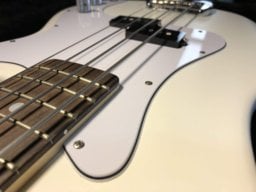
Last owner drilled new holes and while the Schaller is a superior design, I wanted the original bridge back on for the historic aesthetic.Word of dumbness so take it or leave it. The Schaller bridge is a great design but the mount holes aren't exact to Fender so if the last owner dropped it in the original fender drilled holes it may not intonate.
Have fun. That is a cool project. Happy 2021.
Thanks for both the epoxy and nitro tips. I didn't think the crack would grow so didn't stabilize it but you are right that it would be wise to do so. I'll give the nitro more thought. I dig the road worn look currently.That's the coolest grain I've seen on an inexpensive body like a MMaster. It doesn't look like you stabilized the crack in front. If it were mine I'd do that so moisture doesn't widen it and risk your investment of time and $$. 5 min epoxy is really easy and effective for that. You can even match the color if you mix in some sanding dust from the body.
To each his own but I'd use a sander to clean off the rest of the paint and do a nitro clear coat with rattle can nitro from Reranch.com. Even if you use someone else's products check out the refinishing tutorial on the Reranch site. I followed the instructions when I did my first rehab (ironically a Musicmaster with less potential than yours) and got such good results that years later I've finished/refinished at least 25 guitars using variations on their method. Have fun. Looks like a nice project.
Yes. I've no use for it.Are you planning to sell the Schaller bridge?
I've read and been told that this is the original finish and that this paint deterioration pattern is not uncommon in late 70s Fenders. To my novice eyes, it also looked like an original clear coat with a newer layer of white paint but I'm told no by more experienced folks here on TB.It looks like it was natural, then painted white later. it has a nice grain, that's usually reserved for naturals or sunbursts
I'm not sure what I gain by clear coating over the current finish. I think if I were to nitro clear coat, I'd fully strip the body first.clear coat it As it is now

Nice. I agree on both counts. The roller design is brilliant and simple for secure unlimited string spacing but it doesn't really look right on that vintage guitar. Good call and congrats.Last owner drilled new holes and while the Schaller is a superior design, I wanted the original bridge back on for the historic aesthetic.
Any other thoughts on the body crack? Clearly the bass must have sat but down in water in a basement at one point. Do I need to stabilize that crack now? If so, best method? Can I pour some wood glue in there? There is no way I'm pulling that crack closed. It's at the union of two of the swamp ash slabs.
Last edited:

I'm with you on that. I'm in the minority here, but d go with the natural. That's a nice looking natty body right there.I'm not sure what I gain by clear coating over the current finish. I think if I were to nitro clear coat, I'd fully strip the body first.

I'd VERY CAREFULLY try to wedge a very thin blade in there, just enough to very slightly open the gap, and put some glue in there- then clamp as much and tightly as able.
You could try using a bicycle tire inner tube tightly wrapped around the body, but I'd probably make shaped cauls to support the body and use clamps on the cauls.
That's a nice gift and a fine score. Treat it (and your neighbor) well.
I vote natural, or a sick refin.
You could try using a bicycle tire inner tube tightly wrapped around the body, but I'd probably make shaped cauls to support the body and use clamps on the cauls.
That's a nice gift and a fine score. Treat it (and your neighbor) well.
I vote natural, or a sick refin.
Any other thoughts on the body crack? Clearly the bass must have sat in but down in water in a basement at one point. Do I need to stabilize that crack now? If so, best method? Can I pour some wood glue in there? There is no way I'm pulling that crack closed. It's at the union of two of the swamp ash slabs.

If you can fill in that crack in some way that still allows you to show off the nice grain with a transparent or 'burst finish, then great. If not, black would very period-correct. (Probably the safest choice for a guy like me who sorely lacks the skills or patience for this kind of work...)
I love those vintage Ps with tort on black. I might have to go that route with my rattle-canned '78 if I decide to refinish it. (Regular BWB guard would be more authentic FWIW and it looks like in spite of everything yours is in decent shape.)
I love those vintage Ps with tort on black. I might have to go that route with my rattle-canned '78 if I decide to refinish it. (Regular BWB guard would be more authentic FWIW and it looks like in spite of everything yours is in decent shape.)

Very cool neighbor for sure.
I was also given my '78 Musicmaster for free and it was in just about that condition. It was found in a barn in the crummy chipboard case and playing it or leaving it "as is" was never an option for me. I also was told that late 70's MM's, and especially 78's, had paint issues.
My vote is to strip as needed and paint, I like colors over natural. Mine now has a bridge from the 97 re-issue that's string through body design. The arthritis in my hands is not getting better so I just slapped a Bronco neck on it for comfort, much thinner and more comfortable.
They are great basses, value lies in what it means to you, how much you like it and enjoy playing it, not in the $$. This is my "going to my grave with me" bass and it's been through a few changes over the years, always improved IMO.
Best of luck with the project, look forward to seeing what you come up with.
I was also given my '78 Musicmaster for free and it was in just about that condition. It was found in a barn in the crummy chipboard case and playing it or leaving it "as is" was never an option for me. I also was told that late 70's MM's, and especially 78's, had paint issues.
My vote is to strip as needed and paint, I like colors over natural. Mine now has a bridge from the 97 re-issue that's string through body design. The arthritis in my hands is not getting better so I just slapped a Bronco neck on it for comfort, much thinner and more comfortable.
They are great basses, value lies in what it means to you, how much you like it and enjoy playing it, not in the $$. This is my "going to my grave with me" bass and it's been through a few changes over the years, always improved IMO.
Best of luck with the project, look forward to seeing what you come up with.
Last edited:

Preservation. If you want the road-worn look, then a thin clear coat will protect what is left of the finish and protect the body from further wear and deterioration.I'm not sure what I gain by clear coating over the current finish....

Very cool! It's your bass so as long you're happy with the finish, it's perfect!
As far as the body crack, I would post the question in luthiers corner and look through the videos on the StewMac site.
Have you tried clamping it to see if it moves?
As far as the body crack, I would post the question in luthiers corner and look through the videos on the StewMac site.
Have you tried clamping it to see if it moves?

If the neck is straight with no twists and the truss rod functions you're in business!...you're going to fall in love with the 30" scale.. its a game changer...
Fender supposedly tried a water based finish circa 1979 that caused lots of problems. The most notorious example was the first 500 examples of the 25th Anniversary Stratocaster. The pearl white finish quickly deteriorated, and many were recalled and resprayed in the silver used for the rest of the run.
My brother had a Fender Lead II for a while that seems to have suffered from the same problem. The black finish was badly cracked, and it looked like a previous owner tried to fix it with new paint. He eventually stripped it and sprayed some urethane clear coat over top.
My brother had a Fender Lead II for a while that seems to have suffered from the same problem. The black finish was badly cracked, and it looked like a previous owner tried to fix it with new paint. He eventually stripped it and sprayed some urethane clear coat over top.
I have not tried clamping it. Who knows how long ago that separation occurred. I've got some nylon ratchet straps I can use to try and pull it together. I think I'll see what that does and add some wood glue but I'll do more research first.Very cool! It's your bass so as long you're happy with the finish, it's perfect!
As far as the body crack, I would post the question in luthiers corner and look through the videos on the StewMac site.
Have you tried clamping it to see if it moves?


