• TalkBass has been independent since 1998. Add your voice.
    Create a free account to reply to discussions, view embedded media, and browse with fewer display ads.
    Join freeLog in
    Want zero display ads or expanded classifieds tools? Compare plans.

1981 G&L L-1000: Ebony or Rosewood?

halvoric

Supporting Member
Apr 4, 2007
26
44
San Diego, CA
I have read that the early L-1000 fretboards went from Ebony to rosewood at some point. The neck on mine is dated Nov. 11, 1981 and I think it looks like rosewood. Any insight from the Leophiles?

The fretboard:
IMG_0048.jpeg

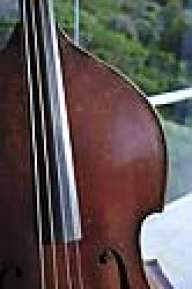
My cello's Ebony fingerboard:
IMG_0046.jpeg
1981 Tokai PB80:
IMG_0049.jpeg
1981 Tokai JB80:
IMG_0050.jpeg
 
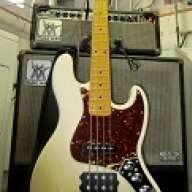
That looks a lot like rosewood to me but I'm no expert. I've seen ebony where the grain is more visible but most of the G&Ls I've seen with ebony were pretty dark/solid looking. Below is one I owned a few years back and it's very similar to the cello board…solid looking at a distance but subtle grain if you really zoom in. Curious to hear what the experience think. Either way gorgeous bass!

IMG_1986.jpeg
 
Last edited:
That L-1000 looks like typical G&L un-dyed ebony to me, which often had colorful chocolatey streaks in it. The pic isn't clear enough to make out the grain to be 100% sure. Post a better pic, you'll know for sure. The default "dark" wood for '80 and '81 G&L basses was ebony. By '82 rosewood took its place. But, as usual there are overlaps between eras, and there were special orders. Nov is late enough in the year for some to have rosewood but I'd bet against yours being rosewood.

The Tokai's are clearly some sort of rosewood, the grain is easy to see. Ebony grain is tight, no matter what how black the color may be.

Post a better pic.

Edit: Nevermind, I can see that it's ebony after enlarging the pic.
 
Last edited:
The ebony G&L used was un-dyed, so its color can be all over the map. It's the texture/porosity that really gives it away. You will not usually see notably open grain lines on ebony, nor will you usually see any significant "rollover" worn into the edges of the board.

At that point in 1981, G&L was starting to use rosewood more and more, phasing ebony out except for fretlesses and guitars. Many 1981 G&L basses, especially later in the year, had rosewood boards. And the texture (can clearly see wide open grains) and the worn edge rollover of your board look like rosewood to me. The color streaks and the way they are separated/blend with each other also looks more like rosewood to me.

The one SVTbass posted looks more like ebony to me.
 
Last edited:
Some of the responses, specifically about pores, have me questioning my choice of rosewood. I'm going to take a look at the L1K I just picked up and will snap a few close up photos of the board….to my knowledge it is rosewood. Looking at the photos of my original L1K it definitely has freckles on the board….or more accurately pores.
 
Last edited:
Thanks for all the responses—wow, did not realize how nuanced this identification could be. For further analysis/discussion, I took some macro shots of the L1K fretboard and my cello's fingerboard (which believe is Ebony) for comparison of grain/pores:
IMG_0055.jpeg

IMG_0054.jpeg

IMG_0053.jpeg

IMG_0056.jpeg

IMG_0057.jpeg

IMG_0058.jpeg

Edit: Added 1981 Tokai Jazz Sound fretboard (Indian Rosewood) macro photos:
IMG_0060.jpeg
IMG_0061.jpeg
 
Last edited:
how does it feel though? they almost feel more different than they look. ebony feels so smooth and slick, rosewood is more spongy, it will never quite have that glassy ebony feel.