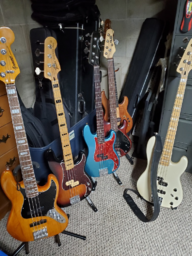
So, I found myself with idle time on my hands....like everyone has recently. While working on some home improvement projects, I needed some power tools, including a table saw, router, air nail gun.....etc. With all these tools, and in between projects on the house, I decided to try my hand at building a bass cabinet (much needed distraction from having to tackle a much larger project).....this turns into a learning moment for me, for a few reasons that I will get into as I describe the build.
(Sorry for the lack of pictures, usually my hands were covered in PL Adhesive when I thought of it, and didn't want to touch my phone)
Parameters I decided on, small and lightweight. Anything else that came out of it would be chalked up to a learning curve, or a plus, for future projects. Since I have the tools and some relatively inexpensive (free) materials, I should probably take advantage of the opportunity.
Decided on 1/2" Birch Plywood. I reached out to a supplier I work with that owns a lumber mill, and asked if he has any birch plywood in 1/2", he said he would check. The next day there was a small pallet of 24" X 36" pieces on the dock with my name on it.....we are off to a good start.
I got busy researching speakers and running them through WinISD. Everything I came up with (in my price range and other desires) came up with too much low end (seriously, I was trying to avoid boominess, and go for punch and clarity), too heavy, or out of stock due to manufacturing closures, and long times due to recent events. Once I found the speaker I wanted to go with (and in my budget), I figured I would look at adding a line array for mid / hi-end (a lot was learned here, will explain later).
At least I have a starting point for the build, based on box size and layout. Box was built, added cross braces, port (still learning), and line array speaker tray.
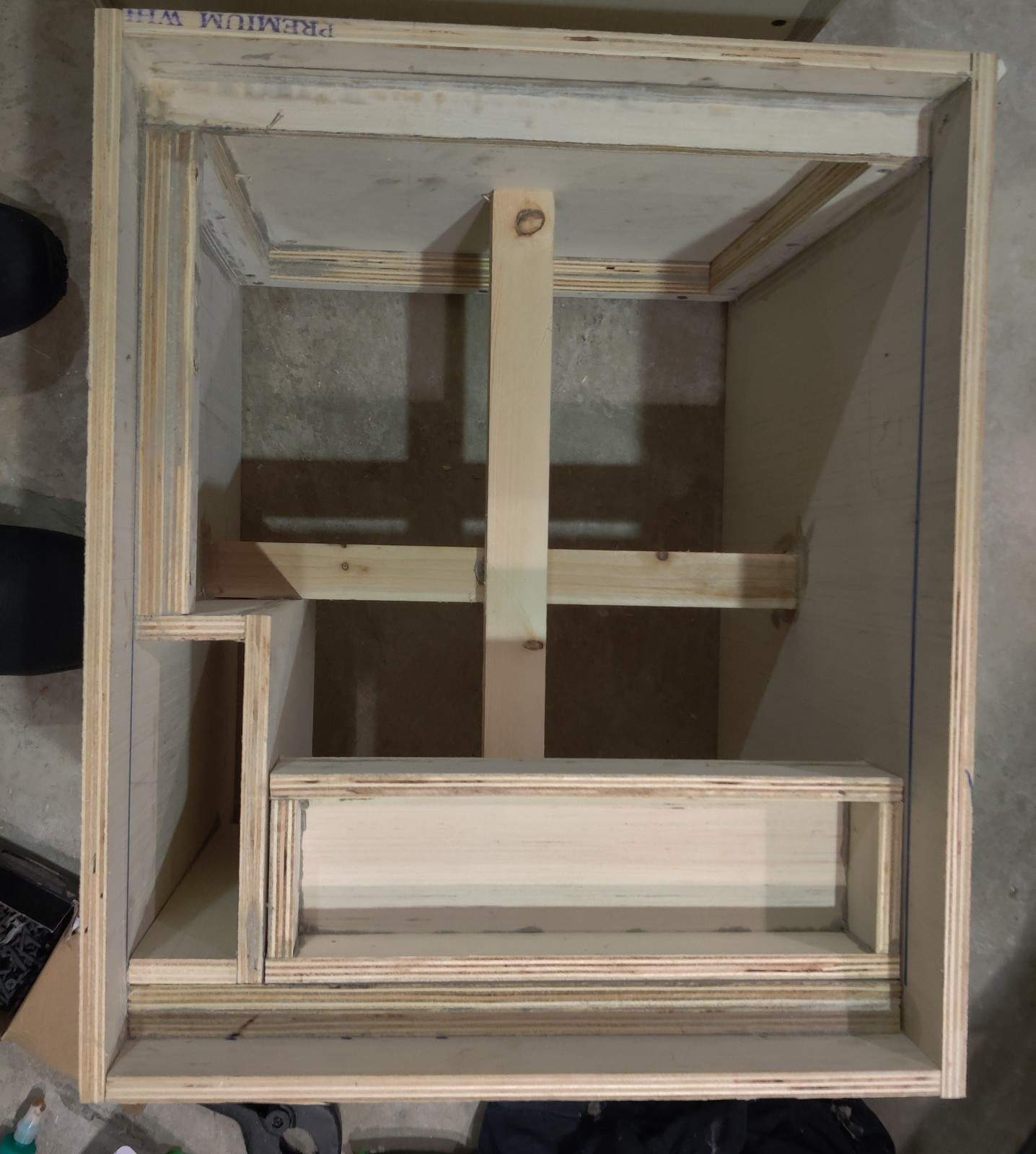
Speakers came in, so now I have a reference for the baffle cutout and I can start lining up the cutouts for the line array speakers.
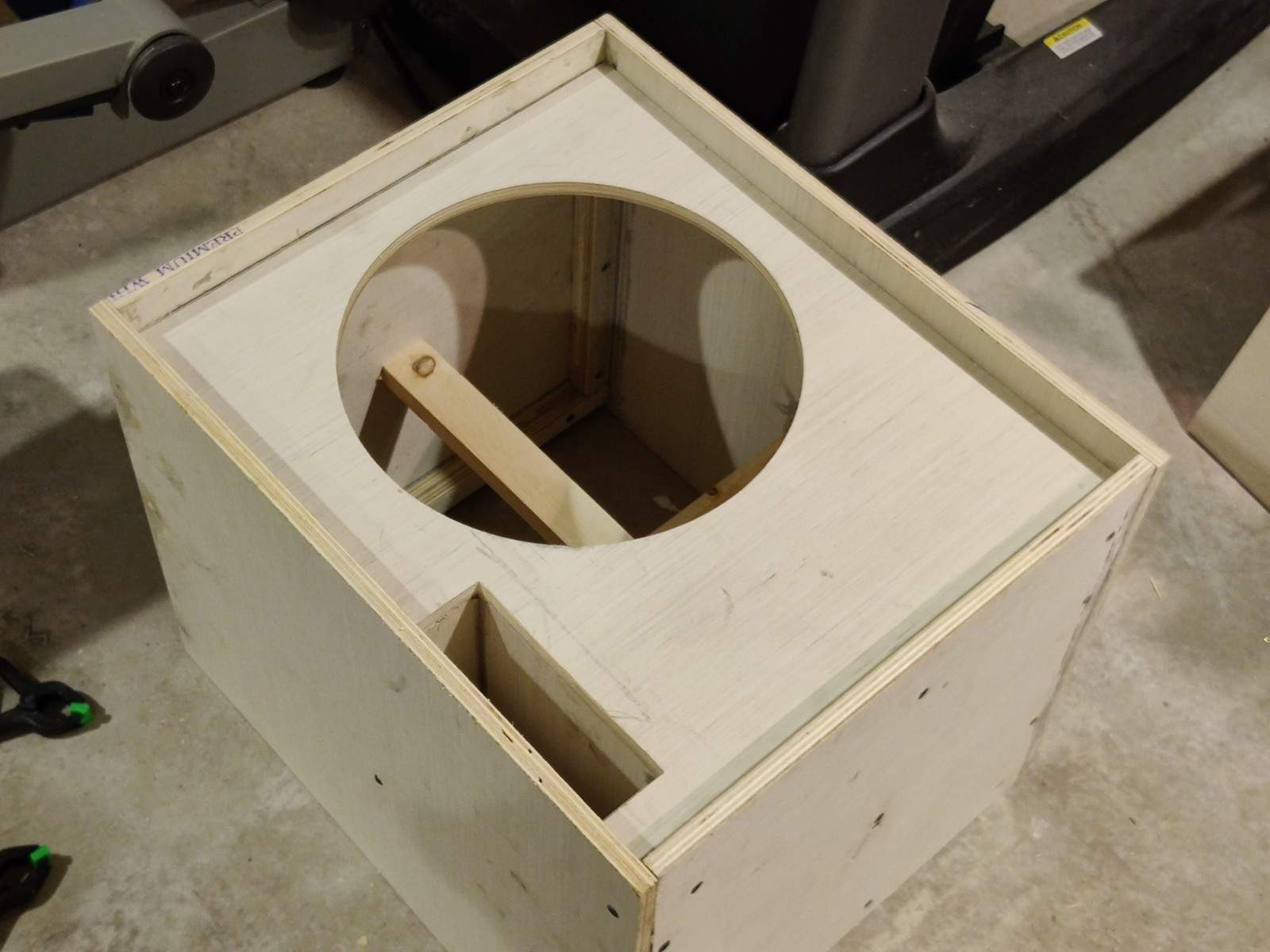
Cut out the holes for the line array speakers, and tested the speakers for fit and room, everything was looking good at this point.
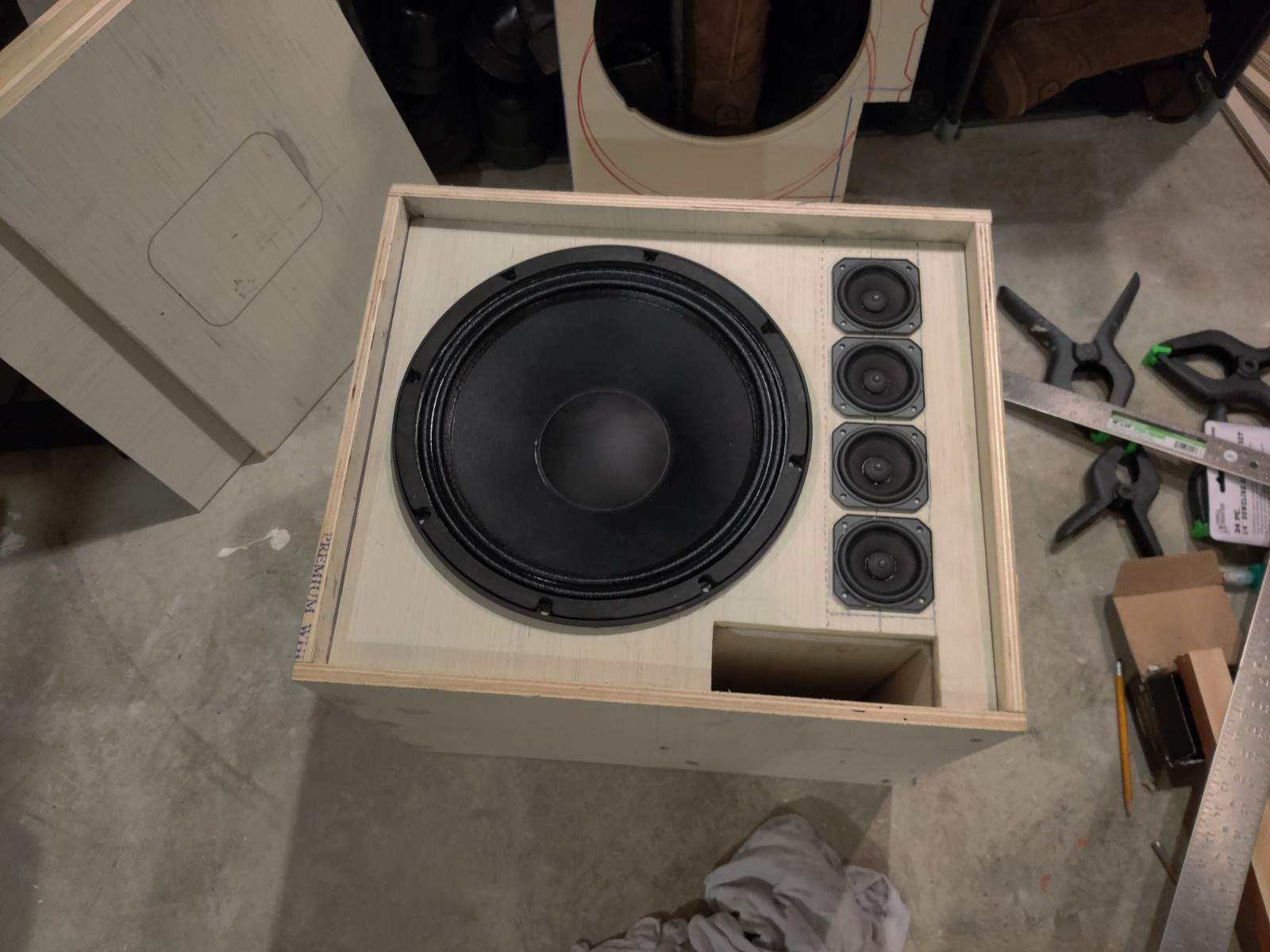
When I was rechecking the WinISD information on the build, I noticed that I calculated the port size incorrectly, and missed some critical information. Stopped for a couple of days while I figured out how to salvage the build without starting over. Calculated a mix of ports, by adding 1-1/2" round ports with the rectangle port in order to get back on track and avoid chuffing issues, and avoid tuning the box less than the woofers resonant frequency. (Lack of pictures here)

Got it tuned correctly, did a low volume test, and it sounded good without any insulation or dampening. Painted the baffle face white, not for any other reason than my other custom 2X12 cabinets are the same way. Most bass cabinets are black on black, and it makes it difficult to see what speakers are loaded in the cabinet. Then I had to figure out what to cover it with.
I work for a Film and Laminates plant, we make custom PVC films and laminates and there are always large rolls of cut off material laying around for recycling....(Once again...Free!). I found a material that is actually used for outdoor decking, it is extremely thick, with a heavy embossing and textile backing. Think of tolex on steroids. It was difficult to work with, especially around the edges. Has a gray tree bark look to it, definitively different from everything else out there.
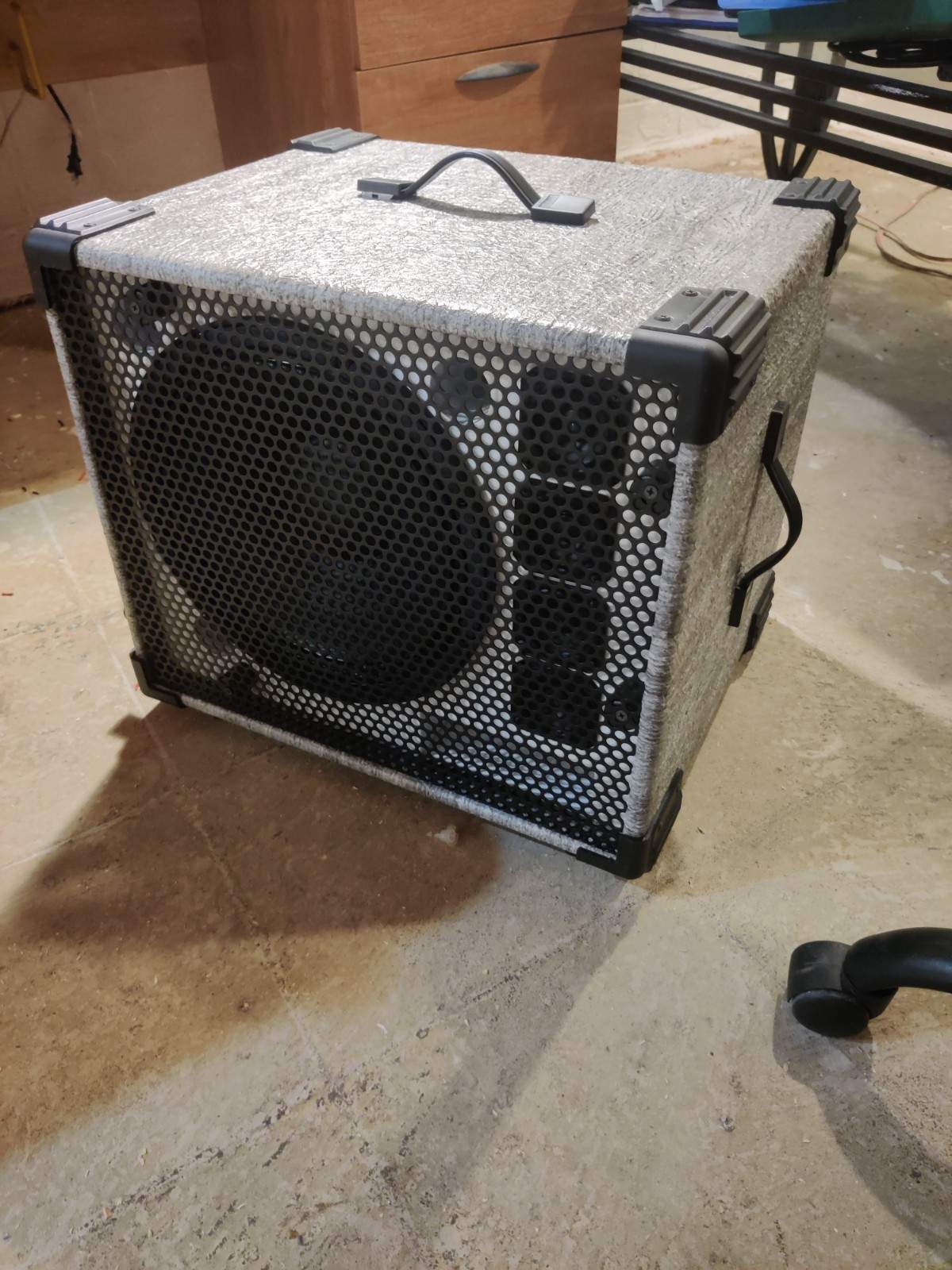
Once I finished the covering, I insulated the side walls and top with 1/2" foam, series / parallel wired the line array (speakers turned out to be too low in sensitivity....another learning moment). Although they were low in sensitivity they do add a little extra to the high mid and treble side of things. Probably the right amount of where I would have a full blown tweeter adjusted to anyway. Added the hardware, screen, corners and it is done. Tested it, and it was light in the low end, I used a Faital Pro 12FH500 for the main driver (another learning moment) although it modeled well, by itself, it wouldn't have had enough low end to make me happy.
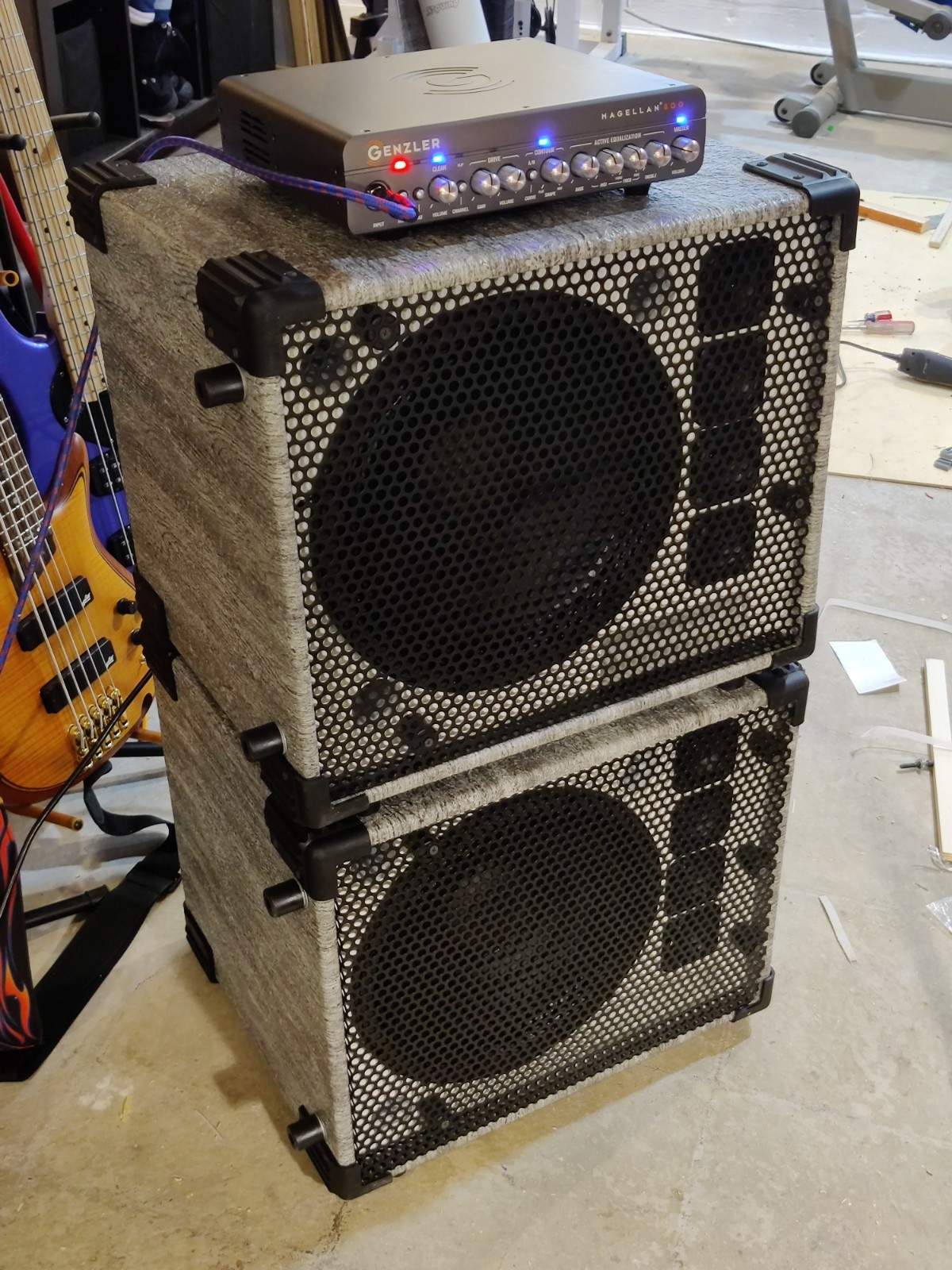
So I made two......together, they sound fantastic. All the low end I could want, a little too much mid range, which is easily dialed out with some slight EQ'ing.....
All in all they actually turned out better than I originally anticipated, learned a few things along the way.....
Now back to your regularly scheduled home improvement projects.
(Sorry for the lack of pictures, usually my hands were covered in PL Adhesive when I thought of it, and didn't want to touch my phone)
Parameters I decided on, small and lightweight. Anything else that came out of it would be chalked up to a learning curve, or a plus, for future projects. Since I have the tools and some relatively inexpensive (free) materials, I should probably take advantage of the opportunity.
Decided on 1/2" Birch Plywood. I reached out to a supplier I work with that owns a lumber mill, and asked if he has any birch plywood in 1/2", he said he would check. The next day there was a small pallet of 24" X 36" pieces on the dock with my name on it.....we are off to a good start.
I got busy researching speakers and running them through WinISD. Everything I came up with (in my price range and other desires) came up with too much low end (seriously, I was trying to avoid boominess, and go for punch and clarity), too heavy, or out of stock due to manufacturing closures, and long times due to recent events. Once I found the speaker I wanted to go with (and in my budget), I figured I would look at adding a line array for mid / hi-end (a lot was learned here, will explain later).
At least I have a starting point for the build, based on box size and layout. Box was built, added cross braces, port (still learning), and line array speaker tray.
Speakers came in, so now I have a reference for the baffle cutout and I can start lining up the cutouts for the line array speakers.
Cut out the holes for the line array speakers, and tested the speakers for fit and room, everything was looking good at this point.
When I was rechecking the WinISD information on the build, I noticed that I calculated the port size incorrectly, and missed some critical information. Stopped for a couple of days while I figured out how to salvage the build without starting over. Calculated a mix of ports, by adding 1-1/2" round ports with the rectangle port in order to get back on track and avoid chuffing issues, and avoid tuning the box less than the woofers resonant frequency. (Lack of pictures here)
Got it tuned correctly, did a low volume test, and it sounded good without any insulation or dampening. Painted the baffle face white, not for any other reason than my other custom 2X12 cabinets are the same way. Most bass cabinets are black on black, and it makes it difficult to see what speakers are loaded in the cabinet. Then I had to figure out what to cover it with.
I work for a Film and Laminates plant, we make custom PVC films and laminates and there are always large rolls of cut off material laying around for recycling....(Once again...Free!). I found a material that is actually used for outdoor decking, it is extremely thick, with a heavy embossing and textile backing. Think of tolex on steroids. It was difficult to work with, especially around the edges. Has a gray tree bark look to it, definitively different from everything else out there.
Once I finished the covering, I insulated the side walls and top with 1/2" foam, series / parallel wired the line array (speakers turned out to be too low in sensitivity....another learning moment). Although they were low in sensitivity they do add a little extra to the high mid and treble side of things. Probably the right amount of where I would have a full blown tweeter adjusted to anyway. Added the hardware, screen, corners and it is done. Tested it, and it was light in the low end, I used a Faital Pro 12FH500 for the main driver (another learning moment) although it modeled well, by itself, it wouldn't have had enough low end to make me happy.
So I made two......together, they sound fantastic. All the low end I could want, a little too much mid range, which is easily dialed out with some slight EQ'ing.....
All in all they actually turned out better than I originally anticipated, learned a few things along the way.....
Now back to your regularly scheduled home improvement projects.