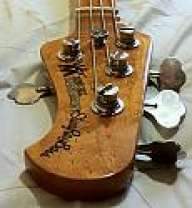
I’ve never owned a Rick, but last year I built myself my own interpretation (“Fantasy Custom Shop”) of the 4004, so I’ll take the liberty of commenting on your points:
The 4001 models had a unique truss rod design that does require a different technique to adjust. The 4003 (replacement for the 4001) uses a pair of conventional rods. Also, as has been mentioned, the earlier neck pickup cavity was a weak point.
The 4001s used softer fret wire; the 4003 uses normal nickel-silver wire like everybody else.
Also well-documented elsewhere, the stock bridge is a cast piece that can sometimes suffer from bending under string tension. Consensus is that a bent bridge will not tend to continue to bend (most of the time). The intonation screws are not in a convenient place, and the mute assembly is archaic and can impede palm muting. Hipshot addressed all of these issues with their replacement piece. The 4004 models use either ABM or Schaller conventional bridges.
It’s double the number of rods on most basses, but it’s not rocket science, and once adjusted, shouldn’t need readjusting for a very long time.
Depends on your technique. If it’s problematic, there are plenty of “S” model Ricks that have contoured, unbound bodies.
Street price is in the ballpark of other US-made basses, although the supply/demand curve is a factor too.
Again, depends on your technique and preferences. If you want to remove it, it only needs to be done once. Another place where the 4004 models shine.
No idea where this comes from. Mine is easily the most comfortable bass in my stable, both due to its weight, its contoured body, and its balance.
Thanks much for your explanations.
Just a matter of making some minor adjustments to technique and to the instrument to get the desired result, which I most certainly don't mind doing. In a way, that's the case with most instruments.
Ric's just seem to be a whole different beast. Doing my due diligence before I make a purchase.
Thanks again.