• TalkBass has been independent since 1998. Add your voice.
    Create a free account to reply to discussions, view embedded media, and browse with fewer display ads.
    Join freeLog in
    Want zero display ads or expanded classifieds tools? Compare plans.

34 scale strings on a 30 scale bass.

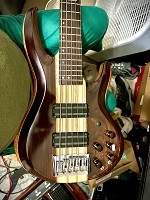
I've got a gretsch junior Jett that I want to modify, and was eyeballing the hipshot D style bridge with the tailpiece. The bass looks to have enough room to install the tailpiece 4 inches back, allowing me to use 34 scale strings. Would this make any difference in string tension? My brain can't seem to fathom one way or the other. The string is longer but the scale from nut to saddle stays the same. Has anyone ever added a tailpiece to add tension? I'm mostly interested in the look and the wider variety of string choice, but was curious about how it may affect tensions. Here's a picture of the bass in question with my dog (to increase views of this post)
Screenshot_20240320-180958_Gallery.jpg
 
  • Like
Reactions: 60bass
I've got a gretsch junior Jett that I want to modify, and was eyeballing the hipshot D style bridge with the tailpiece. The bass looks to have enough room to install the tailpiece 4 inches back, allowing me to use 34 scale strings. Would this make any difference in string tension? My brain can't seem to fathom one way or the other. The string is longer but the scale from nut to saddle stays the same. Has anyone ever added a tailpiece to add tension? I'm mostly interested in the look and the wider variety of string choice, but was curious about how it may affect tensions. Here's a picture of the bass in question with my dog (to increase views of this post)View attachment 5392137
I can’t answer your question with any expertise. I just wanted to say, that’s a good boy right there!!
 
I've got a gretsch junior Jett that I want to modify, and was eyeballing the hipshot D style bridge with the tailpiece. The bass looks to have enough room to install the tailpiece 4 inches back, allowing me to use 34 scale strings. Would this make any difference in string tension? My brain can't seem to fathom one way or the other. The string is longer but the scale from nut to saddle stays the same. Has anyone ever added a tailpiece to add tension? I'm mostly interested in the look and the wider variety of string choice, but was curious about how it may affect tensions. Here's a picture of the bass in question with my dog (to increase views of this post)View attachment 5392137

I agree with Matt. The string's actual tension is determined by the scale length, the distance between the nut and the bridge saddle. Adding extra length between the saddle and the tailpiece (we call that the "afterlength") does not change the tension on the string.

The funny thing is that adding afterlength does change how the string feels when you pluck it. And many people will describe that change in feel as a change in "tension", although the actual tension isn't changed. If you are truly curious about this, we can link you to some older threads arguing this out in mind-numbing engineering detail. The same thing applies to the whole argument about reversing the headstock to gain afterlength on the lowest string to gain "tension".

But, aside from all that, extending the tailpiece back from the bridge is a perfectly valid way to allow a short scale bass to use standard length strings. Which is a desirable thing.

My SSB model bass, which I build, does exactly that. It's 30.5" scale length, but I made up cool little tailpieces at the very back end of the body, so that it uses standard Fender-size Long Scale strings.

IMG_3759B.jpg


IMG_3704B.jpg


IMG_3705B.jpg


And, it also benefits from that change in the feel of the strings.
 
Here's a paste from an old 2018 thread, where I wrote a pretty good description on this topic of string afterlength, feel, tension and "snap":

The question was about whether adding extra string length between the bridge saddles and the tailpiece on a short scale bass will increase the "tension" on the strings:

Well, yes and no. The actual tension in the string is the same. The tension is determined by the scale length (the distance between the bridge saddle and the nut), the gauge/construction of the string, and the note that it is tuned to. Adding extra length at either end, between the saddle and the anchor point/tailpiece, or between the nut and the tuner, does not change the tension of the string.

However, adding that extra length at either end does change the sound and feel of the string. It's a factor I call the "snap" of the string, which is often confused with the tension. It works like this: When you pull sideways on the string, as you are plucking it, the string is stretching like a long spring. Then you release it, and it snaps back to straight, overshoots it, and goes into the back and forth oscillation.

When you add extra length to the string at either end, you are making that spring longer. So, you have to pull it farther sideways to get the same feel on your fingertip, because the string stretches easier.

For example, suppose you have two basses, same scale length, same string, tuned to the same note. One has the standard short distance between the bridge saddle and the anchor point. The other has an extra 3" of length back to the anchor point. Again, the actual tension in both strings will be the same.

But, if you pull the string sideways with a force of, say, 1 pound on your fingertip, there will be a difference. With the extended string, you have to pull the string a longer distance to the side to reach that 1 pound load. It's because there's more length of string to stretch.

Now, when you release the strings of these two basses, the extended string has a longer distance to travel to get back to center. The physics of it is that they will both accelerate at the same rate, because the tension is the same. The extended string will take longer to reach center, but it crosses over center at higher velocity and goes farther to the other side before rebounding. This is the effect that I call "snap". Increasing the overall length of the string increases the snap, regardless of the scale length.

How does this affect the sound? Increasing the snap mainly changes the attack curve of the note. It increases the pulse at the beginning of the note, which is why I call it snap. Think of the percussive sound of upright basses. They have a huge amount of snap because of the very long overall string length. The increased pulse can be heard through the amp, and also unplugged.

The funny thing about increasing the snap is that players will describe it in opposite ways. Some will say that the tension is higher, because they hear that extra pop on the note. Others will say that the tension is lower, because the string feels softer to their fingertip. But actually, the tension is exactly the same.

It's the same factor in all those long arguments about reverse headstocks, and how increasing the length between the nut and the tuner of the B string will increase the "tension" of the string to improve the sound, etc. It doesn't actually increase the tension, but it increases the snap. Which may make the B string sound more like the other strings.

Etc.
?
So, a reverse headstock increases the "snap" on the lower strings, the most on the B, while reducing the snap on the upper strings. That may add more balance to the feel and sound across the strings. But, it's not actually increasing the tension.


Well, yes, but "flop around more" isn't the way I'd describe it. The low B on a reversed headstock, with the extra length out beyond the nut, would swing slightly farther out to the side for the first couple of oscillations. But you'd barely be able to measure it. It would be a couple thousandths of an inch for a few milliseconds.

The Snap effect that I described above happens very quickly at the beginning of the note. It's the result of you pulling the string slightly farther off to the side, then releasing it. It builds up more speed as it crosses the centerline, after you let it go. But within a couple of cycles, it's back to oscillating the same as it would with the shorter outboard length and non-reversed headstock. The snap effect is a measureable lump at the beginning of the attack curve. A small increase in volume in the first few milliseconds of the note. Listening to it, that little extra snap at the beginning of the note makes it sound like the string is operating at higher tension/longer scale length. But it isn't. Adding the extra outboard length doesn't actually increase the tension. It changes the attack curve to make it sound like it has extra tension.​
 
I agree with Matt. The string's actual tension is determined by the scale length, the distance between the nut and the bridge saddle. Adding extra length between the saddle and the tailpiece (we call that the "afterlength") does not change the tension on the string.

The funny thing is that adding afterlength does change how the string feels when you pluck it. And many people will describe that change in feel as a change in "tension", although the actual tension isn't changed. If you are truly curious about this, we can link you to some older threads arguing this out in mind-numbing engineering detail. The same thing applies to the whole argument about reversing the headstock to gain afterlength on the lowest string to gain "tension".

But, aside from all that, extending the tailpiece back from the bridge is a perfectly valid way to allow a short scale bass to use standard length strings. Which is a desirable thing.

My SSB model bass, which I build, does exactly that. It's 30.5" scale length, but I made up cool little tailpieces at the very back end of the body, so that it uses standard Fender-size Long Scale strings.

View attachment 5392510


View attachment 5392508


View attachment 5392509


And, it also benefits from that change in the feel of the strings.
I agree with Matt. The string's actual tension is determined by the scale length, the distance between the nut and the bridge saddle. Adding extra length between the saddle and the tailpiece (we call that the "afterlength") does not change the tension on the string.

The funny thing is that adding afterlength does change how the string feels when you pluck it. And many people will describe that change in feel as a change in "tension", although the actual tension isn't changed. If you are truly curious about this, we can link you to some older threads arguing this out in mind-numbing engineering detail. The same thing applies to the whole argument about reversing the headstock to gain afterlength on the lowest string to gain "tension".

But, aside from all that, extending the tailpiece back from the bridge is a perfectly valid way to allow a short scale bass to use standard length strings. Which is a desirable thing.

My SSB model bass, which I build, does exactly that. It's 30.5" scale length, but I made up cool little tailpieces at the very back end of the body, so that it uses standard Fender-size Long Scale strings.

View attachment 5392510


View attachment 5392508


View attachment 5392509


And, it also benefits from that change in the feel of the strings.
Bruce, that is the coolest retro style bass I have seen. What is it if you do not mind me asking?
 
Bruce, that is the coolest retro style bass I have seen. What is it if you do not mind me asking?

That's one of mine, called the SSB. I'm a pro Luthier of many years experience. I'm mostly known for my Scroll Basses, but this is a short scale bass that I designed back around 2000. I've built 11 of them so far. That one is serial number 010, a special version I call the Nightwind. It's fretless with partial white lines, carved flutes on the headstock and body, and a brushed aluminum pickguard.

I like the design. It's short scale, but it's not a little toy. Because of the long body and long headstock, it's only an inch shorter than a Fender. It's very comfortable to play. I kept the prototype, #001, for myself. And yes, I make everything myself, including the pickups and all the metal hardware.

Here's SSB #011, also fretless, with a mahogany body and a few other special features. Same general design, but in 1940's style. Really Retro.

IMG_8634B.jpg


IMG_8635B.jpg


IMG_8636B.jpg


It uses the same design of the extended tailpieces and Fender-size strings, even though it's 30.5" scale length. And it has a very definite snap in its tone.
 
Last edited:
  • Like
Reactions: 60bass
Very nice! You do incredible work. Does the radio work? I had an old late 30’s Crosley Radio that looked similar to that. It worked on a large battery inside the cabinet. It needed a lot of work. I decided to give it to a young lady back in the 1980’s who was studying Electronic Engineering.

That's a 1938 Philco radio with Shortwave and AM bands. I found it in a junk store in town about 10 years ago. The original speaker was in poor shape, so I reinforced the inside of the cabinet, and put in a GK 15" speaker. I use it as the speaker cabinet at my assembly bench, for testing basses. It's become a mascot around here, and now it's a tradition that all newly-completed basses get photographed leaning against it. Their official Philco Portrait, before heading off to their new owners.

The full radio chassis is still in there, and it appears to be complete. I can't see anything obviously missing or burned up. But it needs to be gone through before applying power to it. There's a guy not far from me who has a hobby business restoring these old Philco radios. When I have the time and money, I'd like to have him restore it. It would be fun to hear it work, and see what it can pull out of the air.

I really like the style and design of the cabinet, that walnut art-deco look. I'm planning to use many of those design features on one of my upcoming new bass models.
 
Last edited:
Let us all repeat the mantra:
1) measure from the ball anchor to the tuner side of the nut;
2) measure from the ball anchor to the middle of the lowest string tuner post;
3) purchase a set of strings that the winding or speaking length is between these two measurements.
As @Bruce Johnson posted, the tension is the same, although the feel may be different.