

Enjoy the benefits of a premium membership!
Upgrade Account
-
TalkBass has been independent since 1998. Add your voice.
Create a free account to reply to discussions, view embedded media, and browse with fewer display ads.
Join free Log in
Want zero display ads or expanded classifieds tools? Compare plans.
You are using an out of date browser. It may not display this or other websites correctly.
You should upgrade or use an alternative browser.
You should upgrade or use an alternative browser.
3rd build- Lightest possible/back problems
- Thread starter Rip Topaz
- Start date
More options
Who Replied?
Neck dive is an important consideration. Gonna focus a little more on relieving that.
Go headless?
mikeyswood
Inactive

Im a little lost  . Cant neck dive be fixed by adjusting the strap button/lock position? Ive never played a bass with neck dive so I dont see how adjusting your strap or strap positioning wouldnt fix the problem, or how a neck could throw off the center of mass
. Cant neck dive be fixed by adjusting the strap button/lock position? Ive never played a bass with neck dive so I dont see how adjusting your strap or strap positioning wouldnt fix the problem, or how a neck could throw off the center of mass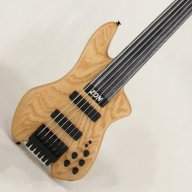
Im a little lost
It can, but sometimes it can also shift the bass out further left, which is more uncomfortable, or make the bass top heavy, which has the tendency to flop forwards.
OP, if you're willing to forgo the higher fret access, mounting the bridge all the way to the end of the body, instead of 3-4 inches into the body like the regular T-bird, will reduce neck length, reducing neck dive and also reducing the reach to the first fret.
At this point you're going to have about 13-15 usable frets.

Try a full scale les paul, warwick thumb, t-bird, rd artist, full scale EB, etc. While its strapped on, let go of it. As the headstock plummets to the floor, you'll experience neck dive.Im a little lost
Certain straps can help alleviate the speed at which it dives and/or how much weight your fretting hand is holding, but try adjusting your mic stand with both hands while wearing a bass like that and it will become perfectly clear. Just about every headstock repair I've done has occured in this way (minus a few falling off their stands or things like that).
Some folks (like Jauqo) think neck dive is an inherent and inexcusable design flaw, while others just don't care as long as it looks cool. I'm not a fan of neck dive, although I don't get too pissy about it. After all, I play my Jazz in my lap sometimes. That's quite a neck-divey combination...

I know I'm really late for this, but pine is honestly the lightest wood that I can think of.. if you chambered it, you wouldn't even know you were wearing a bass.
My last build (precision bass, I think I posted a thread here) had a 5-piece maple/padauk neck and pine body. the neck is heavier than any of my other basses (builds included), but the bass itself weighs.. well, to make an educated guess (compared to my bought basses) about 6.5-7 pounds. I was playing it yesterday in a jam for almost 4 hours straight (we love playing.....) without any issue.
My last build (precision bass, I think I posted a thread here) had a 5-piece maple/padauk neck and pine body. the neck is heavier than any of my other basses (builds included), but the bass itself weighs.. well, to make an educated guess (compared to my bought basses) about 6.5-7 pounds. I was playing it yesterday in a jam for almost 4 hours straight (we love playing.....) without any issue.

Rickett Customs
Commercial User
Do a headless, chaimber the hell out of it. No neck dive at all, unless the headpiece is a big honkin' piece of brass.....

IME a light bass with neck dive can be tougher on the back than a heavy bass that balances well. I think by making the body as light as possible you might make the problem worse. I would suggest concentrating on getting the neck as light as possible with light weight tuners, carbon fiber rods, smaller headstock, light weight woods, etc. and then making sure the body is just heavy enough to balance the weight of the neck.
You could also consider a 2 x 2 tuner configuration. This certainly doesnt keep the thunderbird look but shortening the length of the neck would move the balance point further towards the body.
You could also consider a 2 x 2 tuner configuration. This certainly doesnt keep the thunderbird look but shortening the length of the neck would move the balance point further towards the body.

Wow I had totally forgotten this thread.
Here's where things ended up.
First, I'm headed Friday for my FOURTH back surgery. Been having alot of problems withthe SCS implant, and they're going back in to try to fix things.
Second, I was able to build my fretless Thunderbird. In the end, I used a 2+2 configuration at the headstock, three piece mahogany/walnut/mahogany neck through. The body was African Mahogany with a quilted maple top. Ziricote fingerboard.
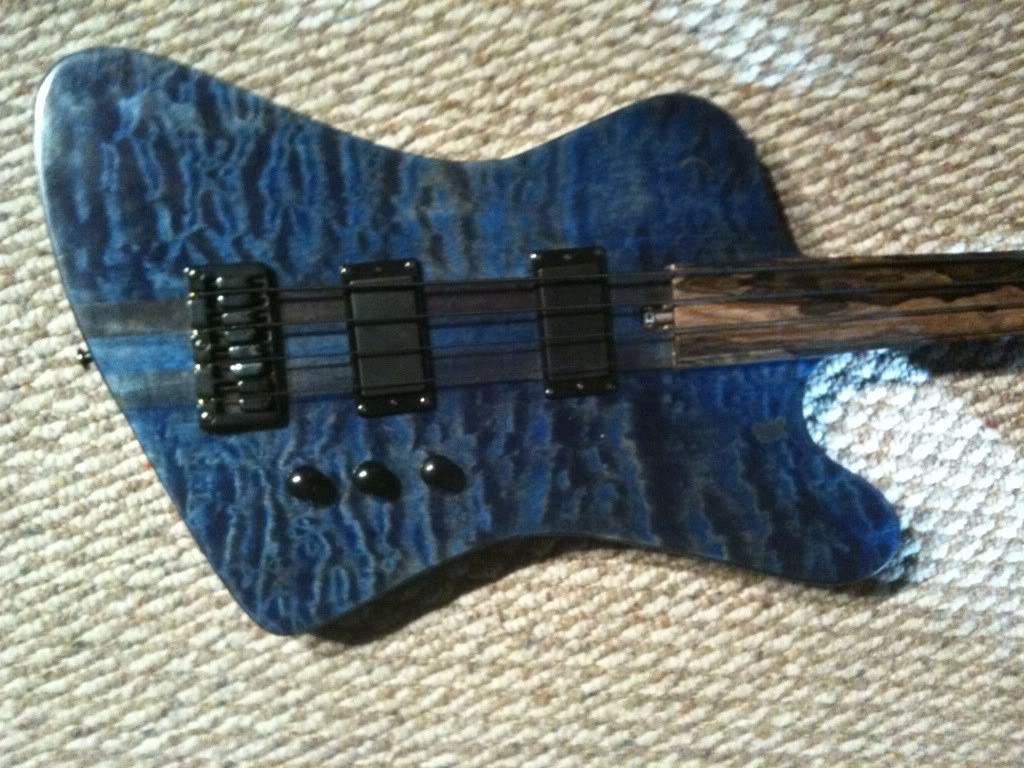
I think the final weight was around 9 lbs. I ended up selling it. It had a beautiful tone that wasn't like any other bass I have, but it was just a bit too heavy to be a regular player so I sent it to a new home.
Here's where things ended up.
First, I'm headed Friday for my FOURTH back surgery. Been having alot of problems withthe SCS implant, and they're going back in to try to fix things.
Second, I was able to build my fretless Thunderbird. In the end, I used a 2+2 configuration at the headstock, three piece mahogany/walnut/mahogany neck through. The body was African Mahogany with a quilted maple top. Ziricote fingerboard.
I think the final weight was around 9 lbs. I ended up selling it. It had a beautiful tone that wasn't like any other bass I have, but it was just a bit too heavy to be a regular player so I sent it to a new home.

Best of luck to you with your back. I have been having back trouble for the last 8 months and have had a three shots so far. I have had some muscular pain before but nerve pain is 195 on a scale of 1-10...
Take a look at the chambers in this pickup testing body for my scroll bass project.
I don't see why you couldn't do the same thing with a T-bird shape too. Maybe a pine center with maple top and back.
(The square chamber at the back is for the under bridge pickup)

Take a look at the chambers in this pickup testing body for my scroll bass project.
I don't see why you couldn't do the same thing with a T-bird shape too. Maybe a pine center with maple top and back.
(The square chamber at the back is for the under bridge pickup)

I think you could go lower than 9 pounds and keep the T Bird shape.
Find some really light weight spanish cedar for the body.
Use a 1/8" top of something that is also light in weight.
Use only one pickup.
Get an Aluminum B birdge from Hipshot and use either Ultralites or the Gotoh 350s.
Do a bolt on neck.
I'd be tempted to try Douglas Fir for the neck if I were in your position. I believe it has one of the best stiffness/density ratios out there.
Use 3/8x1/8" graphite spars if you are worried about the doug fir.
Use a maple fingerboard.
I would think you could get that number between 7 and 8.
Find some really light weight spanish cedar for the body.
Use a 1/8" top of something that is also light in weight.
Use only one pickup.
Get an Aluminum B birdge from Hipshot and use either Ultralites or the Gotoh 350s.
Do a bolt on neck.
I'd be tempted to try Douglas Fir for the neck if I were in your position. I believe it has one of the best stiffness/density ratios out there.
Use 3/8x1/8" graphite spars if you are worried about the doug fir.
Use a maple fingerboard.
I would think you could get that number between 7 and 8.
I have a pine telecaster (guitar) that is 6.8 pounds. The body is not chambered and it has a fat maple neck. I think with a pine center and some side chambers with a maple top you could get it down to around 6 pounds or so.

Ric5
Inactive
- Jan 29, 2008
- 29,772
- 30,452
- Disclosures
- I like 5, 8, 10, and 12 string basses
If you want a light bass get an Epi EBO body, put in t-bird pickups and add a bolt on neck.
Invalid Link Removed
http://www.3dentourage.com/425/5string-sg-bass2.htm
Also basswood is a nice light body wood that resonates well.
Invalid Link Removed
http://www.3dentourage.com/425/5string-sg-bass2.htm
Also basswood is a nice light body wood that resonates well.
Unfortunately I'm not willing to accept a light bass that sounds like crap.
Anything under ten pounds is fine, since I spend most of my playing time sitting down anyway.
Eventually I'll build a six pound Thunderbird. When I do, I'll keep it.
Anything under ten pounds is fine, since I spend most of my playing time sitting down anyway.
Eventually I'll build a six pound Thunderbird. When I do, I'll keep it.

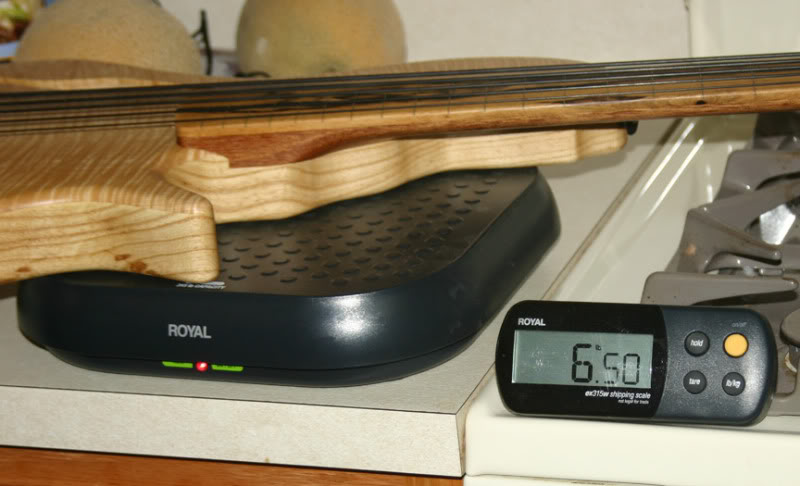
Tom Clement built me a fantastic sounding, playing and balanced fretless that weights 6.5 pounds (on the digital scale).
heavily chambered swamp ash with a laminated neck and pale moon ebony fingerboard.
I think it fits the bill for light weight + beautiful sound.


heavily chambered swamp ash with a laminated neck and pale moon ebony fingerboard.
I think it fits the bill for light weight + beautiful sound.


