• TalkBass has been independent since 1998. Add your voice.
    Create a free account to reply to discussions, view embedded media, and browse with fewer display ads.
    Join freeLog in
    Want zero display ads or expanded classifieds tools? Compare plans.

4:3 Polyrhythms in top 40 music

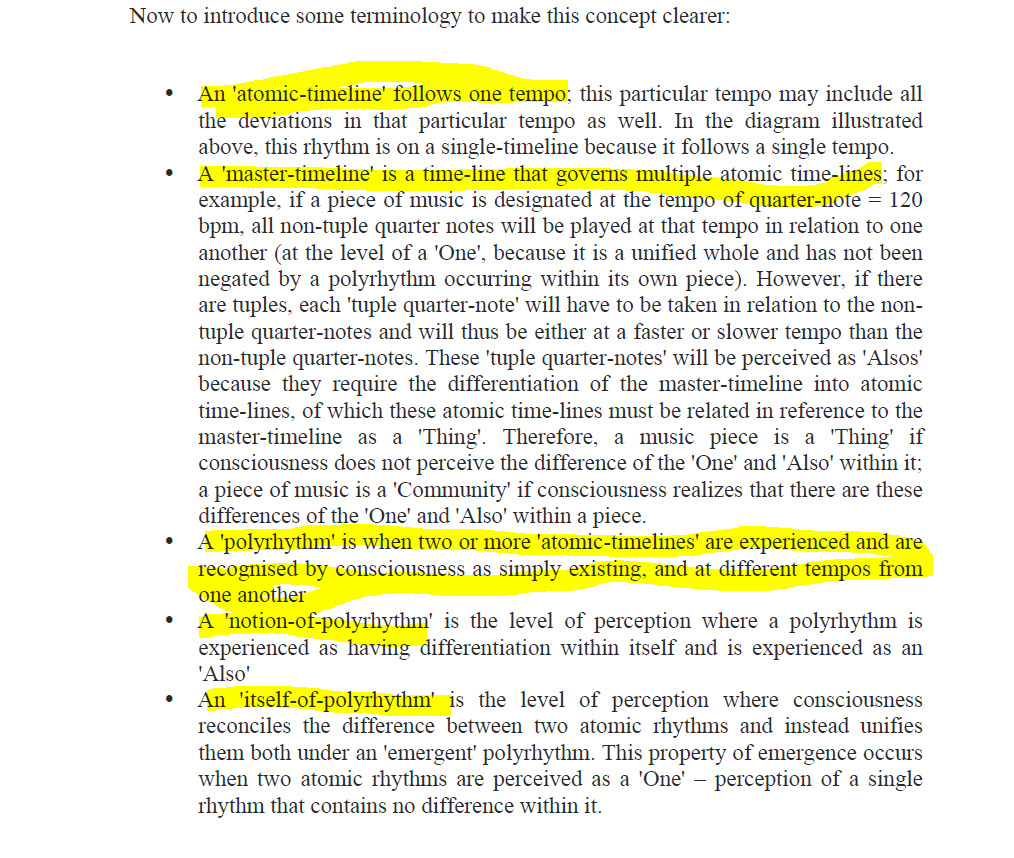
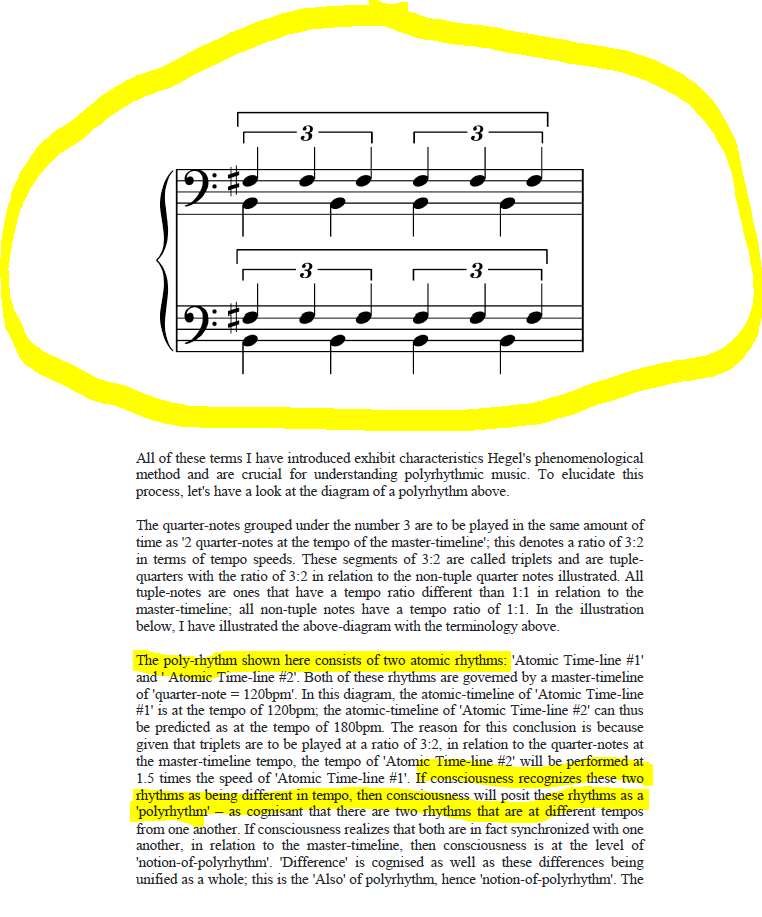
The following thesis looks at the Polyrhythms as "more than one time-line of rhythms."
The author introduces a new term - "atomic rhythm".
Invalid Link Removed

"Unlike paintings or visual art, whenever we listen to any piece of music, we are only
presented with bits and pieces of the entire art-piece at a time; we are never shown the
entirety of the piece because the nature of music is as an ephemeral art form that is
contingent upon time more than anything else. Therefore, music operates in a similar
to film and dance where a musical, or dance or film piece, unfolds throughout time. In
this way, music is similar to a sculpture that can only ever be viewed from one angle
and in one instance in time. Polyrhythmic music is directly intertwined with time,
especially because it posits more than one time-line of rhythms
, which ostensibly
provides the illusion of two "musical-angles" (as if taking a piece of music as a
sculpture) being perceived but will soon be revealed to still be just one rhythm that
consciousness perceives."
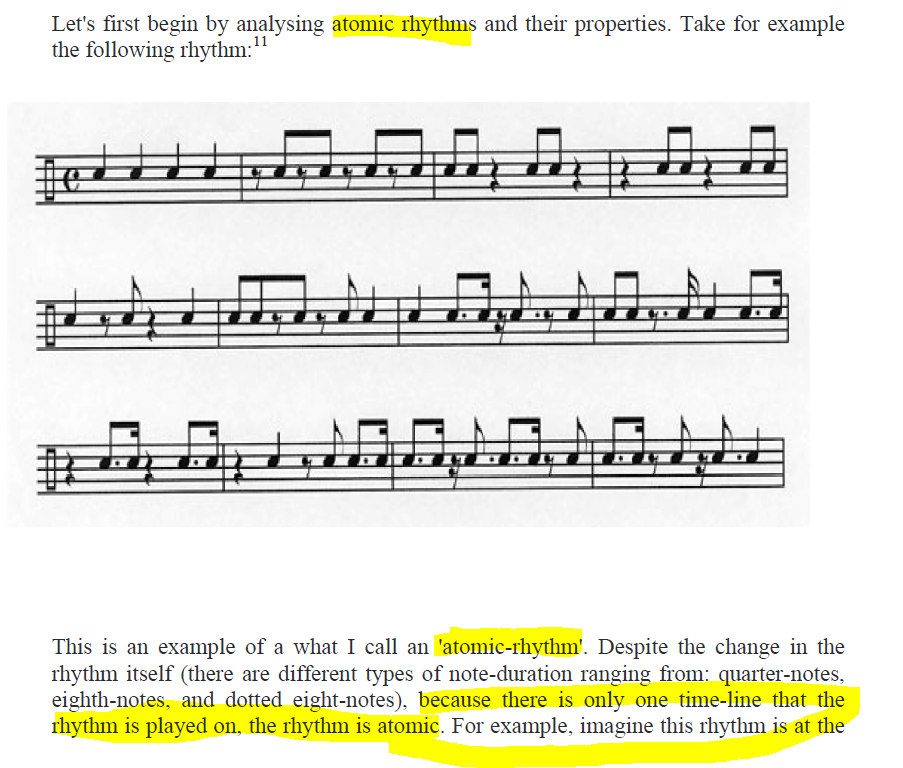
Atomic rhythm.PNG

Atomic rhythm-2.PNG

Atomic rhythm-3.PNG
 
Except it's not 5 quarter notes, it's a syncopated rhythm; if the bottom layer were 5 quarter notes in 5/4 they would be evenly spaced (same number of subdivisions between every attack). That's why I said that's an example of polymeter, not polyrhythm.

Let's take the description of Polyrhythm under the microscope and dissect it.

A polyrhythm is a combination of two or more rhythms played simultaneously while moving at the same linear tempo. So generally speaking, two rhythms are considered a polyrhythm if the number one is their only common divisor. Generally two rhythms are only considered a polyrhythm if they have no common divisor (other than one).

As we can see, the description of Polyrhythm uses the word "RHYTHMS".
It does not say specifically "NOTES", but...

A simple example would be,
"Three evenly-spaced notes against two, with the 3-beat pattern being faster than the 2-beat pattern, so that they both take the same amount of time."

From the book,
"Rhythmic Vocabulary: A Musician's Guide to Understanding and Improvising with Rhythm"
by Alan Dworsky
Let's read his description about Polyrhythm:


Uneven grids.PNG


Now, let's take the description from Encyclopedia Britannica.
polyrhythm | music | Britannica.com
"Polyrhythm, also called Cross-rhythm, the simultaneous combination of contrasting rhythms in a musical composition. Rhythmic conflicts, or cross-rhythms, may occur within a single metre (e.g., two eighth notes against triplet eighths) or may be reinforced by simultaneous combinations of conflicting metres."

Understanding Polyrhythms by Kevin Barrett
Meters, polymeters, polyrhythms, compound meters. What are the differences? | TalkBass.com

"Normally a polyrhythm gives the impression of one musical pulse being superimposed or played against another. In other words we have two different rhythms being played against one another which give the impression of a "cross-rhythm" or "cross-pulse".

Meters, polymeters, polyrhythms, compound meters. What are the differences? | TalkBass.com refers to systemic polyrhythm.
A simple example of a cross-rhythm is 3 evenly-spaced notes against 2 (3:2), also known as a hemiola. Two simple and common ways to express this pattern in standard western musical notation would be 3 quarter notes over 2 dotted quarter notes within one bar of 6/8 time, quarter note triplets over 2 quarter notes within one bar of 2/4 time. Other cross-rhythms are 4:3 (with 4 dotted eight notes over 3 quarter notes within a bar of 3/4 time as an example in standard western musical notation), 5:2, 5:3, 5:4, etc."
Invalid Link Removed

Here is an older TB thread, "Meters, polymeters, polyrhythms, compound meters. What are the differences?"
Invalid Link Removed
 
It's time for you to do a Polyrhythm Hang with Mr. Magadini!

petermagadini.com

He would have a good laugh over this Thread.

Report back YOUR findings.

Let's take the description of Polyrhythm under the microscope and dissect it.

A polyrhythm is a combination of two or more rhythms played simultaneously while moving at the same linear tempo. So generally speaking, two rhythms are considered a polyrhythm if the number one is their only common divisor. Generally two rhythms are only considered a polyrhythm if they have no common divisor (other than one).

As we can see, the description of Polyrhythm uses the word "RHYTHMS".
It does not say specifically "NOTES", but...

A simple example would be,
"Three evenly-spaced notes against two, with the 3-beat pattern being faster than the 2-beat pattern, so that they both take the same amount of time."

From the book,
"Rhythmic Vocabulary: A Musician's Guide to Understanding and Improvising with Rhythm"
by Alan Dworsky
Let's read his description about Polyrhythm:


View attachment 682431


Now, let's take the description from Encyclopedia Britannica.
polyrhythm | music | Britannica.com
"Polyrhythm, also called Cross-rhythm, the simultaneous combination of contrasting rhythms in a musical composition. Rhythmic conflicts, or cross-rhythms, may occur within a single metre (e.g., two eighth notes against triplet eighths) or may be reinforced by simultaneous combinations of conflicting metres."

Understanding Polyrhythms by Kevin Barrett
Meters, polymeters, polyrhythms, compound meters. What are the differences? | TalkBass.com

"Normally a polyrhythm gives the impression of one musical pulse being superimposed or played against another. In other words we have two different rhythms being played against one another which give the impression of a "cross-rhythm" or "cross-pulse".

Meters, polymeters, polyrhythms, compound meters. What are the differences? | TalkBass.com refers to systemic polyrhythm.
A simple example of a cross-rhythm is 3 evenly-spaced notes against 2 (3:2), also known as a hemiola. Two simple and common ways to express this pattern in standard western musical notation would be 3 quarter notes over 2 dotted quarter notes within one bar of 6/8 time, quarter note triplets over 2 quarter notes within one bar of 2/4 time. Other cross-rhythms are 4:3 (with 4 dotted eight notes over 3 quarter notes within a bar of 3/4 time as an example in standard western musical notation), 5:2, 5:3, 5:4, etc."
Invalid Link Removed

Here is an older TB thread, "Meters, polymeters, polyrhythms, compound meters. What are the differences?"
Invalid Link Removed
 
  • Like
Reactions: Whousedtoplay
He would have a good laugh over this Thread.

Report back YOUR findings.

Laughter is the best medicine.
(I think you got way too much distracted by my signature.
"early-morning-backyard-patio" beginner bassist.")

Now, you don't need to hide behind anybody's web-site.
You don't need to hide behind anybody's name.
I'm interested what you think.
About the subject.
Adam posted an interesting (and correct) video about a very simple 4:3 polyrhythm.
I misunderstood a few things in his video and that's how we have crossed into some "uncharted" and "ever-changing" remote areas of Music.

Now.
Do you have anything against the Polyrhythm description?
(I did not create that description - don't blame me.)

"A polyrhythm is a combination of two or more rhythms played simultaneously while moving at the same linear tempo."

Do you agree with Encyclopedia Britannica that
"Polyrhythm, also called Cross-rhythm, the simultaneous combination of contrasting rhythms in a musical composition. Rhythmic conflicts, or cross-rhythms, may occur within a single metre (e.g., two eighth notes against triplet eighths) or may be reinforced by simultaneous combinations of conflicting metres?"

(I also did not create that description - don't blame me for Encyclopedia Britannica.)

I can continue but...
Please first respond to my questions.
 
Please first respond to my questions.

I stated my position. I really do not care anymore, at this point. As the OP stated, ad nauseam, "The music still sounds the same."

Sure, your definition (or Encyclopedia Britannica's) is fine. I'm good with that.

Let us know what Magadini says.

One thing I have gleaned from all off this is that Britney Spears is a genius composer.

Laughter is the best medicine.
(I think you got way too much distracted by my signature.
"early-morning-backyard-patio" beginner bassist.")

Now, you don't need to hide behind anybody's web-site.
You don't need to hide behind anybody's name.
I'm interested what you think.
About the subject.
Adam posted an interesting (and correct) video about a very simple 4:3 polyrhythm.
I misunderstood a few things in his video and that's how we have crossed into some "uncharted" and "ever-changing" remote areas of Music.

Now.
Do you have anything against the Polyrhythm description?
(I did not create that description - don't blame me.)

"A polyrhythm is a combination of two or more rhythms played simultaneously while moving at the same linear tempo."

Do you agree with Encyclopedia Britannica that
"Polyrhythm, also called Cross-rhythm, the simultaneous combination of contrasting rhythms in a musical composition. Rhythmic conflicts, or cross-rhythms, may occur within a single metre (e.g., two eighth notes against triplet eighths) or may be reinforced by simultaneous combinations of conflicting metres?"

(I also did not create that description - don't blame me for Encyclopedia Britannica.)

I can continue but...
Please first respond to my questions.
 
I stated my position. I really do not care anymore, at this point. As the OP stated, ad nauseam, "The music still sounds the same."

As always thank you for your response.

Sure, your definition (or Encyclopedia Britannica's) is fine. I'm good with that.

Let us know what Magadini says.
[/QUOTE]

In my post #65, I've embedded Magadini's video.
I think you probably missed it.
Here are a few snapshots from his tutorial video.
Magadini replaces the word "rhythms" with the word, "meter".
Magadini-1.PNG


Magadini-2 - Copy.PNG

Magadini-3.PNG


One thing I have gleaned from all off this is that Britney Spears is a genius composer.

I could not agree with you more.
 
^^^ I'm sure this is spot on.

I was ONLY pointing out that the OP's examples were not correct.

As far as the genius of Britney Spears? I used to date Britney Spears (the other one), so I have a bias.
Invalid Link Removed
 
  • Like
Reactions: Whousedtoplay
^^^ I'm sure this is spot on.

I was ONLY pointing out that the OP's examples were not correct.

As far as the genius of Britney Spears? I used to date Britney Spears (the other one), so I have a bias.
programming

Here is my opinion.
We live and we argue (sometimes a lot), and then we die. Nothing new here, but...
I truly believe that hundreds of thousands of people in the world would be jealous that you used to date Britney Spears even if she was the "other one". It's the "brand name" that counts.


Till the World Ends - Wikipedia, the free encyclopedia
"Dr. Lukesongwriter, producer, instruments, programming and Invalid Link Removed."

Let's read further from the same web-site:

"The song opens with sirens and a "sizzling" bassline....
In the chorus, the song slows down while Spears sings "I can't take it take it take no more / Never felt like felt like this before / Come on get me get me on the floor / DJ what you what you waiting for?". The melody's 4:3 Invalid Link Removed (??? What the HELL???- WUTP) continues into a chant-like segment, in which "whoa-oh-oh-oh" is repeated.[16][17] The bit was compared by Scott Shettler of AOL to the "rapid word repetition" of Kesha."

--------------------------------------------------
Just because you used to date the other but Britney Spears, let's stay on that song longer.

Here are some other notations of the same part from your girlfriend's song:
BS-1.PNG

BS-2.PNG


Now.
About your disagreement with Adam.
(I don't belong to any FAN group. I respect all musicians - my brothers and sisters.)

Here is what I think.
Adam is a very knowledgeable and highly educated musician, composer, and a true PRO bass player in our, kind of, marginalized Bass Guitar World. His lessons are read and followed by many many of all kinds of bassists in the world.
In short, Adam is a Solid Bass Player, and I'm very happy that he finds time to post/comment here at TB. We don't have a lot of Adam's "caliber" musicians participating in our "R - 5th" discussions here at TB.
And just because Adam is a very knowledgeable and educated musician, he was able without ANY problems to change his shorthand-written notation to fit/suite our "traditional" understanding about Polyrhythms:
"two rhythms are considered a polyrhythm if the number one is their only common divisor.
 
Currently, I'm listening to Vijay Iyer Trio's album - Break Stuff.
Here is a simple but "mantra-ishly - hypnotizing track, "Hood" from that album.
Hood - a tribute to house music producer Robert Hood.

Do we have here elements of polyrhythm, cross-rhythm (the drums/piano), or both, or nothing - just regular Modern Jazz?
Vijay Iyer - piano
Stephan Crump - double bass
Marcus Gilmore - drums

P.S. Pianist Vijay Iyer was voted the Jazz Artist of the Year in the 63rd Annual DownBeat International Critics Poll, and the Vijay Iyer Trio—with bassist Stephan Crump and drummer Marcus Gilmore—topped the Jazz Group category.

Here is their studio version:


Here is the same composition live:
Vijay Iyer Trio performs "Hood" at the Portland Jazz Festival, Portland, Oregon, February 20, 2015.
I'm just fascinated with the bass player - Stephan Crump.
His facial mimic clearly shows the proper articulation and dynamics of his simple bass-line.
 
...

Here is what I think.
...
"two rhythms are considered a polyrhythm if the number one is their only common divisor.

Here's what I think.

I think a lot of the stuff posted above is academic BS, mainly because it is full of self-contradiction and smacks of postulation and hypothesis being presented as fact, especially the psychobabble stuff about how we are all supposed to perceive the rhythms in music.

Poly = "More than one"
Rhythm = "Rhythm"

That is all anyone needs to know.
 
  • Like
Reactions: Whousedtoplay